domingo, 2 de março de 2008

Could Primordial Black Holes Deflect Asteriods on a Collision Course with Earth?

Written by Ian O'Neill
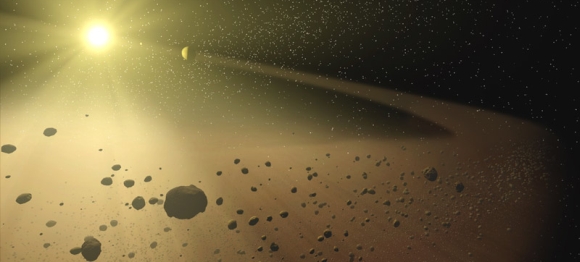
An artists impression of an asteroid belt (credit: NASA)
Primordial black holes (PBHs) are getting mischievous again. These artefacts from the Big Bang could be responsible for hiding inside planets or stars, they may even punch a neat, radioactive hole through the Earth. Now, they might start playing interplanetary billiards with asteroids in our solar system.
Knocking around lumps of rock may not sound very threatening when compared with the small black holes' other accolades, but what if a large asteroid was knocked off course and sent in our direction? This could be one of the most catastrophic events yet to come from a PBH passing through our cosmic neighborhood…

As a race, we are constantly worried about the threat of asteroids hitting Earth. What if another large asteroid - like the one that possibly killed the dinosaurs around 65 million BC or the one that blew up over Tunguska in 1908 - were to come hurtling through space and smash into the Earth? The damage caused by such an impact could devastate whole nations, or plunge the world as we know it to the brink of extinction.
But help is at hand. From the combined efforts by groups such as NASAs Near Earth Object Program and international initiatives, governments and institutions are beginning to take this threat seriously. Tracking threatening Near Earth Asteroids is a science in itself, and for now at least, we can relax. There are no massive lumps of rock coming our way (that we know of). The last scare was a comparatively small asteroid called "2008 CT1" which came within 135,000 km of the Earth (about a third of the distance to the Moon) on February 5th, but there are no others forecast for some time.
So, we now have NEO monitoring down to a fine art - we are able to track and calculate the trajectory of observed asteroids throughout the solar system to a very high degree of accuracy. But what would happen if an asteroid should suddenly change direction? This shouldn't happen right? Think again.
A researcher from the Astro Space Center of the P. N. Lebedev Physics Institute in Moscow has published works focusing on the possibility of asteroids veering off course. And the cause? Primordial black holes. There seems to be many publications out there at the moment musing what would happen should these black holes exist. If they do exist (and there is a high theoretical possibility that they do), there's likely to be lots of them. So Alexander Shatskiy has gotten to the task of working out the probability of a PBH passing through the solar systems asteroid belts, possibly kicking an asteroid or two across Earths orbit.
Shatskiy finds that PBHs of certain masses are able to significantly change an asteroids orbit. There are estimates of just how big these PBHs can be, the lower limit is set by black hole radiation parameters (as theorized by Stephen Hawking), having little gravitational effect, and the upper limit is estimated to be as massive as the Earth (with an event horizon radius of an inch or so - golf ball size!). Naturally, the gravitational influence by the latter will be massive, greatly affecting any piece of rock as it passes by.
Real-time map of the distribution of thousands of known asteroids around the inner solar system. Red and yellow dots represent high risk NEOs (credit: Armagh Observatory)
Should PBHs exist, the probability of finding one passing though the solar system will actually be quite high. But what is the probability of the PBH gravitationally scattering asteroids as it passes? If one assumes a PBH with a mass corresponding to the upper mass estimate (i.e. the mass of the Earth), the effect of local space would be huge. As can be seen from an asteroid map (pictured), there is a lot of rocky debris out there! So something with the mass of the Earth barrelling through and scattering an asteroid belt could have severe consequences for planets nearby.
Although this research seems pretty far-fetched, one of the calculations estimate the average periodicity of a large gravitationally disturbed asteroids falling to Earth should occur every 190 million years. According to geological studies, this estimate is approximately the same.
Shatskiy concludes that should small black holes cause deflection of asteroid orbits, perhaps our method of tracking asteroids may be outdated:
"If the hypothesis analyzed in this paper is correct, modern methods aimed at averting the asteroid danger appear to be inefficient. This is related to the fact that their main idea is revealing big meteors and asteroids with dangerous orbits and, then, monitoring these bodies. However, if the main danger consists in abrupt changes of asteroidal orbits (because of scattering on a PBH), revealing potentially dangerous bodies is hardly possible."

Chasing a Supernova Progenitor

 
The Type Ia supernova 2007on (with red tick) blew up last November in the outskirts of the galaxy NGC 1404, located 65 million light-years away in Fornax.
For the first time ever, astronomers may have found the progenitor of a Type Ia supernova. Or, frustratingly, maybe not.

This matters. The astronomers hoped their discovery would finally settle the nature of these exploding white-dwarf stars, which have become a critical tool for cosmology in the last ten years. But, as happens so often, a definitive answer isn't coming easily.


In old data archived from NASA's Chandra X-ray Observatory, Rasmus Voss (Max Planck Institute for Extraterrestrial Physics, Germany) and Gijs Nelemans (Radboud University, the Netherlands) found an X-ray source at the location where a Type Ia supernova, SN 2007on, later blew up. The supernova was discovered on November 5, 2007, in the outer edge of NGC 1404, an elliptical galaxy some 65 million light-years away in the southern constellation Fornax.


If the X-ray source was indeed the supernova's progenitor, notes Nelemans, this would support the theory that Type Ia explosions occur in binary-star systems where matter from a normal star streams onto a white-dwarf companion. The nuclear fusion of the freshly arrived material on the dwarf's surface would produce strong X-rays.


If such a feasting white dwarf grows heftier than 1.39 solar masses (the "Chandrasekhar limit"), it can't hold itself up against its own gravity anymore, and it starts to collapse inward. Within moments the temperature and pressure at its center become so great that the entire star explodes in a runaway thermonuclear reaction — as a distinctive, Type Ia supernova.


Because all white dwarfs have the same mass when they reach this tipping point, astrophysicists expect all Type Ia's (of a given subtype) to have the same luminosity. Therefore, cosmologists believe they can use Type Ia's as accurate "standard candles" to measure the distances of remote galaxies independently of redshift. By comparing the supernova distances to the redshifts of the host galaxies, astronomers can chart the history of the universe's changing expansion rate. In 1998 such studies led to the discovery that the expansion is speeding up, presumably due to some kind of "dark energy" pervading space.


Two Ways to Collapse


But no one knows for sure whether Type Ia supernovas really arise from a white dwarf accreting matter slowly from a normal star. Another possibility is that the blasts result from the merger of two white dwarfs in a close binary system spiraling together. A better understanding of the nature of Type Ia progenitors might help firm up the cosmological supernova data.


There's a key difference between the two scenarios. In the slow-accretion version, matter falling onto the white dwarf makes it shine brightly in X-rays. In the two-white-dwarfs version, no matter is exchanged beforehand and the system is essentially X-ray dark.


Pinpointing the Site. . . Maybe


Voss and Nelemans published their discovery of the possible X-ray progenitor of SN 2007on in the February 14th issue of Nature. It seemed to settle the question in favor of the standard, slow-accretion model.


However, after their paper was accepted for publication in mid-December, nagging doubts about the apparent association have surfaced.


In particular, more precise measurements of the supernova's position with telescopes run by the European Southern Observatory in Chile, including the Very Large Telescope at Cerro Paranal, reveal a small offset from the Chandra X-ray source's position. The discrepancy is barely more than one arcsecond, but that's enough to mean the X-ray source and the supernova had nothing whatever to do with each other — if in fact the X-ray position is as accurate as Chandra's operators believed.


Probably it is. Only a few X-ray photons were detected in the four-year-old Chandra observation, but that's enough that the probability of the X-ray source really being the supernova progenitor is now estimated to be no more than 1 percent, says Nelemans.


On the other hand, given the rarity of similar X-ray sources, the probability of a chance alignment is also less than 1 percent! "One way or the other, we have come across a very improbable event," says Nelemans.


Future observations should settle the issue. If the X-ray source was indeed what blew up later, it should now be gone. Voss and Nelemans are applying for Chandra time later this year to check.


Meanwhile, they are on the hunt for X-ray progenitors of other Type Ia events.


Posted by:
Lucimary Vargas
Além Paraíba-MG-Brasil
observatorio.monoceros@gmail.com

Cassini finds mingling moons may share a dark past

NASA/JPL NEWS RELEASE
Posted: February 21, 2008


Despite the incredible diversity of Saturn's icy moons, theirs is a story of great interaction. Some of them are pock-marked, some seemingly dirty, others pristine, one spongy, one two-faced, some still spewing with activity and some seeming to be captured from the far reaches of the solar system. Yet many of them have a common thread -- black "stuff" coating their surfaces.


This collage showcases several of Saturn's moons. Credit: NASA/JPL/Space Science Institute
See larger image here

 
"We are beginning to unravel the mysteries of these different and strange moons," said Rosaly Lopes, Cassini scientist at NASA's Jet Propulsion Laboratory, Pasadena, Calif. She coordinated a special section of 14 papers about Saturn's icy moons that appears in the February issue of the journal Icarus.

Taken together, the papers bring an idea that Cassini scientist Bonnie Buratti calls "the ecology of the Saturn system" to the forefront. "Ecology is about your entire environment - not just one body, but how they all interact," said Buratti. "The Saturn system is really interesting, and if you look at the surfaces of the moons, they seem to be altered in ways that aren't intrinsic to them. There seems to be some transport in this system."

Though the details of that transport are not yet clear, mounting evidence suggests that some mechanism has spread the mysterious dark material found on several of the moons from one to another; the material may even have a common cometary origin. Along those lines, several of the new papers focus on similarities between the dark material found on different moons - on Hyperion and Iapetus, for example, or between Phoebe and Iapetus.

Roger Clark of the U.S. Geological Survey in Denver goes further, saying, "We see the same spectral signature on all the moons that have coatings of dark material." Clark is lead author of one of the new papers, which focuses on Saturn's moon Dione. His team found the dark material there to be extremely fine-grained, making up only a very thin layer on the moon's trailing side. Its distribution and composition, as measured by the Cassini visual and infrared mapping spectrometer, indicate that the dark material is not native to Dione. And scientists see many of the same signatures there that appear on the moons Phoebe, Iapetus, Hyperion and Epimetheus, and also in Saturn's F-ring.

As for where this material comes from and what the dark material is, Clark said, "It's a mystery, which makes it intriguing. We're still trying to find the exact match." The visual and infrared spectrometer detected unique absorption bands in the dark material within the Saturn system, which scientists have not seen anywhere else in the solar system. "The data keep getting better and better," he said. "We're ruling things out and figuring out pieces." So far, the team has identified bound water and, possibly, ammonia in the dark material.

Ongoing geologic activity is another component of Saturn's ecology as some of the moons continue to feed the planet's rings, which in turn affect many of the moons.

Clark's team reports tentative evidence to support the hypothesis presented earlier this year that Dione is still geologically active. In one series of observations, the infrared spectrometer detected a cloud of methane and water ice encircling Dione in its orbit within the outer portions of Saturn's E-ring.

Of course the big story is the icy plumes spewing from the warm, south polar region of Enceladus. These plumes are believed to be feeding the E-ring. A paper led by Frank Postberg of the Max Planck Institute for Nuclear Physics in Heidelberg, Germany, says there are traces of organic compounds or silicate materials within the water ice-dominated E-ring, close to Enceladus. This implies that the moon's rocky core and liquid water are dynamically interacting. The finding could bolster a theory that Dennis Matson and Julie Castillo of JPL put forth this year, which said that a warm, organic brew might lie just below Enceladus' surface.

Cassini's next close study of an icy moon is the highly-anticipated flyby of Enceladus scheduled for March 12. During that flyby, Cassini will pass by the active moon at a distance of only 50 kilometers (30 miles) at its point of closest approach, and at a distance of around 200 kilometers (120 miles) when it passes through the plumes.

The Cassini-Huygens mission is a cooperative project of NASA, the European Space Agency and the Italian Space Agency. JPL, a division of the California Institute of Technology in Pasadena, manages the Cassini-Huygens mission for NASA's Science Mission Directorate, Washington. The Cassini orbiter was designed, developed and assembled at JPL.


Posted by:
Lucimary Vargas
Além Paraíba-MG-Brasil
observatorio.monoceros@gmail.com

The light and dark of Venus

Venus Express has revealed a planet of extraordinarily changeable and extremely large-scale weather.
Provided by ESA
This is a picture of Venus's atmosphere, taken by the VMC during Venus Express orbit number 443 on July 8, 2007. The view shows the southern hemisphere of the planet. ESA/MPS/DLR/IDA [View Larger Image]
February 22, 2008
Bright hazes appear in a matter of days, reaching from the South pole to the low southern latitudes and disappearing just as quickly. Such global weather, unlike anything on Earth, has given scientists a new mystery to solve on Venus.

The cloud-covered world of Venus is all but a featureless, unchangeable globe at visible wavelengths of light. Switch to the ultraviolet and it reveals a truly dynamic nature. Transient dark and bright markings stripe the planet, indicating regions where solar ultraviolet radiation is absorbed or reflected, respectively.

Venus Express watches the behavior of the planet's atmosphere with its Venus Monitoring Camera (VMC). It has seen some amazing things. In July 2007, VMC captured a series of images showing the development of the bright southern haze. Within days, the high-altitude veil continually brightened and dimmed, moving towards equatorial latitudes and back towards the pole again.

Such global weather suggests that fast dynamical, chemical and microphysical processes are at work on the planet. During these episodes, the brightness of the southern polar latitudes increased by about a third and faded just as quickly, as sulfuric acid particles coagulate.

"This bright haze layer is made of sulfuric acid," says Dmitri Titov, VMC Co-Investigator and Venus Express Science Coordinator, Max Planck Institute for Solar System Research in Germany. That composition suggests the existence of a formation process to the VMC team.
An artists impression of The Venus Express spacecraft, on mission around Venus. ESA/AOES Medialab [View Larger Image]
At an altitude of about 70 kilometers and below, Venus' carbon dioxide-rich atmosphere contains small amounts of water vapor and gaseous sulfur dioxide. These are usually buried in the cloud layer that blocks our view of the surface at visible wavelengths.

However, if some atmospheric process lifts these molecules high up above the cloud tops, they are exposed to solar ultraviolet radiation. This breaks the molecules, making them highly reactive. The fragments find each other and combine quickly to form sulfuric acid particles, creating the haze.

"The process is a bit similar to what happens with urban smog over cities," says Titov. With over 600 orbits completed, the VMC team now plans to look for repeating patterns of behavior in the build-up and decrease of the haze layer.

What causes the water vapor and sulfur dioxide to well up in the first place? The team does not know yet. Titov says that it is probably an internal dynamical process in the planet's atmosphere. Also, the influence of solar activity on haze formation has not been completely ruled out.

When the team has worked out what causes the hazes and their vigorous dynamics, there is still another problem waiting to be solved. The dark markings on these images are one of the biggest remaining mysteries of Venus' atmosphere. They are caused by some chemical species, absorbing solar ultraviolet radiation. However, as yet, planetary scientists do not know the identity of the chemical. Now that they can spot these dark patches quickly with VMC, the team hopes to use another Venus Express instrument, VIRTIS, to pinpoint the exact chemical composition of these regions.

Questions Linger on Satellite Shooting

February 25, 2008
The Philadelphia Inquirer

By Faye Flam, The Philadelphia Inquirer Feb. 25--It was hard not to be wowed with the bull's-eye hit last week that disintegrated an out-of-control spy satellite carrying 1,000 pounds of toxic fuel. But space scientists still questioned its necessity and wondered at its implications for weaponizing space.

The interceptor that the Navy used had never been tested against anything nearly as fast-moving as the spy satellite destined to crash to Earth March 6.

"From that point of view, it was pretty remarkable they were able to hit it," said Geoffrey Forden, a physicist at MIT who calculated the potential dangers of the plummeting satellite. But when it comes to why the Pentagon did it, he said, "They have been very opaque about their decision-making process."

Said John Pike, a space policy analyst and director of GlobalSecurity.org: "The claim there was danger from the fuel is not the most preposterous thing the Pentagon has ever said. But it seemed to be a bit of a stretch."

The Navy shot the satellite down on Wednesday using an Aegis missile designed as part of the "Star Wars" program to intercept enemy missiles.

Tracking the satellite with radar, a ship in the Pacific shot a three-stage missile called an SM-3. An off-board tracking system would have gotten it close to the path of the 17,000-m.p.h. satellite, Pike said, "sort of like your GPS navigator." Then, the missile's own heat-seeking guidance would have allowed it to home in exactly.

The Aegis system had been tested 13 times against dummy missiles near Hawaii, Forden said, and it succeeded in 11 of those.

The satellite was moving two to three times faster than the test targets, he said, and would have been brighter from reflected sunlight. To deal with that, engineers made some last-minute adjustments in the software, said Lt. Col. Karen Finn, a Pentagon spokeswoman.

But did they have to do it?

Forden and other scientists question the danger posed by the satellite, which had been out of control since its radio broke after its 2006 launch.

The Pentagon said 1,000 pounds of unspent hydrazine fuel was frozen, said Jonathan McDowell, a Harvard astrophysicist who has worked on NASA research satellites.

If that were the case, it would pose more of a danger than liquid fuel, which would probably burn up on contact with the atmosphere. Hydrazine, which is toxic, can cause nerve damage and breathing problems if inhaled, and is listed as a possible carcinogen.

"If you imagine this big iceberg of frozen hydrazine coming through the atmosphere," he said, some of it could potentially remain solid before it hit the Earth.

But, he said, in his experience working with NASA astronomy satellites, hydrazine fuel would freeze only if it were consistently shielded from the sun. You would expect this errant satellite to tumble, he said, keeping the fuel liquid.

"Why was this satellite's hydrazine frozen when others aren't frozen?" McDowell asked. "I'd like someone to press them on this."

Attempts to reach a Pentagon scientist were unsuccessful.

Frozen or not, the fuel might not have survived reentry into Earth's atmosphere, scientists said.

McDowell questioned why this satellite was shot down when so many other satellites and spent rockets fall without anyone worrying about them. "Big chunks of metal fall out of the sky all the time," he said.

The 75-ton Skylab fell in 1979, and while it didn't have a big chunk of fuel, "overall the risk from that was much higher," McDowell said.

McDowell said some hydrazine reportedly survived the crash of the space shuttle Columbia in 2003, but the difference was that the shuttle was an immense vehicle designed to withstand the heat of reentry.

Some of the scientists said they worried that the missile shot would encourage the Chinese to continue developing technology to shoot down our satellites.

"You know it's going to make it more difficult for the U.S. to tell anyone else not to develop antisatellite technology," said Laura Grego, an astrophysicist at the Union of Concerned Scientists.

The Chinese used a similar missile system last year to shoot down their own satellite in a test. "We made a big to-do about it and rightly condemned them," MIT's Forden said.

Harvard's McDowell said the United States started experimenting with antisatellite missiles in the 1960s, in some cases shooting nuclear warheads at them. One test, he said, killed about half the satellites in orbit at the time.

In the 1980s, the United States shot down several more satellites in further testing, he said, in one case sending an antisatellite missile from under an F-15 fighter plane. Then, for 20 years, there were no satellite-destroying tests in space, he said. "Last year, the Chinese test reopened the door."

Pike said he wasn't sure last week's show would make a difference to the Chinese. "They want to be able to shoot down our spy satellites . . . they needed no encouragement," he said. "It would be stupid not to and they're not stupid."

Contact staff writer Faye Flam at 215-854-4977 or fflam@phillynews.com.

Staff writer Tom Avril contributed to this article.

-----

To see more of The Philadelphia Inquirer, or to subscribe to the newspaper, go to http://www.philly.com.

Copyright (c) 2008, The Philadelphia Inquirer

Distributed by McClatchy-Tribune Information Services.

For reprints, email tmsreprints@permissionsgroup.com, call 800-374-7985 or 847-635-6550, send a fax to 847-635-6968, or write to The Permissions Group Inc., 1247 Milwaukee Ave., Suite 303, Glenview, IL 60025, USA.

A service of YellowBrix, Inc.


Ulysses solar mission coming to a natural end

EUROPEAN SPACE AGENCY NEWS RELEASE
Posted: February 25, 2008
 
Ulysses, the mission to study the Sun's poles and the influence of our star on surrounding space is coming to an end. After more than 17 years in space - almost four times its expected lifetime - the mission is finally succumbing to its harsh environment and is likely to finish sometime in the next month or two.

Ulysses is a joint mission between ESA and NASA. It was launched in 1990 from a space shuttle and was the first mission to study the environment of space above and below the poles of the Sun. Originally designed for a lifetime of five years, the mission has surpassed all expectations. The reams of data Ulysses has returned have forever changed the way scientists view the Sun and its effect on the space surrounding it.

Ulysses is in a six-year orbit around the Sun. Its long path through space carries it out to Jupiter's orbit and back again. The further it ventures from the Sun, the colder the spacecraft becomes. If it drops to 2 degrees C, the spacecraft's hydrazine fuel will freeze.

This has not been a problem in the past because Ulysses carries heaters to maintain a workable on-board temperature. The spacecraft is powered by the decay of a radioactive isotope and over the 17-plus years, the power it has been supplying has been steadily dropping. Now, the spacecraft no longer has enough power to run all of its communications, heating and scientific equipment simultaneously.

"We expect certain parts of the spacecraft to reach 2 degrees C pretty soon," says Richard Marsden, ESA's Ulysses Project Scientist and Mission Manager. This will block the fuel pipes, making the spacecraft impossible to manoeuvre.  

Ulysses passing JupiterIn an attempt to solve this problem, the ESA-NASA project team approved a plan to temporarily shut off the main spacecraft transmitter. This would release 60 watts of power that could be channelled to the science instruments and the heater. When data was to be transmitted back to Earth, the team planned to turn the transmitter back on. Unfortunately, during the first test of this method in January, the power supply to the radio transmitter failed to turn back on.

"The decision to switch the transmitter off was not taken lightly. It was the only way to continue the science mission," says Marsden, who is a 30-year veteran of the project, having worked on it for 12 years before the spacecraft was launched.

After many attempts, the Ulysses project team now consider it highly unlikely that the X-band transmitter will be recovered. They believe the fault can be traced to the power supply, meaning that the extra energy they hoped to gain cannot be routed to the heater and science instruments after all.

So, the spacecraft has lost its ability to send large quantities of scientific data back to Earth and is facing the gradual freezing of its fuel lines. This spells the end of this highly successful mission. "Ulysses is a terrific old workhorse. It has produced great science and lasted much longer than we ever thought it would," says Marsden. "This was going to happen in the next year or two, it has just taken place a little sooner than we hoped."

The team plan to continue operating the spacecraft in its reduced capacity for as long as they can over the next few weeks. "We will squeeze the very last drops of science out of it," says Marsden.

Posted by:
Lucimary Vargas
Além Paraíba-MG-Brasil
observatorio.monoceros@gmail.com

A New Antarctic Observatory

Weary scientists are returning from the bleak and barren Antarctic Plateau, where they endured some of the harshest conditions on Earth — all in the name of astronomy. They've installed a first-of-its-kind, fully automated observatory to prove that Dome Argus ("Dome A"), the plateau's highest point, is the finest observing site on Earth.

Dome A in Antarctica
Dome Argus ("Dome A"), 13,400 feet above sea level, marks the highest part of the Antarctic Plateau.
Sky & Telescope
The robotic installation, dubbed Plateau Observatory (Plato for short), sits atop the ice sheet 13,400 feet (4.1 km) above sea level. Midwinter temperatures there can plummet to –120°F. "It is the coldest and driest place on Earth," noted team member and astrophysicist Lifan Wang (Texas A&M University, Chinese Center for Antarctic Astronomy) in a press release.

The location's high elevation and near absence of wind means that the new telescopes from Australia, China, and the US will operate virtually free of the turbulent atmosphere, thick with water vapor, that plagues observers elsewhere. "These conditions are expected to allow ground-based observations that would otherwise not be possible except form expensive airborne and space telescopes," says astronomer and team member Craig Kulesa (University of Arizona).

Plato at Dome A
Here's how Dome A looked as Plato's installation team prepared to leave. Its solar panels sit nearby and the power module (not pictured) lies farther off, so any exhaust doesn't interfere with observing.
University of South Wales
Built by the University of New South Wales in Australia, Plato consists of two large, well-insulated steel boxes. The instrument module, bright yellow against the stark blue and white landscape, keeps seven telescopes and their electronics relatively warm at 0°F. Other sensors keep tabs on the temperature, wind, humidity, and cloud cover.

About 50 yards away is its bright green counterpart, which houses six small diesel engines that power the observatory once the Sun disappears for four months at the end of March. When the Sun's up, solar panels teetering on stilts above the snow augment the needed electricity. Plato and its equipment is designed to be completely automated for a year.

Four 6-inch optical telescopes from China make up the C-Star instrument, which will monitor large regions of the sky for transient events. Two cameras from Caltech make up the Gattini instrument, which will measure sky's brightness and aurora. A radio telescope dubbed Pre-HEAT from the University of Arizona and the University of Exeter will observe at submillimeter wavelengths to measure water vapor in the air and glimpse interstellar clouds. Both Gattini and Pre-HEAT were funded in part by the National Science Foundation.

"Many of these telescopes are pathfinders for future
 
"Many of these telescopes are pathfinders for future Antarctic ventures," says Kulesa. For example, Pre-HEAT is a precursor to the larger, 20-inch, High Elevation Antarctic Terahertz telescope (HEAT), which Kulesa and others are planning to make for Plato. They hope it will be the first to see the birth of interstellar clouds, the observations of which may give us insight into the origins of the universe.

Led by the Polar Research Institute of China (PRIC), a 17-member installation team traveled in November from Shanghai to Australia, where they picked up Plato before sailing for 2½ weeks to Antarctica. Then they hauled the two modules (total mass: 7 tons!) for three weeks to Dome A, arriving January 11th. Some 800 miles from the coast and 600 miles from the US-operated Amundsen-Scott South Pole Station, the remote site has only been visited once before — by a PRIC team in 2004, to install an automated weather station.

This winter's observations will be a component of the International Polar Year. However, Chinese astronomers have bigger plans for the Dome A site. They plan to spend more than $25 million over the next few years to create a permanent station there

 
Posted by:
Lucimary Vargas
Presidente
Observatório Monoceros
Além Paraíba-MG-Brasil
http://www.monoceros.xpg.com.br
http://astronomicando.blogspot.com
http://arqueoastronomy.blogspot.com


Via Láctea pode conter 'centenas de planetas' propícios à vida


Ilustração de planetas (Nasa)

Para pesquisador, noção atual do sistema solar será 'repensada'

Planetas rochosos e provavelmente com condições adequadas para o surgimento de vida são mais comuns em nossa galáxia do que se crê atualmente, afirmaram pesquisadores americanos durante um congresso científico nos Estados Unidos.

O astrônomo Michael Meyer, professor associado da Universidade do Arizona, afirmou que entre 20% e 60% das estrelas semelhantes ao Sol na Via Láctea têm em sua órbita planetas com estruturas rochosas semelhantes à da Terra.
"Nossas observações encontraram evidência de formação de planetas rochosos, não diferentes dos processos que levaram ao planeta Terra", ele afirmou no encontro da Associação Americana para o Avanço da Ciência (AAAS, na sigla em inglês), que se realiza até esta segunda-feira em Boston, Massachussetts.
Meyer citou um estudo de sua autoria publicado na edição de fevereiro da revista científica The Astrophysics Journal com conclusões baseadas em observações dos telescópios Hubble e Spitzer.
Nelas, os investigadores detectaram discos de poeira cósmica em torno de estrelas, supostamente resultantes de grandes rochas que se chocaram entre si antes de formar planetas.
"Nossa antiga visão de que o sistema solar tem nove planetas será suplantada por uma de que existem centenas, se não milhares de planetas no nosso sistema solar", afirmou Meyer à BBC.
Condições
Em sua intervenção no evento, a pesquisadora Débora Fischer, da San Francisco State University, disse que é mais provável encontrar vida extraterrestre em planetas de determinada massa e a certa distância de uma estrela.
Dadas essas condições, ela afirmou, é possível que um planeta possa suportar vida a partir de carbono - ou seja, orgânica -, pois o clima "não será muito quente nem frio, e poderia haver acúmulo de água".
Já o pesquisador da agência espacial americana (Nasa) Alan Stern ressalvou que vasculhar o espaço em busca de vida em outros planetas é como "procurar uma agulha em um palheiro".
"É como se quiséssemos explorar a América do Norte estando na costa leste e conhecendo apenas os cem quilômetros iniciais", ele afirmou. "Não sabemos realmente o que vamos encontrar."
Os pesquisadores concordaram que a nova geração de telescópios, que serão empregados em missões espaciais futuras, trará mais informações para aumentar o conhecimento da humanidade sobre o sistema planetário.

China lançará sua segunda sonda lunar em 2009

Efe, em Pequim
A China deve lançar sua segunda sonda lunar, a Chang E-2, em 2009, disse um dos cientistas responsáveis pelo primeiro lançamento, informou a agência de notícias Xinhua.
Ye Peijian, comandante-em-chefe e desenhista da Chang E-1, revelou este plano em entrevista na qual também explicou que a Chang E-1 retomou o contato com o centro de controle terráqueo após ser obrigada a variar sua órbita para evitar a sombra produzida pelo eclipse ocorrido ontem.
O eclipse afetou a alimentação do sistema energético da sonda por um período não especificado.
"A Chang E-1 foi aprovada nos testes", disse Ye.
Está previsto que o satélite realize outro reajuste orbital durante o eclipse previsto para agosto.
O aparelho, de 2.350 kg, leva a bordo oito equipamentos de vigilância com os quais captura imagens tridimensionais.
A missão chinesa prevê, além disso, uma aterrissagem na lua em 2012, mediante o uso de um veículo móvel, e outra em 2017, nessa ocasião com tomada de mostras de solo lunar para sua posterior análise na Terra.
 
 
Posted by:
Lucimary Vargas
Além Paraíba-MG-Brasil
observatorio.monoceros@gmail.com

sábado, 23 de fevereiro de 2008

Supernovas - Boletim Brasileiro de Astronomia - Ed. 449


http://www.boletimsupernovas.com.br/

Quinta-feira, 21 de fevereiro de 2008 - Edicao No. 449

Indice:

_ BRASIL E ARGENTINA ANALISAM CONSTRUCAO DE SATELITE
_ FOGUETE BRASILEIRO LEVA 72 TILAPIAS AO ESPACO
_ A DESTRUICAO DE UM SATELITE POR MISSIL 'A LUZ DO DIREITO ESPACIAL
_ CARLOS GANEM E' INDICADO PARA ASSUMIR A AGENCIA ESPACIAL BRASILEIRA
(AEB)
_ ASTRONOMIA E ASTRONAUTICA TEM DESTAQUE DURANTE CAMPUS PARTY BRASIL 2008
_ ASTRONOMOS CALIBRAM A ESCALA DE DISTANCIAS DO UNIVERSO
_ ESTRELA JOVEM NO SEU COBERTOR DE PO
_ GALAXIA ULTRA-JOVEM E' ENCONTRADA NO UNIVERSO DISTANTE
_ AS RESERVAS DE HIDROCARBONETOS DE TITA' SUPERAM AMPLAMENTE AS DA TERRA
_ DESCOBERTO POSSIVEL PROGENITOR DE UM TIPO PARTICULAR DE SUPERNOVA
_ DESCOBERTO O PRIMEIRO ASTEROIDE TRIPLO PROXIMO DA TERRA
_ DESCOBERTO SISTEMA PLANETARIO DISTANTE PARECIDO COM O NOSSO
_ ROBOS MARCIANOS QUESTIONAM AS CONDICOES DE MARTE PARA HOSPEDAR VIDA
_ TALVEZ A MAIOR PARTE DAS ESTRELAS DO TIPO SOLAR PROXIMAS POSSAM
FORMAR PLANETAS
_ EFEMERIDES PARA A SEMANA

----------------------------------------------------------
ASTRONOMIA NO BRASIL
----------------------------------------------------------

BRASIL E ARGENTINA ANALISAM CONSTRUCAO DE SATELITE
14/02/208. O presidente da Agencia Espacial Brasileira (AEB/MCT),
Miguel Henze, participou na terca-feira (12/2) da reuniao do Grupo de
Trabalho Brasil-Argentina sobre Cooperacao nos Usos Pacificos do
Espaco Exterior, em Buenos Aires. Representantes dos dois paises
avaliarao o projeto de construcao de um satelite conjunto, batizado de
Sabia, e elaborar uma declaracao conjunta de cooperacao na area
espacial que deve ser assinada pelo presidente dos dois paises. No
ultimo encontro, realizado em novembro de 2007, brasileiros e
argentinos concordaram em propor uma missao espacial conjunta, que
inclui projetar, produzir e lancar um satelite de observacao da Terra
com tecnologias avancadas. Os principais objetivos da missao serao
fornecer informacoes globais das propriedades opticas dos oceanos, com
aplicacoes nas areas de oceanografia e climatologia, e monitorar
recursos naturais, com enfase em prospeccao mineral e protecao ao
meio-ambiente. O satelite deve ser baseado numa plataforma de alto
desempenho, estabilizada em tres eixos, com capacidade de carga util
de ate' 800 kg com 700 W de potencia media. O sensor optico tera'
caracteristicas tecnologicas inovadoras, cuja especificacao preliminar
preve' entre 15 e 25 bandas selecionaveis dentro do espectro visivel e
infravermelho. O projeto contribuira' para a independencia tecnologica
da Argentina e do Brasil na area de sensores de qualidade espacial,
cuja obtencao no mercado internacional esta' sujeita a restricoes. O
novo satelite sera' o primeiro desenvolvido em conjunto. ( Fonte:
Coordenacao de Comunicacao Social da AEB )
Ed: CE

FOGUETE BRASILEIRO LEVA 72 TILAPIAS AO ESPACO
12/02/2008. Animais ficarao em ambiente sem gravidade em experiencia
sobre a doenca do movimento. Por incrivel que pareca, os peixes tambem
ficam mareados. Como os seres humanos, algumas especies sofrem a
chamada doenca do movimento ou cinetose, marcada por sintomas como
tontura, enjoo e nausea. Para entender mais sobre a doenca, que faz
com que algumas pessoas sintam se mal em carros, barcos e outros meios
de transporte, um foguete brasileiro sera' lancado ao espaco, hoje, na
Suecia, levando 72 tilapias para um experimento que busca esclarecer
as causas da cinetose. O foguete VSB-30 sera' lancado no Centro
Espacial de Esrange, no norte do pais, em uma missao que e' parte do
Projeto Texus, conduzido por cientistas alemaes com financiamento da
Agencia Espacial Europeia (ESA). As tilapias (Oreochr omis mo ss am
bic us ) vao ser elevadas a uma altura de 260 km a 270 km. Durante
aproximadamente seis minutos, o foguete ficara em ambiente de
microgravidade (valores de gravidade proximos de zero), a fim de
possibilitar o experimento. Resultados poderao ser uteis em estudos
com humanos Segundo o cientista alemao Ralf Anken, as tilapias foram
escolhidas por serem peixes extremamente resistentes. A escolha dos
peixes como cobaias se deve ao fato de que eles tambem podem ficar
enjoados, embora nem todas as especies sofram do problema. Peixes com
cinetose nadam em circulos continuos. Como sao animais vertebrados,
com estruturas de ouvido interno semelhantes `as dos mamiferos, o
experimento permitira' aplicar as suas conclusoes aos estudos
realizados com humanos. A causa da cinetose ainda nao e' conhecida.
Acredita-se que o enjoo seja resultado de informacoes desencontradas,
que confundem o cerebro quando se anda de barco, por exemplo. ( Fonte:
O Globo )
Ed: CE

A DESTRUICAO DE UM SATELITE POR MISSIL 'A LUZ DO DIREITO ESPACIAL
"Como conciliar o uso militar do espaco, suas ameacas e efeitos
incontrolaveis, seus danos e perdas imprevisiveis, com o dever de
atender ao bem e aos interesses da totalidade dos paises numa
atividade vista como atributo de toda a especie humana?" A destruicao
do satelite espiao norte-americano NROL-21 por um missil
anti-balistico, decretada pelo governo dos EUA, levanta questoes
juridicas internacionais sobre o uso militar do espaco cosmico que
merecem ser conhecidas e estudadas com muita atencao. Ainda que o
missil anti-balistico nao esteja sendo usado em missao de guerra, e'
obvio que o fato, se efetivado, podera' ser visto como preparacao para
uma guerra no espaco. Certo, o lancamento de misseis balisticos nao
esta' proibido pelo Tratado do Espaco, de 1967, a lei maior das
atividades espaciais, ratificado por cerca de 100 paises e de
aceitacao universal. O Artigo 4º deste tratado proibe a colocacao em
orbita da Terra de artefatos de destruicao em massa (nucleares,
quimicos e biologicos). Mas os voos sub-orbitais (que nao entram em
orbita) de misseis, inclusive com armas de destruicao em massa a
bordo, nao estao proibidos. Um missil anti-balistico, quando acionado,
nao precisa entrar em orbita para cumprir sua missao. Um voo
sub-orbital basta. Ocorre que o Tratado do Espaco, embora nao vete o
voo sub-orbital dos misseis anti-balisticos, consagra acima de tudo,
em seu espirito e logica interna, o uso do espaco para fins pacificos.
Ja' no preambulo, ele reconhece "o interesse que representa para toda
a humanidade o programa de exploracao e uso do espaco cosmico para
fins pacificos" e expressa o desejo de "contribuir para o
desenvolvimento de ampla cooperacao internacional no que concerne aos
aspectos cientificos e juridicos da exploracao e uso do espaco cosmico
para fins pacifico". O Artigo 9º, por sua vez, determina que se um
pais "tem razoes para crer que uma atividade ou experiencia realizada
por ele mesmo ou seus nacionais no espaco cosmico (...) criaria um
obstaculo capaz de prejudicar as atividades dos demais Estados (...)
em materia de exploracao e utilizacao pacifica do espaco cosmico
(...), devera' fazer as consultas internacionais adequadas antes de
empreender a referida atividade ou experiencia". Isso implica que os
EUA, que ratificaram o Tratado do Espaco, deveriam consultar os demais
paises antes de destruir o seu satelite inoperante, pois isso podera'
produzir efeitos potencialmente perigosos aos outros paises. Nao
parece que esta regra tenha sido respeitada. O compromisso do Tratado
do Espaco com a paz e a cooperacao fica ainda mais evidente no Artigo
1º, chamado "clausula do bem comum". Segundo ele, as atividades
espaciais "deverao ter em mira o bem e o interesse de todos os paises,
qualquer que seja o estagio de seu desenvolvimento economico e
cientifico, e sao incumbencia de toda a humanidade". Dai' a pergunta:
como conciliar o uso militar do espaco, suas ameacas e efeitos
incontrolaveis, seus danos e perdas imprevisiveis, com o dever de
atender ao bem e aos interesses da totalidade dos paises numa
atividade vista como atributo de toda a especie humana? Numa epoca de
terrorismo desenfreado, promovido com e sem o apoio de governos, este
desafio se torna especialmente complicado. O mais coerente, natural e
necessario, neste momento, e' seguir o caminho do bem comum. Ele nos
conduz a um grande tratado internacional, como o proposto pela Russia
e China na Conferencia de Desarmamento, em Genebra, na terca-feira
passada, dia 12, proibindo o uso de armas no espaco. Tanto a China
quanto os EUA ja' estao na corrida pela criacao de armas
anti-satelites, que vao desde misseis ate' canhoes de laser. A China
testou um missil ao abater um velho satelite meteorologico, em 11 de
janeiro de 2007. Os EUA estao empenhados ha' anos em instalar um
sistema global anti-missil, capaz de se converter em um sistema de
eliminacao de satelites que eles proprios considerem, de forma
unilateral, como "inimigos". Essa tendencia, claro, poe em risco a
seguranca de um sem-numero de paises. E so' podera' ser revertida por
amplo acordo, que nao so' interrompa o processo armamentista atual mas
tambem garanta a seguranca permanente de seus signatarios e de toda a
comunidade de paises. Hoje tal acordo esta' longe de ser alcancado.
Mas um novo governo norte-americano podera' repensar positivamente a
questao. O jornal "The New York Times", em editorial publicado sabado
ultimo, dia 16, afirma que "os EUA, como a nacao mais dependente de
satelites, deveria trabalhar para banir todas as armas
anti-satelites", porque "esta e' a melhor forma de proteger a
seguranca dos EUA e sua credibilidade". Seria talvez bem-vindo, em um
eventual novo clima norte-americano, um posicionamento mais vigoroso
sobre o assunto por parte das chamadas potencias medias. A Europa, com
certeza, nao negaria seu apoio a tao sensata mudanca de rumo. Afinal,
nao se trata, ainda, de fechar o espaco cosmico a todo e qualquer uso
militar – inexistem condicoes politicas para tanto no mundo atual. Por
ora, trata-se apenas de impedir a instalacao e o uso de qualquer tipo
de arma no espaco. A medida, obviamente, convem `a esmagadora maioria
dos paises, que nao tem motivos para ver o espaco cosmico a nao ser
como um santuario de paz e uma fonte inesgotavel de beneficios para
seus programas nacionais de desenvolvimento sustentado aqui na Terra.
Alguma duvida? Jose' Monserrat Filho e' professor de Direito Espacial
e chefe da Assessoria de Assuntos Internacionais do Ministerio da
Ciencia e Tecnologia. ( Fonte: Jose' Monserrat Filho, JC )
Ed: CE

CARLOS GANEM E' INDICADO PARA ASSUMIR A AGENCIA ESPACIAL BRASILEIRA (AEB)
20/02/2008. Ganem foi indicado pelo ministro da C&T, Sergio Rezende, e
sua designacao deve ser assinada pelo presidente Luiz Inacio Lula da
Silva. Apos a saida de Sergio Gaudenzi, em agosto do ano passado, para
a Infraero, o engenheiro Miguel Henze assumiu interinamente a
presidencia da AEB. Ganem diz que recebeu o convite como uma
convocacao e que seu trabalho sera' "estruturar uma agenda numa
agencia que e' fundamental pro pais." Para ele, a hora e' de decisao
para o pais. "Ou Brasil entra definitivamente ou fica fora de um
espaco que e' absolutamente visivel aos olhos das grandes potencias e
dos paises que querem participar da corrida do espaco. Devemos
enxergar o espaco como um novo nicho, uma nova oportunidade de
negocios, alem de novas fontes de pesquisa para os jovens e de acoes
que podem desenvolver outras atividades industriais brasileiras". Ele
cita como um caso de sucesso a distribuicao de imagens feita pelo
Inpe, a partir do projeto Cbers. "Hoje, o Brasil cede imagens a um
conjunto de paises, que nao tem a nossa capacidade, justamente pela
falta de investimentos. Esse programa do Inpe representa hoje um
mercado potencial para o pais na area de alta tecnologia. Se
conseguirmos juntar a isso o lancamento de satelites, aproveitando a
nossa posicao geografica estrategica, ai entao e' que nos seremos
felizes sem fazer forca, mas esse e' um esforco muito grande que
depende de uma atitude focada do governo para que o Brasil possa se
apresentar como `player' desse negocio de bilhoes de dolares". Para
Ganem, o Brasil tem uma forte vocacao para a area espacial. "Temos um
forte contingente de natureza cientifica, de natureza tecnica e
vocacional, ai' estou fazendo uma simplificacao do que significa a
nossa comunidade academica, tecnologica e da comunidade
estrategico-militar. Essa associacao faz com que possamos ser
protagonista em relacao aos negocios no espaco". Falta, a seu ver, uma
decisao dos governos e da sociedade em geral. "Com a mesma enfase que
se fala nisso hoje, se falava em inovacao ha' 20 anos. Hoje a inovacao
existe, mas e' preciso um esforco para que as coisas acontecam", diz.
"Se o Brasil quer lancar foguete, o Centro de Lancamento de Alcantara
deve ser tratado como estrategico. Se o Brasil pretende ter um papel
de protagonista, Alcantara tem que ser entendida e respeitada como
tal", defende o indicado para a Agencia. Ele, porem, na ignora a
questao social envolvida na implantacao do Centro, no Maranhao. "Tenho
a capacidade de entende as distancias, os reclames locais, e saber
construir entre os interessados a melhor agenda, que concilie
interesses de uma comunidade que ali esta' ha' anos com aquilo que o
progresso e o desenvolvimento local e do pais exigem". Mas, para ele,
o CLA e' um imperativo. "Eu diria que sem pensar numa base lancadora o
Brasil nao esta' de fato conjugando o verbo `espaciar'. Isso tem que
ser entendido no ambito do governo federal e tambem no ambito dos
estados e municipios e, sobretudo, pelo conjunto representado pela
sociedade civil, no ambito das parcerias publico-privadas. Acho que a
engenharia brasileira vai ser capaz de prover solucoes, de construir
parcerias e de estabelecer um modelo no qual a comunidade academica
junto com a comunidade empresarial saibam fazer parcerias proveitosas
que resultem num negocio novo, em Alcantara, no Maranhao, e na
Barreira do Inferno, no Rio Grande do Norte. Carlos Ganem e'
economista, ex-advogado e administrador de empresa, e ja' exerceu
muitas funcoes tanto no setor publico, quanto no privado. Trabalhou na
Embratel, no BNDES, na Interbras, no Sebrae, entre outras entidades.
Foi consultor de agencias internacionais como o BID, FAO, Unido e
PNUD. ( Fonte: Luis Amorim, JC )
Ed: CE

ASTRONOMIA E ASTRONAUTICA TEM DESTAQUE DURANTE CAMPUS PARTY BRASIL 2008
20/02/2008. Foram seis dias incansaveis de tecnologia e claro, muita
astronomia. Esse foi o clima da semana que foi realizada a primeira
Campus Party no Brasil, no complexo da Bienal na capital paulista. O
grande evento tecnologico que ocorre habitualmente na Espanha,
conquistou sua versao brasileira com o verdadeiro tempero tropical. O
Boletim Supernovas (BSN) acompanhou de perto todo evento realizado do
dia 11 a 17 de fevereiro. Aproximadamente de cinco mil participantes e
visitantes tornaram a CP 2008 Brasil um grande sucesso. Na area de
astronomia a programacao foi completa e despertou interesse tanto em
amantes de ciencia, como apenas em curiosos. Diversas sessoes de
planetarios, inflavel e o Planetario do Ibirapuera, emocionaram o
publico que pode presenciar uma bela simulacao dos dos astros no ceu.
A programacao comecou com uma verdadeira aula de historia da
astronomia. O professor Walmir Cardoso relatou sua experiencia com os
indios brasileiros, onde na oportunidade trabalhou com a comunidade
dos Tukanos no Amazonas, em oficinas para construcao de cartas
celestes e calendarios a partir da observacao a olho nu. Roberto de
Andrade Martins apresentou um belo conteudo na mesma linha, trazendo
as visoes antigas dos ceus e a integracao do processo do historiador
com a tecnologia da Internet. Alias, tecnologia na astronomia nao
faltou! Tivemos palestras sobre softwares que simulam fielmente o ceu,
e aplicacoes astronomicas que enriquecem os recursos do conhecido
software Google Earth. Cristovao Jaques promoveu um verdadeiro curso
sobre automacao de telescopios, desde a estrutura do observatorio, a
controles do telescopio e cameras. Em condicoes meteorologicas
favoraveis, foi possivel controlar e ate' obter imagens remotamente, a
partir do telescopio situado dentro da cidade de Belo Horizonte, em
Minas Gerais. Dentro do tema, Jose' C. Diniz e Fabio "Plocos"
enriqueceram brilhantemente o conteudo, trazendo e explorando todos os
recursos da astrofotografia moderna. Diversas palestras e oficinas
exploraram as varias maneiras de capturar as imagens dos astros usando
desde telescopios avancados a uma simples webcam. Os participantes
aprenderam muito com a larga experiencia do Diniz, e muitos puderam
utilizar as tecnicas ensinadas durante a semana para capturar imagens
para o concurso de astrofotografia. "A intencao e' mostrar que hoje e'
possivel fotografar os astros sem muita complicacao, utilizando
cameras digitais das mais simples", disse Diniz. Outras atracoes na
area de Astronautica tambem enriqueceram as atividades. Uma exposicao
de foguetes experimentais chamou a atencao que quem passava proximo ao
estande. Os foguetes foram construidos pelo grupo Avangers, de
Piracicaba (SP). Os participantes tambem puderam construir seu proprio
foguete durante uma oficina ministrada por Joao Paulo Delicato. Cada
um aprendeu os principios do funcionamento do foguete e confeccionou o
proprio kit para levar e lancer em casa com seguranca. No fim da
oficina, alguns foguetes foram demonstrados e lancados proximo ao lago
do Ibirapuera. Joao Paulo tambem trouxe muita emocao humana ao
apresentar o paralelo entre sonhar e ousar, com a palestra "Voar e'
para humanos". Em seguida toda a Campus Party pode acompanhar a
palestra especial e especial do astronauta brasileiro, Marcos Pontes.
Com 20 anos de idade, Jerusa Luciana Bezerra saiu sozinha de Foz do
Iguacu direto para a Campus Party em Sao Paulo, exclusivamente para
acompanhar as atividades de astronomia. A jovem, que sonha em ser
fisica, tambem e' apaixonada por astronautica. "A ousadia sempre fez
parte da vida dos grandes herois. Foi com ousadia e persistencia que
uma dia o ser humano realizou um sonho e foi ao espaco", comentou
Jerusa. Alem de acompanhar todo o evento, o Boletim Supernovas
apresentou um forum onde foi contada a historia de nove anos de
boletim, trazendo toda a experiencia do corpo editorial ao longo
desses anos. O novo site de noticias foi explorado em seus detalhes,
assim como uma oficina mostrando como as noticias sao selecionadas,
editadas e postadas no sistema do boletim, exibindo todos os detalhes
do processo de publicacao. Os rumos futuros do BSN tambem foram
discutidos, com sugestoes e aperfeicoamentos. Naelton Araujo e Paulo
pedrosa tracaram uma panorama das listas de discussao de astronomia na
Internet, alem de trazer uma oficina de como criar e divulgar sua
propria lista. Temas como poluicao luminosa, planetarismo, clubes,
muito bate-papo e troca de experiencias complementaram a semana. Um
concurso de astrofotografia que foi executado durante todo o evento,
fechou com chave de ouro a participacao da astronomia como um todo. Um
vencedor e uma vencedora, que fizeram suas fotos do ceu durante a
semana, ganharam dois telescopios Celestron com premio. "Estamos com a
sensacao de dever cumprido. Espero que todos que estiveram conosco
tenham gostado de tudo que foi preparado e apresentado. Foi uma grande
festa de conhecimento", disse Walmir Cardoso, coordenador de
Astronomia da Campus Party 2008.
Ed: CE

----------------------------------------------------------
ASTRONOMIA NO MUNDO
----------------------------------------------------------

ASTRONOMOS CALIBRAM A ESCALA DE DISTANCIAS DO UNIVERSO
11/02/2008. Aproveitando a presenca do `eco de luz', uma equipe de
astronomos utilizou o Telescopio de Nova Tecnologia, NTT, da
Organizacao Observatorio Europeu Austral (ESO), em La Silla, no Chile,
para medir com 1% de nivel de precisao, a distancia da estrela RS Pup,
que e' uma estrela variavel cefeida, classe que constitui um dos
primeiros passos na escala cosmica de distancias. ( Fonte:
http://www.eso.org/public/outreach/press-rel/pr-2008/pr-05-08.html )
Ed: JG

ESTRELA JOVEM NO SEU COBERTOR DE PO
11/02/2008. Estrelas recem nascidas, sao vistas furtivamente sob seu
cobertor de berco de po' na imagem dinamica da nuvem escura de Rho
Ophiuchi, obtida pelo Telescopio Espacial Spitzer, da NASA. Chamada de
Rho Oph pelos astronomos, e' uma das regioes de formacao de estrelas
mais proxima do Sistema Solar. Localizada entre as constelacoes de
Ophiuchus e Scorpius, a nebulosa esta' a apenas 407 anos luz de
distancia da Terra. ( Fonte:
http://www.jpl.nasa.gov/news/news.cfm?release=2008-023 )
Ed: JG

GALAXIA ULTRA-JOVEM E' ENCONTRADA NO UNIVERSO DISTANTE
12/02/2008. As imagens realizadas pelos telescopios espaciais Hubble e
Spitzer, auxiliados por um zoom natural provocado pela lente
gravitacional gerada por um massivo aglomerado de galaxias, revelaram
uma galaxia que talvez seja uma das mais jovens e brilhantes vistas no
meio da epoca chamada de `idade escura', a cerca de 700 milhoes de
anos apos o Big Bang. ( Fonte:
http://hubblesite.org/newscenter/archive/releases/2008/2008/08/full/ )
Ed: JG

AS RESERVAS DE HIDROCARBONETOS DE TITA' SUPERAM AMPLAMENTE AS DA TERRA
13/02/2008. O satelite natural alaranjado de Saturno, Tita', tem
centenas de vezes mais hidrocarbonetos liquidos que todas as reservas
conhecidas de petroleo e gas natural que existem na Terra, segundo
novos dados da missao Cassini. Os hidrocarbonetos chovem do ceu se
acumulando em vastos depositos que formam lagoas e dunas. As novas
descobertas desse estudo liderado por Ralph Lorenz, membro da equipe
do radar de Cassini, pertencente ao Laboratorio de Fisica Aplicada da
Universidade Johns Hopkins, estao publicadas na Geophysical Research
Letters de 29 de janeiro de 2008. ( Fonte:
http://www.esa.int/esaCP/SEMCSUUHJCF_index_0.html )
Ed: JG

DESCOBERTO POSSIVEL PROGENITOR DE UM TIPO PARTICULAR DE SUPERNOVA
13/02/2008. Imagem publicada pelo telescopio espacial Chandra, da
NASA, mostra evidencias da possivel deteccao de um sistema binario de
estrelas que foi posteriormente destruido na explosao da Supernova
2007on, na galaxia eliptica NGC 1404. Descoberta pelo telescopio
robotico de 25 cm chamado de TAROT, em La Silla, no Chile, em novembro
de 2007. A imagem do Chandra foi obtida 4 anos antes da deteccao da
Supernova, conhecida como de tipo Ia. ( Fonte:
http://chandra.harvard.edu/photo/2008/ngc1404/ )
Ed: JG

DESCOBERTO O PRIMEIRO ASTEROIDE TRIPLO PROXIMO DA TERRA
13/02/2008. Considerado um asteroide medio simples, 2001 SN263, agora
esta' se revelando o primeiro asteroide triplo proximo da Terra. O
asteroide, com tres corpos em orbita uns dos outros, foi descoberto na
semana passada por astronomos que usam o telescopio radar da Fundacao
Nacional das Ciencias (NSF) no Observatorio de Arecibo, em Porto Rico.
( Fonte:
http://www.news.cornell.edu/stories/Feb08/AreciboAsteroid.html )
Ed: JG

DESCOBERTO SISTEMA PLANETARIO DISTANTE PARECIDO COM O NOSSO
14/02/2008. Uma equipe internacional de astronomos descobriram dois
planetas num sistema planetario distante – a cerca de 5.000 anos-luz –
que lembram versoes menores de Jupiter e Saturno . A descoberta sugere
que a nossa galaxia alberga muitos sistemas parecidos com o nosso, diz
Scott Gaudi, professor assistente de Astronomia na Universidade do
Estado de Ohio. Gaudi e os seus colegas apresentaram seus resultados
no numero de 15 de fevereiro de 2008, da Science. ( Fonte:
http://researchnews.osu.edu/archive/analog.htm )
Ed: JG

ROBOS MARCIANOS QUESTIONAM AS CONDICOES DE MARTE PARA HOSPEDAR VIDA
15/02/2008. Como o sal que se utiliza como conservante, as altas
concentracoes de minerais dissolvidos no ambiente umido primordial de
Marte –conhecido pelas descobertas do robo' Opportunity da NASA – pode
ter frustrado qualquer desenvolvimento ou sobrevivencia de microbios.
( Fonte:
http://www.nasa.gov/mission_pages/mer/news/mer-20080215.html )
Ed: JG

TALVEZ A MAIOR PARTE DAS ESTRELAS DO TIPO SOLAR PROXIMAS POSSAM FORMAR
PLANETAS
17/02/2008. Astronomos descobriram que os planetas terrestres podem
ter se formado ao redor de muitas, senao da maioria, das estrelas
proximas similares ao Sol, da nossa galaxia. Esses novos resultados
sugerem que os mundos com possibilidades de vida poderiam ser mais
comuns do que se pensava. O astronomo Michael Meyer, da Universidade
do Arizona, em Tucson, e seus colegas utilizaram o telescopio espacial
Spitzer, da NASA, para determinar se os sistemas planetarios como o
nosso sao comuns ou raros na nossa galaxia, a Via Lactea. Eles
descobriram que pelo menos 20 por cento, e possivelmente ate' 60 por
cento, das estrelas similares ao Sol sao candidatas `a formacao de
planetas rochosos. ( Fonte:
http://www.jpl.nasa.gov/news/news.cfm?release=2008-027 )
Ed: JG

----------------------------------------------------------
EFEMERIDES PARA A SEMANA
----------------------------------------------------------
21/02/2008 a 01/03/2008
Efemerides dia-a-dia
Ed: RG

21 Fevereiro
Eclipse Total da Lua, Inicio da Totalidade 01:00
Maximo Eclipse Lunar total, mag 1.111, Duracao da fase de totalidade
51.0 min. Duracao da fase parcial 206.1 min. Duracao
da fase Penumbral 342.3 min. 01:26
Lua Cheia 01:30
Lua em Libracao Este 01:38
Eclipse Lunar, Final da Totalidade 01:51
Eclipse Lunar, Final do Eclipse 03:09
Sol inicia rotacao de numero 2067 15?46

22 Fevereiro
Sonda Cassini sobrevoa a lua Titan
Ganymed, 5.4mag, Inicio de sombra 05:07

23 Fevereiro
Europa, 6.4mag, Inicio de Transito 05:22
Europa, Final da Sombra 06:05

24 Fevereiro
Saturno proximo da Terra a 8.291 UA 04:00
Saturno em Oposicao , 0.2mag 07:00

25 Fevereiro
Cometa P/2000 B3 LINEAR em Perielio a 1.709UA do Sol 21:08
Mercurio e Venus em conjuncao separados a 1.3 graus 23:35

26 Fevereiro
Cometa P/200 B3 LINEAR em Perielio a 1.709 UA do sol
Asteroide 2002 TD66 passa a 0.043 UA da Terra
Io, 5.8mag, Inicio de Sombra 04:49
Mercurio e Venus em Conjuncao separacao de 1.2 graus 14:52

27 Fevereiro
Mercurio e Venus separados a 1.1 grau 05:47
Lua em Apogeu a 40.4403.4 km da Terra 22:25
Lua em Libracao Noprte 22:29

28 Fevereiro
Io, 5.8mag, Final de Transito 02:34
Mercurio em meia fase 04:09

29 Fevereiro
Lua em Libracao Maxima 18:48

1 de Marco
Chuveiro Rho Leonids, maximo de 1 a 4 de marco
Europa(6.4 mag), inicio de sombra 04:59
Luz cinerea 05:02

----------------------------------------------------------
GLOSSARIO
----------------------------------------------------------

Os verbetes deste Glossario foram extraidos do Astro.dic -
Dicionario de Astronomia e Areas Afins, que disponibiliza todo seu
conteudo no Site:
http://www.ceaal.al.org.br/astrodic/
Ed: LL

----------------------------------------------------------
Supernovas - Boletim Brasileiro de Astronomia, e' uma publicacao
semanal em forma de boletim eletronico, via e-mail, estruturado em
diferentes Editorias e elaborado pela comunidade astronomica
profissional e amadora brasileira com o objetivo de ampliar a
divulgacao de informacoes sobre a Astronomia no Brasil e no mundo.
Semanalmente, ele e' enviado a aproximadamente 10000 interessados.
Informacoes gerais sobre Astronomia e Ciencias afins podem ser
encontradas no site do Boletim na Internet, no endereco:
http://www.boletimsupernovas.com.br/
Para receber semanalmente o Boletim, envie um e-mail para
<
boletimsupernovas-subscribe@yahoogroups.com> e para deixar de
assina-lo envie um e-mail para
<
boletimsupernovas-unsubscribe@yahoogroups.com>. Nao e' necessaria
nenhuma informacao no corpo desses e-mails.
Devido a limitacoes de diversos provedores de e-mails, a acentuacao
grafica das edicoes sao omitidas.
Informacoes, sugestoes e criticas podem ser encaminhadas aos
editores, abaixo relacionados:

Site:
http://www.boletimsupernovas.com.br
E-mail: boletim@boletimsupernovas.com.br

Editores Chefes:
Angela Minatel (AM): <
angela@boletimsupernovas.com.br>
Beatriz Ansani (BVA): <
beatriz@boletimsupernovas.com.br>
Carlos Eduardo Contato (CE): <
cadu@boletimsupernovas.com.br>
Jorge Honel (JH): <
honel@boletimsupernovas.com.br>
Marcelo Breganhola (MB): <
breganhola@boletimsupernovas.com.br>

Editores de Astronomia no Brasil:
Alexandre Amorim (AA): <
amorim@boletimsupernovas.com.br>
Carlos Eduardo Contato (CE): <
cadu@boletimsupernovas.com.br>
Ednilson Oliveira (EO): <
ednilson@boletimsupernovas.com.br>
Edvaldo Trevisan (EJT): <
edvaldo@boletimsupernovas.com.br>
Kepler Oliveira (KO): <
kepler@boletimsupernovas.com.br>
Marcelo Breganhola (MB): <
breganhola@boletimsupernovas.com.br>

Editores de Astronomia no Mundo:
Jaime Garcia (JG): <
jaime@boletimsupernovas.com.br>

Editor de Efemerides:
Rosely Gregio (RG): <
rosely@boletimsupernovas.com.br>

Editor do Glossario:
Luiz Lima (LL): <
lima@boletimsupernovas.com.br>

.
 
Posted by:
Lucimary Vargas
Presidente
Observatório Monoceros
Além Paraíba-MG-Brasil
http://www.monoceros.xpg.com.br
http://astronomicando.blogspot.com
http://arqueoastronomy.blogspot.com
http://www.arquivohistorico-mg.com.br

sexta-feira, 22 de fevereiro de 2008

Astronomia.com - Newsletter 22 febbraio 2008


Caro appassionato/a,
come ogni settimana Astronomia.com Ti invia le utlime pubblicazioni:

Una galassia appena nata (21 febbraio) - di Claudio Elidoro
Scoperta quella che probabilmente è la più giovane e brillante galassia mai osservata finora nell'infanzia dell'universo.
News completa: http://www.astronomia.com/2008/02/21/una-galassia-appena-nata/

Il primo NEO triplo (20 febbraio) - di Claudio Elidoro
Le osservazioni radar compiute dagli astronomi di Arecibo indicano che intorno al NEO 2001 SN263 orbitano due satelliti.
News completa: http://www.astronomia.com/2008/02/20/il-primo-neo-triplo/

Eclisse Totale di Luna (19 febbraio) - di Francesca Diodati
La sera di mercoledì 20, in America la luna piena si vestirà di rosso, forse anche di turchese. Avremo un'eclissi totale di luna, per la prossima dovremo attendere fino a dicembre 2010.
Articolo completo: http://www.astronomia.com/2008/02/19/eclisse-totale-di-luna/

Un nome per il Telescopio Spaziale! (18 febbraio) - di Stefano Simoni
La NASA chiede aiuto al pubblico appassionato per il nome definitivo da assegnare al Gamma-Ray Large Area Space Telescope, attualmente battezzato GLAST, prima del suo lancio in orbita a metà 2008.
Articolo completo: http://www.astronomia.com/2008/02/18/un-nome-per-il-telescopio-spaziale/

Un ponte di gas (16 febbraio) - di Claudio Elidoro
Scoperto grazie a osservazioni radio il punto di contatto con la Via Lattea del gigantesco ponte di idrogeno che la unisce alle Nubi di Magellano.
News completa: http://www.astronomia.com/2008/02/16/un-ponte-di-gas/

Asteroidi e Comete (15 febbraio) - di Pierluigi Panunzi
Negli ultimi anni, grazie alle immagini che alcune sonde spaziali ci hanno inviato nel corso delle loro missioni, abbiamo studiato nel dettaglio molti oggetti appartenti al nostro Sistema Solare: gli asteroidi e le comete.
Articolo completo: http://www.astronomia.com/2008/02/15/asteroidi-e-comete/

Un grande pianeta al di là di Nettuno? (11 febbraio) - di Claudio Elidoro
Accettato per la pubblicazione su Astronomical Journal un complesso studio che spiega la struttura della Fascia di Edgeworth-Kuiper invocando la presenza di un massiccio pianeta transnettuniano.
News completa: http://www.astronomia.com/2008/02/11/un-grande-pianeta-al-di-la-di-nettuno/

Appuntamento alla prossima settimana!
Lo staff di Astronomia.com

quarta-feira, 20 de fevereiro de 2008

Total Lunar Eclipse--Full Coverage


Space Weather News for Feb. 19, 2008
http://spaceweather.com/

LUNAR ECLIPSE: On Wednesday night, February 20th, the full Moon will turn a
delightful shade of red and possibly turquoise, too. It's a total lunar
eclipse-the last one until Dec. 2010. Sky watchers in Europe, the Americas,
parts of the Middle East and Africa are favored for good views of the
two-hour event. Visit http://spaceweather.com/ for full coverage including
maps and timetables, live webcasts and discussion.

SPY SATELLITE UPDATE: The US Navy's first attempt to hit malfunctioning spy
satellite USA 193 with a missile could come on Wednesday night during the
lunar eclipse. This is based on an air traffic advisory warning pilots to
steer clear of a patch of Pacific Ocean near Hawaii just when USA 193 is due
to pass overhead. Until the satellite is shot down, it remains visible to
casual sky watchers during evening passes over US and Canadian towns and
cities; experienced observers say the decaying satellite is sometimes as
bright as the stars of Orion, making it an easy target for unaided eyes and
off-the-shelf digital cameras. Details, photos and more information are
available at http://spaceweather.com/. Subscribers to Spaceweather PHONE
(http://spaceweatherphone.com/) will receive email and telephone alerts when
the spy-sat is about to appear over their backyards.


Posted by:
Lucimary Vargas
Além Paraíba-MG-Brasil
observatorio.monoceros@gmail.com

LinkWithin

Related Posts Plugin for WordPress, Blogger...