quinta-feira, 30 de outubro de 2008

O fim anunciado da Phoenix


Neve em Marte Crédito: NASA
Ao fim de poucos meses, a missão da sonda americana Phoenix está prestes a terminar. Habituados como estamos à duradoura prestação dos dois rovers (Spirit e Opportunity), este facto pode provocar alguma estranheza. Contudo, não existem razões para tal: a posição da sonda na superfície de Marte
Marte
Marte é o quarto planeta do Sistema Solar, a contar do Sol. É o último dos chamados planetas interiores. O seu diâmetro é cerca de 50% mais pequeno do que o da Terra e possui uma superfície avermelhada, sendo também conhecido como planeta vermelho.
não lhe permite resistir muito mais tempo, já que o Sol
Sol
O Sol é a estrela nossa vizinha, que se encontra no centro do Sistema Solar. Trata-se de uma estrela anã adulta (dita da sequência principal) de classe espectral G. A temperatura na sua superfície é aproximadamente 5800 graus centígrados e o seu raio atinge os 700 mil quilómetros.
mergulha para o horizonte e as temperaturas baixam, trazendo o gelo (ou melhor, os gelos, de água e de dióxido de carbono) que há-de encerrar a sonda num túmulo branco. Mas até lá, a sonda prossegue na sua missão, analisando amostras de solo e perscrutando o que se passa na atmosfera
atmosfera
1- Camada gasosa que envolva um planeta ou uma estrela. No caso das estrelas, entende-se por atmosfera as suas camadas mais exteriores. 2- A atmosfera (atm) é uma unidade de pressão equivalente a 101 325 Pa.
marciana.
Foi assim que foi detectada a formação e queda de neve a cerca de 4 km de altitude; porém, até agora, não parece haver evidências de que essa neve tenha atingido o solo do planeta
planeta
Um planeta é um objecto que se forma no disco que circunda uma estrela em formação e cuja massa é superior à de Plutão (1/500 da massa da Terra) e inferior a 10 vezes a massa de Júpiter. Ao contrário das estrelas, os planetas não produzem luz, apenas reflectem a luz da estrela que orbitam.
vermelho. Quanto ao solo, foi anunciado que tinha sido identificada a presença de partículas de carbonatos – outra prova, se necessário fosse, do papel que a água desempenhou no passado do planeta. Convém referir, ainda assim, que estas minúsculas partículas podem ter tido origem noutra região do planeta, e que a sua idade é de todo desconhecida.
Entretanto, a câmara MARDI, de que se fala noutra peça, vai ser usada para obter imagens detalhadas da área sob a sonda em que há gelo exposto (consequência da aterragem, feita com recurso a pequenos jactos) e muito provavelmente também para tentar perceber a natureza dos grãos que se acumularam na estrutura do trem de aterragem da Phoenix, e que parecem crescer e mudar de posição ao longo do tempo.
 
.

Lucimary Vargas
Presidente
Observatório Astronômico Monoceros
Além Paraíba-MG-Brasil
observatorio.monoceros@gmail.com

Índia lança primeiro satélite à Lua

da France Presse, em Sriharikota (Índia)
A primeira missão indiana à Lua foi lançada na manhã desta quarta-feira do Centro Espacial de Sriharikota, no sudeste da Índia. O foguete indiano PSLV partiu às 6h22 local (22h52 Brasília), levando o satélite Chandrayaan-1, equipado com uma sonda lunar.
O lançamento da missão não tripulada transcorreu como previsto, disse um responsável do centro espacial.
O foguete PSLV deve colocar em órbita o Chandrayaan-1 a 385.000 km da Terra e o satélite realizará uma série de experiências e observações envolvendo a Lua, durante dois anos, incluindo estudos topográficos e busca de minerais e substâncias químicas.
O projeto Chandrayaan-1, avaliado em US$ 80 milhões, deve preceder outra missão semelhante, em 2010 ou 2012, segundo a agência espacial indiana, que planeja mandar um homem ao espaço.
.

Lucimary Vargas
Presidente
Observatório Astronômico Monoceros
Além Paraíba-MG-Brasil
observatorio.monoceros@gmail.com
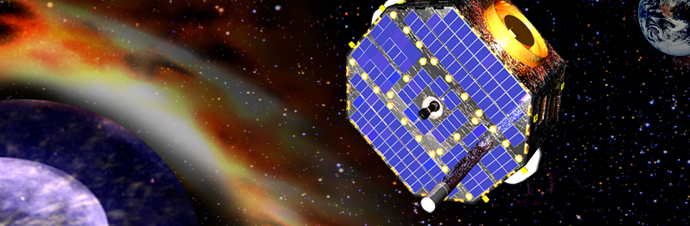
New Eye on the Outer Solar System Launches Successfully

Written by Nancy Atkinson
The Interstellar Boundary Explorer.  Credit: NASA

The Interstellar Boundary Explorer. Credit: NASA

There's a new spacecraft in Earth orbit, with a really "far out" mission: to map the outer solar system. NASA's Interstellar Boundary Explorer mission, or IBEX launched successfully from the Kwajalein Atoll in the Pacific Ocean at 1:47 p.m. EDT, Sunday, from an Orbital Sciences Pegasus XL launch vehicle. IBEX will be the first spacecraft to image and map dynamic interactions taking place in the outer solar system. The two Voyager probes sent back a limited amount of information about the region of space where our solar system ends and interstellar space begins. But beyond that, not much is known about this area. The region is about three times further from the sun than the orbit of planet Pluto. "No one has seen an image of the interaction at the edge of our solar system where the solar wind collides with interstellar space," said IBEX Principal Investigator David McComas of the Southwest Research Institute in San Antonio. "We know we're going to be surprised."

The spacecraft separated from the third stage of its Pegasus launch vehicle at 1:53 p.m. and immediately began powering up components necessary to control onboard systems. The operations team is continuing to check out spacecraft subsystems.

"After a 45-day orbit raising and spacecraft checkout period, the spacecraft will start its exciting science mission," said IBEX mission manager Greg Frazier of NASA's Goddard Space Flight Center in Greenbelt, Md.

"The heliosphere's boundary region is enormous, and the Voyager crossings of the termination shock, while historic, only sampled two tiny areas 10 billion miles (16 billion km) apart," NASA scientist Eric Christian said.

Voyager 1 passed the inner boundary in 2004 and Voyager 2 crossed over last year.

The solar wind, a stream of electrically conducting gas continuously moving outward from the sun at 1 million mph (1.6 million kph), blows against this interstellar material and forms a huge protective bubble around the solar system. This bubble is called the heliosphere.

As the solar wind reaches far beyond the planets to the solar system's outer limits, it encounters the edge of the heliosphere and collides with interstellar space. A shock wave is present at this boundary.

"Every six months, we will make global sky maps of where these atoms come from and how fast they are traveling. From this information, we will be able to discover what the edge of our bubble looks like and learn about the properties of the interstellar cloud that lies beyond the bubble," physicist Herb Funsten of the U.S. Department of Energy's Los Alamos National Laboratory.

Sources: NASA, Reuters

.

Lucimary Vargas
Presidente
Observatório Astronômico Monoceros
Além Paraíba-MG-Brasil
observatorio.monoceros@gmail.com
Did Lightning and Volcanoes Spark Life on Earth?

Written by Nancy Atkinson
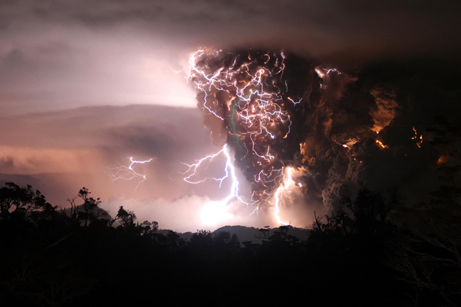
Chilean Volcano in 2008 creates lightning.  Credit: AP

Chilean Volcano in 2008 creates lightning. Credit: AP

Maybe the fictional Dr. Frankenstein wasn't so crazy after all. Two scientists have resurrected an old experiment, breathing life into a "dead" notion about how life began on our planet. New analysis shows that lightning and gases from volcanic eruptions could have given rise to the first life on Earth.

"It's alive!"…


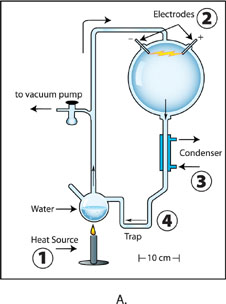
Back in the early 1950s, two chemists Stanley Miller and Harold Urey of the University of Chicago did an experiment that tried to recreate the conditions of a young Earth to see how the building blocks of life could have arisen. They used a closed loop of glass chambers and tubes with water and different mixes of hydrogen, ammonia, and methane; the gases thought to be in Earth's atmosphere billions of years ago. Then they zapped the mixture with an electrical current, to try and confirm a hypothesis that lightning may have triggered the origin of life. After a few days, the mixture turned brown.
When Miller analyzed the water, he found it contained amino acids, which are the building blocks of proteins — life's toolkit. The spark provided the energy for the molecules to recombine into amino acids, which rained out into the water. The experiment showed how simple molecules could be assembled into the more complex molecules necessary for life by natural processes, like lightning in Earth's primordial atmosphere.
The apparatus used for Miller's original experiment. Credit: NASA
But there was a problem. Theoretical models and analyses of ancient rocks eventually convinced scientists that Earth's earliest atmosphere was not rich in hydrogen, so many researchers thought the experiment wasn't an accurate re-creation of early Earth. But the experiments performed by Miller and Urey were ground-breaking.

"Historically, you don't get many experiments that might be more famous than these; they re-defined our thoughts on the origin of life and showed unequivocally that the fundamental building blocks of life could be derived from natural processes," said Adam Johnson, a graduate student with the NASA Astrobiology Institute team at Indiana University, Bloomington. Johnson is the lead author on a paper that resurrects the old origin-of-life experiments, with some tantalizing new findings.

Miller died in 2007. Two former graduate students of Miller's –geochemists Jim Cleaves of the Carnegie Institution of Washington (CIW) in Washington, D.C., and Jeffrey Bada of Indiana University, Bloomington–were examining samples left in Miller's lab. They found the vials of products from the original experiment and decided to take a second look with updated technology. Using extremely sensitive mass spectrometers at NASA's Goddard Space Flight Center Cleaves, Bada, Johnson and colleagues found traces of 22 amino acids in the experimental residues. That is about double the number originally reported by Miller and Urey and includes all of the 20 amino acids found in living things.

Miller actually ran three slightly different experiments, one of which injected steam into the gas to simulate conditions in the cloud of an erupting volcano. "We found that in comparison to Miller's classic design everyone is familiar with from textbooks, samples from the volcanic apparatus produced a wider variety of compounds," said Bada.

This is significant because thinking on the composition of Earth's early atmosphere has changed. Instead of being heavily laden with hydrogen, methane, and ammonia, many scientists now believe Earth's ancient atmosphere was mostly carbon dioxide, carbon monoxide, and nitrogen. But volcanoes were active during this time period, and volcanoes produce lightning since collisions between volcanic ash and ice particles generate electric charge. The organic precursors for life could have been produced locally in tidal pools around volcanic islands, even if hydrogen, methane, and ammonia were scarce in the global atmosphere.

So, this breathes life into the notion of lightning jump-starting life on Earth. Although Earth's primordial atmosphere was not hydrogen-rich, gas clouds from volcanic eruptions did contain the right combination of molecules. Is it possible that volcanoes seeded our planet with life's ingredients? While no one knows what happened next, the researchers are continuing their experiments in an attempt to determine if volcanoes and lightning are the reasons we're here.

The paper was published in Science on Oct. 17, 2008

Sources: NASA, ScienceNOW


.

Lucimary Vargas
Presidente
Observatório Astronômico Monoceros
Além Paraíba-MG-Brasil
observatorio.monoceros@gmail.com
Plumes of methane identified on Mars

Finding could influence choice of landing site for Mars Science Laboratory.

Eric Hand

Ithaca, New York

More than four years after researchers first said they had found methane gas on Mars, a scientist claims that he has "nailed" the controversial detection and identified key sources of the gas.


Nili Fossae is a hotspot for martian methane, says Michael Mumma (below).
Nili Fossae is a hotspot for martian methane, says Michael Mumma (below).JPL-Caltech/Univ. Arizona/NASA

On Earth, methane is mostly biological in origin; on Mars, it could signal microbes living deep underground. The latest work suggests that martian methane is concentrated in both space and time — at a handful of hotspots hundreds of kilometres across, plumes of methane bloom and dissipate in less than a year.
News of the detection is rippling through the Mars community just months before a destination is picked for the Mars Science Laboratory (MSL), the US$2-billionrover that is due to launch in 2009. It will carry an instrument that could both detect trace amounts of methane and help discern whether it is of biological or geological origin. One of the proposed methane plumes blankets one of the seven possible landing sites: Nili Fossae, which was given a middling ranking by the science community after a September evaluation that did not consider the emerging methane results.
"Now we've got these little signposts saying: 'Look, here I am. Come here!'" says Michael Mumma, a planetary scientist at NASA's Goddard Space Flight Center in Greenbelt, Maryland. He presented his team's work on 11 October at a meeting of the American Astronomical Society in Ithaca, New York.

Michael MummaMichael Mumma, of NASA's Goddard Space Flight Center in Greenbelt, Maryland.NASA

Mumma has been arguing for methane on Mars since 2003, when other startling findings began to emerge. One group, using the Canada-France-Hawaii Telescope on Mauna Kea, Hawaii, found global trace methane levels of 10 parts per billion, but could see no more detail than that. A second group, using thousands of spectra taken by the European Space Agency's Mars Express orbiter, found similar global levels, with hints of regional variability in concentration (V. Formisano et  al. Science 306, 1758–1761; 2004). But some of that paper's impact was diluted when the lead investigator, Vittorio Formisano of the Institute of Physics and Interplanetary Space in Rome, made separate claims of ammonia and formaldehyde that have not been confirmed.
Mumma, a spectroscopy expert, obtained data from telescopes in Hawaii and Chile that supported the notion of methane hotspots.
Now he says he knows for sure and is ready to publish. Having obtained four more years of data, Mumma has confirmed the presence of methane by matching four lines in his infrared spectra of the planet's atmosphere to the characteristic signature of methane — a more definite determination than previous analyses — and found more evidence that the methane is localized in discrete hotspots, which peak at levels of 60 parts per billion. "His numbers have changed a lot over time. But Mike has made a pretty compelling case," says Steven Squyres, a planetary scientist at Cornell University in Ithaca, and principal investigator for the Mars rovers Spirit and Opportunity.

"Now we've got these little signposts saying: 'Look, here I am. Come here!'"

More important than the peak concentrations, Mumma says, are the short lifetimes of the plumes. Previously, methane was thought to be destroyed in the atmosphere by sunlight — a slow process that allows the gas to mix in the atmosphere and persist for about 300 years. A global level of 10 parts per billion and a lifetime of hundreds of years means that a few hundred tonnes of methane are entering the atmosphere each year: the work of a few thousand cows. But plumes of 60 parts per billion that live for less than a year imply a methane-production rate several orders of magnitude higher. "This is a big deal," says Sushil Atreya of the University of Michigan in Ann Arbor, a co-author of the 2004 Mars Express paper.
Whether the methane plumes are biological or geological in origin is impossible to know at the moment, says Atreya. For example, microbes could be living in deep groundwater below a perma­frost zone, and their waste methane could percolate up and leak out. The methane could also come from chemical reactions in which buried volcanic rocks rich in the mineral olivine interact with water. A third possibility is that the methane is escaping from buried clathrates, deposits of methane ice formed long ago by one of the other two mechanisms.
But NASA's next Mars rover will be able to analyse, at levels of parts per trillion, the fractional concentrations of the carbon isotopes in each methane molecule. Life on Earth prefers to process lighter carbon-12 atoms. And so, on Mars, methane freighted with carbon-12 could be a sign of a biological origin.
ADVERTISEMENT
anatureconference
John Grotzinger, a geologist at the California Institute of Technology in Pasadena and project scientist for the MSL, says the methane detection could be important in deciding the MSL's destination. "We're going to take this very seriously," he says. "We all need to sit back and evaluate the data and find out if Nili Fossae is the only place where this occurs." The methane results could be considered at a meeting early next month, when the seven sites are evaluated from an engineering and safety standpoint.
A reshuffling of the sites' rankings could be in order, Grotzinger adds, but he wants some hard data to consider. "Talks don't count. The paper needs to be published," he says.
A paper describing Mumma's work is under review at Science.
.
Lucimary Vargas
Presidente
Observatório Astronômico Monoceros
Além Paraíba-MG-Brasil
observatorio.monoceros@gmail.com

Feeding Time at the Stellar Zoo: Infant Stars Generate Lots of Gas

Written by Ian O'Neill

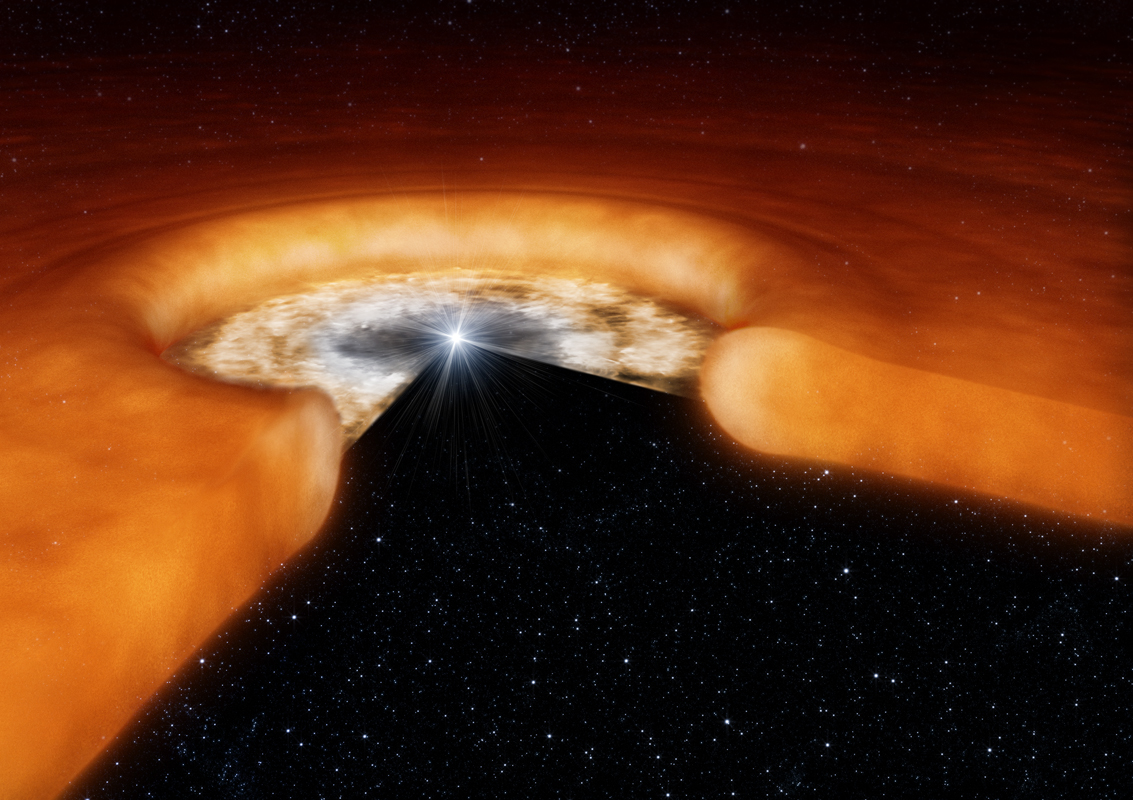
Artist's impression of a young star with surrounding disk of dust (ESO/L. Calçada)

Artist's impression of a young star with surrounding disk of dust and extended stellar wind (ESO/L. Calçada)

Understanding how stars form is critical to astronomers. If we can gain a better understanding of how intermediate-size infant stars grow, we can begin to answer some of the most perplexing questions hanging over the evolution of our own Solar System. Unfortunately, the nearest star forming regions are about 500 light years away, meaning that astronomers cannot simply use traditional optical telescopes to peer into star-forming disks of gas and dust. So, researchers working with the European Southern Observatory (ESO) are combining high resolution spectroscopic and interferometry observations to give the most detailed view yet of infant stars eating away at their proto-planetary disk, blasting out violent stellar winds as they do so…

It sounds like baby stars are very much like their human counterparts. They need a conveyor belt of food supplying their development and they blast huge amounts of waste back out in the form of gas. These findings come from researchers using the ESO's Very Large Telescope Interferometer (VLTI), giving us milli-arcsecond resolution when focusing on these star-forming regions. The detail this provides is equivalent to studying the period ('full stop' as I prefer to call it) at the end of this sentence at a distance of 50 km (31 miles).

This high resolution is achieved by combining the light from two or more telescopes separated by a certain distance. This distance is known as the "baseline," and interferometers such as the VLTI have a large baseline (of up to 200 metres), simulating a telescope diameter equivalent to this distance. However, the VLTI now has another trick up its sleeve. The AMBER spectrometer can be used in conjunction with the interferometer observations to give a more complete view of these feeding stars, probing deep into the spectrum of light being emitted from the region.

"So far interferometry has mostly been used to probe the dust that closely surrounds young stars. But dust is only one percent of the total mass of the discs. Their main component is gas, and its distribution may define the final architecture of planetary systems that are still forming." - Eric Tatulli, co-leader of the VLTI international collaboration from Grenoble, France.

The Herbig Ae/Be star R Coronae Australis, a young intermediate-size star (2MASS)

The Herbig Ae/Be star R Coronae Australis, a young intermediate-size star (2MASS)

Using the combined power of the VLTI and AMBER instrument, astronomers have been able to map this gas surrounding six stars belonging to the Herbig Ae/Be family. These particular stars are typically less than 10 million years old and a few times the mass of our Sun. They are very active stars in the process of forming, dragging huge amounts of material from a surrounding disk of dust.

Until now, astronomers have not been able to detect gas emission from young stars feeding on their stellar disks, thereby keeping the physical processes acting close to the star a mystery.

"Astronomers had very different ideas about the physical processes that have been traced by the gas. By combining spectroscopy and interferometry, the VLTI has given us the opportunity to distinguish between the physical mechanisms responsible for the observed gas emission," says co-leader Stefan Kraus from Bonn in Germany. In two of the Herbig Ae/Be stars, there is evidence for a large quantity of dust falling into them, thereby increasing their masses. In four cases, there is evidence for a strong stellar wind, forming an extended stellar gas outflow.

The VLTI observations also reveal dust from the surrounding disk is much closer than one would expect. Usually there is a cut-off distance for dust location as the stars heat will cause it to vaporize. However, it would appear in one case that gas between the star and dusty disk shields the dust from evaporating; the gas acts as a radiation-block, allowing the dust to extend closer to the star.

"Future observations using VLTI spectro-interferometry will allow us to determine both the spatial distribution and motion of the gas, and might reveal whether the observed line emission is caused by a jet launched from the disc or by a stellar wind", Kraus added.

These phenomenal observations of star-forming dust disks and gas emission, 500 light years away, open up a new kind of high-resolution astronomy. This will help us understand how our Sun fed off its surrounding disk of dust, eventually forming the planets and, ultimately, how life on Earth was possible…

Source: ESO

.

Lucimary Vargas
Presidente
Observatório Astronômico Monoceros
Além Paraíba-MG-Brasil
observatorio.monoceros@gmail.com

Uma trombada cósmica

Postado por Cássio Barbosa em 07 de Outubro de 2008 às 17:59
Que colisões entre galáxias podem produzir um surto de formação de estrelas nós já sabíamos. Agora, que uma colisão dessas poderia interromper a formação de estrelas é novidade!
m86
É isso que Jeffrey Kenney da Universidade de Yale, está propondo agora. Estudando o par de galáxias composto por M86 (uma elíptica) e NGC 4438 (uma espiral) com uma câmera capaz de observar as duas galáxias ao mesmo tempo, Kenney descobriu que elas sofreram uma colisão. Até agora ninguém tinha desconfiado disso, e só mesmo essa câmera de grande campo de visada conseguiu produzir imagens onde isso fica claro.
As imagens obtidas por Kenney mostram um tentáculo de gás com 400 mil anos-luz de comprimento conectando as duas galáxias. Essas galáxias estão no aglomerado de Virgem, a uns 50 milhões de anos-luz. Uma terceira galáxia poderia estar envolvida, mas sua velocidade era baixa demais para fazer parte da colisão. M83 possui um filamento de gás conhecido, mas até agora não havia nenhuma ligação dele com outra galáxia desse aglomerado.
Depois que as duas galáxias trombaram, o gás de NGC 4438 foi arrancado e espichado por M83 em pleno aglomerado. Tudo indica que essa colisão se deu muito rapidamente, e essa pode ser a resposta para o mistério do fim da produção de estrelas em M83.
Colisões de baixa velocidade entre galáxias devem provocar formação de estrelas porque as galáxias passam mais tempo interagindo e o gás não acaba ficando mais perto das galáxias. Já numa colisão entre duas galáxias com muita massa, o processo deve ser mais rápido e, ao invés de provocar a formação de estrelas, a passagem de uma galáxia pela outra deve arrancar o gás para o meio entre as duas. Isso arranca e esquenta o gás das galáxias, formando um cenário exatamente oposto ao necessário para promover a formação de estrelas.
Essa é a primeira vez que esse efeito é observado, mas pode vir a ser uma alternativa ao modelo atual. Por esse modelo, um buraco negro gigante na região central das galáxias elípticas produz tanta energia que o gás é aquecido a ponto de não se condensar em estrelas. Apesar de boa, essa explicação não se encaixa em todos os casos.
.
Lucimary Vargas
Presidente
Observatório Astronômico Monoceros
Além Paraíba-MG-Brasil
observatorio.monoceros@gmail.com

quarta-feira, 29 de outubro de 2008

Supermassive black holes common in early Universe

BY DR EMILY BALDWIN
ASTRONOMY NOW
Posted: October 17, 2008Observations of a spectacular collision of galaxies in the distant Universe have revealed that colossal black holes were present when galaxies were just beginning to form.
The observations were made with the Submillimeter Array (SMA) in Hawaii, which focuses on wavelengths of 200 microns to 1 millimetre that are most sensitive to the very cold gas and dust associated with the earliest evolutionary stages of stars, galaxies and planets. The SMA can peer into these primordial interstellar clouds and witness the birth of stars. 

This image captures the moment, approximately 12 billion years ago, when the observed galaxy's black hole ripped a stream of dusty gas from a neighbour. Image: STFC.


In the new observations galaxy 4C60.07 attracted the attention of astronomers because of its bright radio emission that betrayed the presence of a quasar – a black hole spinning rapidly as it feeds on its parent galaxy. At first, astronomers thought that the gas surrounding the black hole was undergoing a burst of star formation, turning fresh new gas into stars at a rate of about 5,000 of our Suns every year. But the latest research revealed that the stars of 4C60.07 are actually much older than originally perceived. Instead, the star forming factory is located in a previously unknown companion galaxy, which is rich in gas and clouded with dust, and has another colossal black hole residing at its centre.
"This new image reveals two galaxies where we only expected to find one," says Professor Rob Ivison, lead author of the study that will be published in the Monthly Notices of the Royal Astronomical Society. "Remarkably, both galaxies contain super-massive black holes. Such monsters are rare and we now suspect that the radio galaxy had only 'turned on' because it is involved in a collision with a previously unknown galaxy, which helps feed its black hole and thus power the radio jets."
The two galaxies – and their central black holes – smashed together in a dramatic collision, but because this cataclysmic event occurred less than two billion years after the big bang, the galaxies will have long since merged, creating a single monstrous black hole. The implications are wide reaching, and the astronomers can't help but wonder how many other colossal black holes may be lurking unseen in the distant Universe.
"We know the black holes we have found are massive because one is powering a pair of staggeringly luminous radio lobes and the other is modifying the whole optical/infrared spectral energy distribution of its parent galaxy," Ivison tells Astronomy Now. "Massive black holes were already known to exist in the early Universe, but these objects are amazingly rare – we can count them on our fingers. Until now, they were thought to be freaks – completely unrepresentative of the general galaxy population. The observations we've presented in this paper show that such massive black holes may be ten-a-penny."
The galaxies hosting the black holes are both about the size of the Milky Way, but each one is unique. "The radio galaxy looks to be more evolved than its neighbour," says Ivison. "It may have used up most of its gas by forming stars and feeding its black hole in the run-up to the collision, possibly hundreds of millions of years earlier. The neighbour is forming thousands of stars in an intense starburst, triggered by the collision, so it is less evolved and clearly has plenty of gas."
The presence of these two giant black holes in both of the galaxies has big implications for their genesis, since supermassive black holes take time to grow and can have a profound influence on the evolution of their parent galaxy, by triggering star formation or even shutting it down completely. Understanding the prevalence of black holes in the early years of the Universe will rely on combining information from across the whole electromagnetic spectrum. The UK's revolutionary new submillimetre camera, SCUBA 2, should play a key role in black hole characterisation and help astronomers to monitor their growth and their host galaxies in much more detail.
.
Lucimary Vargas
Presidente
Observatório Astronômico Monoceros
Além Paraíba-MG-Brasil
observatorio.monoceros@gmail.com
Phoenix completes soil deliver

BY DR EMILY BALDWIN
ASTRONOMY NOW
Posted: October 22, 2008
NASA's Phoenix Mars Lander has finished scooping soil samples to deliver to its onboard laboratories, and is now preparing to analyse samples already obtained before the Sun completely sets on the mission.
Last week, the lander's robotic arm successfully delivered soil into oven six of the Thermal and Evolved Gas Analyser (TEGA), a bonus for the mission since the mission goal of filling and examining soil in at least three of the ovens has already been completed.

This image shows four of the eight cells in the TEGA instrument. TEGA's ovens, located underneath the cells, heat soil samples so the released gases can be analysed. Left to the right the cells are numbered 7, 6, 5 and 4, with the most recent delivery to cell 6 Image: NASA/JPL-Caltech/University of Arizona/Max Planck Institute.

The project scientists are keen to analyse the samples as the power Phoenix generates continues to drop as autumn on Mars gradually sets in. "My entire team is working very hard to make use of the power we have before it disappears," says William Boynton, the lead scientist for TEGA. "Every time we fill an oven, we potentially learn more about Mars' geochemistry." TEGA's tiny ovens heat the soil to as high as 1,000 degrees Celsius in order to sniff out the gases derived from heating the soil.
Meanwhile, the spacecraft's robotic arm is digging into the lower portion of the Upper Cupboard and Stone Soup regions of the Phoenix workspace and the Surface Stereoscopic Imager is documenting trenching so scientists can better map out the geology of the ice table already found a few centimetres below the surface. "We're basically trying to understand the depth and extent of the ice table to tie together how geology and climate control its formation," says Phoenix mission scientist Diana Blaney of NASA's Jet Propulsion Laboratory.
Later this week, mission engineers will instruct Phoenix to use its robotic arm to attempt to push a soil sample piled in a funnel on top of the lander's Wet Chemistry Laboratory into a cell for analysis. Images of the soil already captured will be taken using the Optical Microscope. In addition, digital-elevation models of a rock called Sandman are scheduled with Phoenix's Robotic Arm Camera.
Mission scientists will continue to research and analyse the soil samples in the coming months, long after Phoenix stops operating on the surface.
.
Lucimary Vargas
Presidente
Observatório Astronômico Monoceros
Além Paraíba-MG-Brasil
observatorio.monoceros@gmail.com

Aqui começou a discórdia

Postado por Cássio Barbosa em 15 de Outubro de 2008 às 10:53
Cá estou eu em mais uma viagem para congresso. Desta vez, vim participar de um encontro para comemorar os 70 anos de um colaborador meu. O congresso está acontecendo no Observatório Lowell, no Arizona (EUA). Além do congresso em si, o local escolhido é bastante interessante, já que este foi o observatório onde Plutão foi descoberto, além de outras coisas. Agora que eu já fiz minha apresentação, modéstia à parte bastante elogiada, estou mais tranqüilo para atualizar o blog.
Tudo começou em 1893, quando Percival Lowell, um diplomata formado em matemática, ouviu dizer que Schiaparelli, o astrônomo italiano que observou os canais de Marte, estava ficando cego e não poderia mais continuar seu trabalho. Em 1894 ele construiu seu observatório no alto de uma colina em Flagstaff. O local foi escolhido depois de intensa pesquisa e se revelou um excelente sítio, muito escuro e muito seco, quase um deserto.
Esse observatório era dedicado ao estudo do Sistema Solar, em especial de Marte e seus canais. De acordo com a teoria de Lowell, os marcianos usavam esses canais para levar água dos pólos para o resto do planeta. Segundo ele, era possível perceber a vegetação crescendo em torno do canal de tempos em tempos. Lowell registrou suas observações em desenhos coloridos (cheguei a manuseá-los em uma biblioteca da USP) e em globos marcianos como este no museu do observatório (que não deu para pegar).
Marte globo
Além de Marte, Lowell também estudou intensivamente Mercúrio (produzindo alguns rascunhos de sua superfície), determinou o período de rotação de Mercúrio e Vênus e determinou a constituição interna de Júpiter e Saturno a partir da observação de seus satélites. Além dos canais marcianos, outra obsessão de Lowell era descobrir o nono planeta do Sistema Solar, que ele chamava de Planeta X.
Para tentar localizá-lo, Lowell partiu do mesmo princípio usado para descobrir Netuno. Depois de descoberto, Urano por vezes se "atrasava" ou se "adiantava" e não era encontrado na posição prevista. O astrônomo inglês John Adams e o matemático francês Urbain Le Verrier (independentemente) modelaram essas pertubações como sendo originárias de um outro planeta e definiram qual deveria ser a sua posição no céu. Aí começou uma corrida para ver quem descobriria o tal planeta até que finalmente Netuno foi observado em 23 de setembro de 1846 por James Challis. Essa história tem detalhes que envolvem desleixo, competição e coincidências que outra hora eu conto, mas Galileu já tinha observado Netuno em dezembro de 1612 e janeiro de 1613. No entanto, como o planeta tem um movimento muito lento no céu, Galileu não percebeu nenhuma mudança em sua posição, de modo que o confundiu com uma estrela.
Voltando ao Planeta X, Lowell tentou aplicar o mesmo raciocínio para Netuno, que teimava em não estar na posição prevista. Hoje sabemos que essas perturbações são ocasionadas pelos outros planetas gigantes do Sistema Solar e não poderiam ser criadas por um corpo celeste tão pequeno como Plutão. Em 1915, é possível que Lowell tenha feito algumas fotos de Plutão, que teria passado despercebido. Depois de sua morte, em 1916, apenas em 1929 a busca pelo Planeta X foi retomada por Clyde Tombaugh. Finalmente, em 1930, Plutão foi descoberto nesse aparelho da foto abaixo. Ele é um comparador de campos e funciona de modo simples: uma foto de uma determinada região do céu era tirada e, após duas semanas, tirava-se outra foto dessa mesma região. As duas eram colocadas lado a lado e iluminadas alternadamente. Se alguma coisa mudasse de uma imagem para outra, estaria ali um corpo do Sistema Solar, já que as estrelas não se mexem.
Piscadela
Quase 100 anos depois, Plutão foi rebaixado à categoria de planeta anão, mas aparentemente essa história não terminou. Na assembléia geral da União Astronômica Intenacional do ano que vem, que vai acontecer no Rio de Janeiro, essa decisão deve ser rediscutida. Na porta do museu do observatório, quatro urnas estão penduradas e o visitante pode votar nas seguintes opções: "Plutão deve ser considerado um planeta", "Plutão deve ser considerado um planeta anão", "Plutão não deve ser considerado nenhum tipo de planeta" ou "Quem se importa? Eu quero ajudar a manter o observatório!". A votação é feita com cédulas de dinheiro, em forma de doações. Para minha surpresa, planeta anão está ganhando com 320 dólares, contra 226 para planeta.
 
.
Lucimary Vargas
Presidente
Observatório Astronômico Monoceros
Além Paraíba-MG-Brasil
observatorio.monoceros@gmail.com

Nasa lança sonda Ibex para explorar os confins do Sistema Solar

Publicidade da France Presse, em Washington
A Nasa lançou neste domingo a sonda Ibex, cuja missão de dois anos tem o objetivo de obter imagens e mapear os misteriosos confins do Sistema Solar, onde começa, a dezenas de bilhões de quilômetros da Terra, o espaço interestelar.
A sonda foi lançada às 15h45 no horário de Brasília, segundo a agência espacial.
A Ibex (Interstellar Boundary Explorer) está dotada de instrumentos que a permitirão obter imagens e estabelecer a primeira cartografia dessa vasta zona de turbulências e campos magnéticos mesclados, onde as partículas dos ventos solares quentes se chocam com as partículas interestelares de outras estrelas da Via Láctea.
"As regiões fronteiriças do espaço interestelar são essenciais porque nos protegem da maioria dos raios galácticos mais perigosos", disse David McComas, diretor científico da missão.
"Sem a zona, os raios penetrariam na órbita terrestre tornando os vôos orbitais humanos muito mais perigosos", acrescentou McComas.
As únicas informações das quais os cientistas dispõem sobre os confins do Sistema Solar foram dadas pelas sondas Voyager 1 e Voyager 2, lançadas em 1977 e ainda em operação.
A sonda Ibex foi lançada a bordo de um foguete Pegasus que, por sua vez, foi lançado de um tri-reator Lockheed L-1011 voando a 12 mil metros sobre as Ilhas Marshall no Oceano Pacífico.
Leia mais


Especial
.
Lucimary Vargas
Presidente
Observatório Astronômico Monoceros
Além Paraíba-MG-Brasil
observatorio.monoceros@gmail.com

A crise em Marte… ou talvez não


A crise em Marte… ou talvez não

2008-10-17

Imagem de artista comparando o tamanho do Mars Science Laboratory com um dos rovers actualmente em Marte. Crédito: NASA/JPL-Caltech.
Há uns meses atrás (Abril) já aqui tínhamos alertado para os problemas que o Mars Science Laboratory (MSL), o novo rover marciano da NASA – com lançamento previsto para 2009 – estava a enfrentar. Basicamente, os custos tinham excedido largamente as previsões, e era preciso mais dinheiro. Muito dinheiro: uns 200 milhões de dólares. E claro que havia problemas técnicos na génese dessa necessidade. Porém, essa perspectiva parecia difícil de satisfazer – mesmo antes do recente agudizar da crise económica mundial. Agora, a notícia surgiu perante o grande público, e fala-se abertamente do adiamento da missão para 2011… o que, aliás, só aumentaria os custos. Portanto, pode-se dizer que haverá com toda a certeza um esforço importante para levar a missão para a rampa de lançamento a tempo e horas de aproveitar a janela que se abre em Outubro de 2009.

Apesar do clima de incerteza, nada leva a pensar que a exploração de Marte vá sofrer uma interrupção. No início do ano, o programa americano esteve sujeito a fortes críticas do então director de ciência da NASA – que, entretanto, se demitiu, fazendo a comunidade "marciana" soltar um suspiro colectivo de alívio. E já se sabe que em 2013 a NASA avançará com mais uma sonda orbital. Este novo satélite marciano, MAVEN (Mars Atmosphere and Volatile Evolution Mission), terá como objectivo principal o estudo da atmosfera marciana e da sua evolução, sobretudo dos processos que têm levado à perda de parte substancial desse envelope gasoso ao longo da história do planeta. Espera-se também que nesse mesmo ano seja finalmente enviado para Marte o rover europeu ExoMars, capaz de investigar quaisquer indícios de vida que lhe surjam à frente dos instrumentos.

Para 2016, os americanos estudam o envio de outro rover, mais pequeno que o MSL, ou seja, das dimensões dos actuais MER (Spirit e Opportunity). O papel que lhe seria atribuído seria, para lá da exploração detalhada de uma área interessante (passado com água, potencial para instalação de uma base humana futura), testar algumas tecnologias com vista à futura missão MSR – Mars Sample Return, a executar muito provavelmente na década de 20, e para a qual se procura uma vasta cooperação internacional. É verdade que falta muito tempo, mas os problemas que se colocam a uma missão desse género são também muito grandes, desde a recolha, preparação e acondicionamento de amostras de rochas e solo marcianos até ao seu envio, recepção e armazenamento na Terra. Trata-se porém de um passo fundamental na compreensão da história do planeta vermelho, e uma pedra basilar dos programas de exploração americano e europeu, quer se dê uma (desejável) convergência entre eles ou não. Só depois disso se poderá começar a falar seriamente de missões tripuladas… um sonho que está ainda a décadas da realização.

Embora haja quem afirme que poderia ser feito em menos de 10 anos. Mas essa é uma história para outra ocasião.


Apoios:


© NUCLIO - Núcleo Interactivo de Astronomia 2001-2006

.
Lucimary Vargas
Presidente
Observatório Astronômico Monoceros
Além Paraíba-MG-Brasil
observatorio.monoceros@gmail.com

LinkWithin

Related Posts Plugin for WordPress, Blogger...