sexta-feira, 31 de outubro de 2008

Espectáculo celeste hoy al atardecer

Estimados amigos
Este dia 31 de Octubre en cuanto se oculte el sol preparence a ver un espectáculo celeste en donde los participantes principales son La Luna, Antares Venus (el mas brillante en éstos dias) y Júpiter.

Mapa celeste proporcionado porla NASA.

Esperando que lo disfruten

Su amigo de siempre
Fernando Cruz
AstroSahagun
Meteorologia_Antares
Desde Cd. Sahagún, Hgo. México

quinta-feira, 30 de outubro de 2008

COROT sees sunquakes in other stars

BY DR EMILY BALDWIN
ASTRONOMY NOW
Posted: October 24, 2008
The CNES/ESA Earth orbiting COROT satellite has applied the technique of seismology to the study of stellar interiors, probing the interiors of three stars beyond our own Sun for the first time.

COROT can detect 'starquakes', acoustic waves generated deep within a star that ripple across the star's surface, altering its brightness. By studying these variations, a star's mass, age and structure can be determined. Image: CNES.

Like the propagation of seismic waves on Earth providing information about our planet's interior, sound waves travelling throughout the Sun and other stars carry information about what is happening below the surface. The study of these waves propagating through a star is known as helioseismology, and has already been used to generate complex models of the interior conditions on our Sun, showing that different layers of our home star rotate at different speeds to generate the Sun's magnetic field, and that jet streams of plasma run thousands of kilometres below the surface.
Oscillations of the Sun's surface can also be tracked by direct observations and related to interior processes by the tool of helioseismology. Similar oscillations can be observed on other stars by watching for variations in the light emitted by the star as the surface wobbles, revealing both the internal structure of the star and the way energy is transported from the core to the surface.
"Other techniques to estimate stellar oscillations have been used from the ground, but they are limited in what they can do," says Malcolm Fridlund, ESA Project Scientist for COROT at ESA's European Space Research and Technology Centre (ESTEC). "Adverse weather conditions, plus the fact that you cannot observe stars during daytime, oblige ground astronomers to interrupt their observations."

COROT consists of a 27 centimetre telescope and was launched in December 2006. Image: CNES/D. Ducros.

The COROT satellite allows uninterrupted viewing from afar, and with high sensitivity instruments such as a 4-CCD camera capable of recording tiny variations of light intensity emitted from a star, COROT offers a new view of our stellar neighbourhood. In the new study, three Sun-like stars were scrutinized by COROT: HD499933, HD181420 and HD181906, revealing 'sunquakes' rumbling inside their interiors.
"The fact that COROT succeeded in probing the interior of Sun-like stars with direct measurements for the first time is a huge leap in understanding stars in general", says Fridlund. "In addition, this will help us to understand, by comparison, our own Sun even better."
COROT was launched at the end of 2006 and was designed as both a planet hunter and star surveyor, having clocked up six exoplanets to date with the aim of surveying around 120,000 stars for exoplanets, and over a hundred stars for stellar seismology studies.
 
.

Lucimary Vargas
Presidente
Observatório Astronômico Monoceros
Além Paraíba-MG-Brasil
observatorio.monoceros@gmail.com

NASA orbiter reveals details of a wetter Mars

NASA NEWS RELEASE
Posted: October 28, 2008
WASHINGTON -- NASA's Mars Reconnaissance Orbiter has observed a new category of minerals spread across large regions of Mars. This discovery suggests that liquid water remained on the planet's surface a billion years later than scientists believed, and it played an important role in shaping the planet's surface and possibly hosting life.


Credit: Credit: NASA/JPL-Caltech/Univ. of Arizona
 
Researchers examining data from the orbiter's Compact Reconnaissance Imaging Spectrometer for Mars have found evidence of hydrated silica, commonly known as opal. The hydrated, or water-containing, mineral deposits are telltale signs of where and when water was present on ancient Mars.

"This is an exciting discovery because it extends the time range for liquid water on Mars, and the places where it might have supported life," said Scott Murchie, the spectrometer's principal investigator at the Johns Hopkins University Applied Physics Laboratory in Laurel, Md. "The identification of opaline silica tells us that water may have existed as recently as 2 billion years ago."

Until now, only two major groups of hydrated minerals, phyllosilicates and hydrated sulfates, had been observed by spacecraft orbiting Mars. Clay-like phyllosilicates formed more than 3.5 billion years ago where igneous rock came into long-term contact with water. During the next several hundred million years, until approximately 3 billion years ago, hydrated sulfates formed from the evaporation of salty and sometimes acidic water.

The newly discovered opaline silicates are the youngest of the three types of hydrated minerals. They formed where liquid water altered materials created by volcanic activity or meteorite impact on the Martian surface. One such location noted by scientists is the large Martian canyon system called Valles Marineris.

"We see numerous outcrops of opal-like minerals, commonly in thin layers extending for very long distances around the rim of Valles Marineris and sometimes within the canyon system itself," said Ralph Milliken of NASA's Jet Propulsion Laboratory in Pasadena, Calif.

Milliken is lead author of an article in the November issue of "Geology" that describes the identification of opaline silica. The study reveals that the minerals, which also were recently found in Gusev Crater by NASA's Mars rover Spirit, are widespread and occur in relatively young terrains.

In some locations, the orbiter's spectrometer observed opaline silica with iron sulfate minerals, either in or around dry river channels. This indicates the acidic water remained on the Martian surface for an extended period of time. Milliken and his colleagues believe that in these areas, low-temperature acidic water was involved in forming the opal. In areas where there is no clear evidence that the water was acidic, deposits may have formed under a wide range of conditions.

"What's important is that the longer liquid water existed on Mars, the longer the window during which Mars may have supported life," says Milliken. "The opaline silica deposits would be good places to explore to assess the potential for habitability on Mars, especially in these younger terrains."

The spectrometer collects 544 colors, or wavelengths, of reflected sunlight to detect minerals on the surface of Mars. Its highest resolution is about 20 times sharper than any previous look at the planet in near-infrared wavelengths.

NASA's Jet Propulsion Laboratory manages the Mars Reconnaissance Orbiter mission for NASA's Science Mission Directorate in Washington. Lockheed Martin Space Systems, Denver, is the prime contractor for the project and built the spacecraft. The Applied Physics Laboratory led the effort to build the spectrometer and operates the instrument in coordination with an international team of researchers from universities, government and the private sector.


.

Lucimary Vargas
Presidente
Observatório Astronômico Monoceros
Além Paraíba-MG-Brasil
observatorio.monoceros@gmail.com

MESSENGER reveals more of Mercury's hidden territory

Scientists have now seen about 95 percent of the innermost planet.
Provided by NASA
Mercury
This image of Mercury captured was by MESSENGER on the probe's second approach. NASA/Johns Hopkins University Applied Physics Laboratory/Carnegie Institution of Washington [View Larger Image]
October 29, 2008
A NASA spacecraft gliding over Mercury's battered surface for the second time this year revealed more previously unseen real estate on the innermost planet.

The probe also produced several science firsts and is returning hundreds of new photos and measurements of the planet's surface, atmosphere, and magnetic field.

The MErcury Surface, Space ENvironment, GEochemistry, and Ranging (MESSENGER) spacecraft flew by Mercury shortly after 4:40 A.M. EDT, October 6. It completed a critical gravity assist to keep it on course to orbit Mercury in 2011 and unveiled 30 percent of Mercury's surface never seen by a spacecraft.

"The region of Mercury's surface that we viewed at close range for the first time this month is bigger than the land area of South America," said Sean Solomon, principal investigator and director of the Department of Terrestrial Magnetism at the Carnegie Institution of Washington. "When combined with data from our first flyby and from Mariner 10, our latest coverage means that we have now seen about 95 percent of the planet."

The spacecraft's science instruments operated throughout the flyby. Cameras snapped more than 1,200 pictures of the surface, while the laser altimeter profiled the area's topography. The comparison of magnetosphere observations from the spacecraft's first flyby in January with data from the probe's second pass provids key new insight into Mercury's internal magnetic field and reveals new features of its magnetosphere. The magnetosphere is the volume surrounding Mercury that is controlled by the planet's magnetic field.

"The previous flybys by MESSENGER and Mariner 10 provided data only about Mercury's eastern hemisphere," said Brian Anderson of the Johns Hopkins University Applied Physics Laboratory (APL) in Laurel, Maryland. "The most recent flyby gave us our first measurements on Mercury's western hemisphere, and with them, we discovered that the planet's magnetic field is highly symmetric."

The probe's Mercury Laser Altimeter (MLA), allowed scientists, for the first time, to correlate high-resolution topography measurements with high-resolution images.

"The MLA collected altimetry in regions where images from MESSENGER and Mariner 10 data are available, and new images were obtained of the region sampled by the altimeter in January," said Maria Zuber, co-investigator and head of the Department of Earth, Atmospheric, and Planetary Sciences at the Massachusetts Institute of Technology. "These topographic measurements now improve considerably the ability to interpret surface geology."

The Mercury Atmospheric and Surface Composition Spectrometer observed Mercury's thin atmosphere, known as an exosphere. The instrument searched for emissions from sodium, calcium, magnesium, and hydrogen atoms. Observations of magnesium are the first detection of this chemical in Mercury's exosphere. Preliminary analysis suggests the spatial distributions of sodium, calcium, and magnesium are different. Simultaneous observations of these spatial distributions, also a first for the spacecraft, have opened a window into the interaction of Mercury's surface and exosphere.

Spacecraft images reveal for the first time vast geologic differences on the surface.

"Now that MESSENGER's cameras have imaged more than 80 percent of Mercury, it is clear that, unlike the moon and Mars, Mercury's surface is more homogeneously ancient and heavily cratered, with large extents of younger volcanic plains lying within and between giant impact basins," said co-investigator Mark Robinson of Arizona State University in Tempe.

See Astronomy.com's comprehensive coverage of MESSENGER's second flyby of Mercury.
.

Lucimary Vargas
Presidente
Observatório Astronômico Monoceros
Além Paraíba-MG-Brasil
observatorio.monoceros@gmail.com

Solar system's young twin has two asteroid belts

HARVARD-SMITHSONIAN CENTER FOR ASTROPHYSICS NEWS RELEASE
Posted: October 27, 2008
Astronomers have discovered that the nearby star Epsilon Eridani has two rocky asteroid belts and an outer icy ring, making it a triple-ring system. The inner asteroid belt is a virtual twin of the belt in our solar system, while the outer asteroid belt holds 20 times more material. Moreover, the presence of these three rings of material implies that unseen planets confine and shape them.


This artist's conception shows the closest known planetary system to our own, called Epsilon Eridani. Credit: NASA/JPL-Caltech
 
The star Epsilon Eridani is slightly smaller and cooler than the Sun. It is located about 10.5 light-years from Earth in the constellation Eridanus. (A light-year is the distance light travels in one year, or about 6 trillion miles.) Epsilon Eridani is the ninth closest star to the Sun and is visible to the unaided eye. It is also younger than the Sun, with an approximate age of 850 million years.

Epsilon Eridani and its planetary system show remarkable similarities to our solar system at a comparable age.

"Studying Epsilon Eridani is like having a time machine to look at our solar system when it was young," said Smithsonian astronomer Massimo Marengo (Harvard-Smithsonian Center for Astrophysics). Marengo is a co-author of the discovery paper, which will appear in the Jan. 10 issue of The Astrophysical Journal.

Lead author Dana Backman (SETI Institute) agreed, saying, "This system probably looks a lot like ours did when life first took root on Earth."

Our solar system has a rocky asteroid belt between Mars and Jupiter, about 3 astronomical units from the Sun. (An astronomical unit equals the average Earth-Sun distance of 93 million miles.) In total, it contains about 1/20 the mass of Earth's Moon. Using NASA's Spitzer Space Telescope, the team of astronomers found an identical asteroid belt orbiting Epsilon Eridani at a similar distance of 3 astronomical units.

They also discovered a second asteroid belt 20 astronomical units from Epsilon Eridani (about where Uranus is located in our solar system). The second asteroid belt contains about as much mass as Earth's Moon.

A third, icy ring of material seen previously extends about 35 to 100 astronomical units from Epsilon Eridani. A similar icy reservoir in our solar system is called the Kuiper Belt. However, Epsilon Eridani's outer ring holds about 100 times more material than ours.


This artist's diagram compares the Epsilon Eridani system to our own solar system. The two systems are structured similarly, and both host asteroids (brown), comets (blue) and planets (white dots). Credit: NASA/JPL-Caltech
See larger image here
When the Sun was 850 million years old, theorists calculate that our Kuiper Belt looked about the same as that of Epsilon Eridani. Since then, much of the Kuiper Belt material was swept away, some hurled out of the solar system and some sent plunging into the inner planets in an event called the Late Heavy Bombardment. (The Moon shows evidence of the Late Heavy Bombardment - giant craters that formed the lunar seas of lava called mare.) It is possible that Epsilon Eridani will undergo a similar dramatic clearing in the future.

"Epsilon Eridani looks a lot like the young solar system, so it's conceivable that it will evolve similarly," said Marengo.

The Spitzer data show gaps between each of the three rings surrounding Epsilon Eridani. Such gaps are best explained by the presence of planets that gravitationally mold the rings, just as the moons of Saturn constrain its rings.

"Planets are the easiest way to explain what we're seeing," stated Marengo.

Specifically, three planets with masses between those of Neptune and Jupiter would fit the observations nicely. A candidate planet near the innermost ring already has been detected by radial velocity studies. Those studies suggested that it orbited Epsilon Eridani on a highly elliptical path, characterized by an eccentricity of 0.7. The new finding rules out such an orbit, because the planet would have cleared out the inner asteroid belt long ago through gravitational disruption.

A second planet must lurk near the second asteroid belt, and a third at about 35 astronomical units near the inner edge of Epsilon Eridani's Kuiper Belt. Future studies may detect these currently unseen worlds, as well as any terrestrial planets that may orbit inside the innermost asteroid belt.

Headquartered in Cambridge, Mass., the Harvard-Smithsonian Center for Astrophysics (CfA) is a joint collaboration between the Smithsonian Astrophysical Observatory and the Harvard College Observatory. CfA scientists, organized into six research divisions, study the origin, evolution and ultimate fate of the universe.

.

Lucimary Vargas
Presidente
Observatório Astronômico Monoceros
Além Paraíba-MG-Brasil
observatorio.monoceros@gmail.com

Cosmic lens reveals distant galactic violence

Astronomers gained a rare glimpse of the violent assembly of a young galaxy.
Provided by NRAO, Socorro, New Mexico
Cosmic lens
Imaging a distant galaxy using a gravitational lens. Bill Saxton/NRAO/AUI/NSF [View Larger Image]
October 21, 2008
By cleverly unraveling the workings of a natural cosmic lens, astronomers have gained a rare glimpse of the violent assembly of a young galaxy in the early universe. Their new picture suggests that the galaxy has collided with another, feeding a super-massive black hole and triggering a tremendous burst of star formation.

The astronomers used the National Science Foundation's Very Large Array (VLA) radio telescope in Socorro, New Mexico, to look at a galaxy more than 12 billion light-years from Earth, seen as it was when the universe was only about 15 percent of its current age. Between this galaxy and Earth, lies another distant galaxy so perfectly aligned along the line of sight that its gravity bends the light and radio waves from the farther object into a circle, or "Einstein Ring."

This gravitational lens made it possible for the scientists to learn details of the young, distant galaxy that would have been unobtainable otherwise.

"Nature provided us with a magnifying glass to peer into the workings of a nascent galaxy, providing an exciting look at the violent, messy process of building galaxies in the early history of the universe," said Dominik Riechers, who led this project at the Max Planck Institute for Astronomy in Germany and now is a Hubble Fellow at the California Institute of Technology (Caltech) in Pasadena.

The new picture of the distant galaxy, dubbed PSS J2322+1944, shows a massive reservoir of gas, 16,000 light-years in diameter, that contains the raw material for building new stars. A super-massive black hole is voraciously eating material, and new stars are being born at the rate of nearly 700 suns per year. By comparison, our Milky Way Galaxy produces the equivalent of about three to four suns per year.

The black hole appears to be near the edge, rather than at the center, of the giant gas reservoir. Astronomers say this location indicates the galaxy has merged with another.

"This whole picture of massive galaxies and super-massive black holes assembling themselves through major galaxy mergers so early in the universe is a new paradigm in galaxy formation. This gravitationally lensed system allows us to see this process in unprecedented detail," Chris Carilli of the National Radio Astronomy Observatory in Charlottesville, Virginia, said.

In 2003, astronomers studied PSS J2322+1944 and found the Einstein Ring by observing carbon monoxide (CO) molecules emit radio waves. When astronomers see large amounts of CO in a galaxy, they conclude that there also is a large amount of molecular hydrogen present, and thus a large reservoir of fuel for star formation.

In the latest study, scientists painstakingly produced a physical model of the lensing intermediate galaxy. By knowing the galaxy's mass, structure, and orientation, they deduced the details of how it bends light and radio waves from the more-distant galaxy. Then they reconstructed a picture of the distant object. By doing multiple VLA images made at different radio frequencies helped the team measure the motions of the gas in the distant galaxy.

"The lensing galaxy was, in effect, part of our telescope. By projecting backward through the lens, we determined the structure and dynamics of the galaxy behind it," Fabian Walter said of the Max-Planck Institute for Astronomy in Germany.

George Djorgovski of Caltech used the digitized Palomar Observatory Sky Survey to discover PSS J2322+1944. Later radio and optical studies showed it had a huge reservoir of dust and molecular gas and indicated gravitational lensing.

Albert Einstein's General Theory of Relativity predicted gravitational lenses in 1919. In 1936, Einstein showed that a perfectly aligned gravitational lens would produce a circular image, but he felt the chances of actually observing such an object were nearly zero. The first gravitational lens was discovered in 1979, and researchers using the VLA in 1987 discovered the first Einstein Ring.

MESSENGER unveils more 'hidden' territory on Mercury

JHU-APL NEWS RELEASE
Posted: October 29, 2008
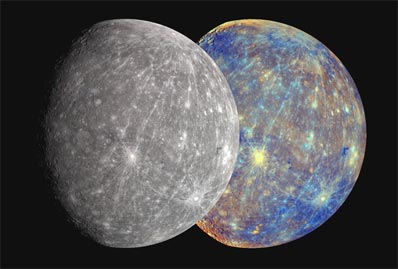
Credit: NASA/Johns Hopkins University Applied Physics Laboratory/Carnegie Institution of Washington
 
Gliding over the battered surface of Mercury for the second time this year, NASA's MESSENGER spacecraft has revealed even more previously unseen real estate on the innermost planet, sending home hundreds of photos and measurements of its surface, atmosphere, and magnetic field.

The probe flew by Mercury shortly after 4:40 a.m. EDT on October 6, 2008, completing a critical gravity assist to keep it on course to orbit Mercury in 2011 and unveiling 30 percent of Mercury's surface never before seen by spacecraft.

"The region of Mercury's surface that we viewed at close range for the first time this month is bigger than the land area of South America," says Sean Solomon, MESSENGER principal investigator and the director of the Department of Terrestrial Magnetism at the Carnegie Institution of Washington. "When combined with data from our first flyby and from Mariner 10, our latest coverage means that we have now seen about 95% of the planet."

MESSENGER's science instruments worked feverishly through the flyby - cameras snapped more than 1,200 pictures of the surface, while topography beneath the spacecraft was profiled with the laser altimeter. "We have completed an initial reconnaissance of the solar system's innermost planet, enabling us to gain a global view of Mercury's geological history and internal magnetic field geometry for the first time," Solomon continues.

The comparison of magnetosphere observations from MESSENGER's first flyby in January with data from the probe's second pass has provided key new insight into the nature of the planet's internal magnetic field and revealed new features of Mercury's magnetosphere.

"The previous flybys by MESSENGER and Mariner 10 provided data only on Mercury's eastern hemisphere," explains Brian Anderson, of the Johns Hopkins University Applied Physics Laboratory (APL) in Laurel, Md. "The most recent flyby gave us our first measurements on Mercury's western hemisphere, and with them we discovered that the planet's magnetic field is highly symmetric."

"This seemingly simple result is significant for the planet's internal field because it implies that the dipole is even more closely aligned with the planet's rotation axis than we could conclude before the second flyby," says Anderson, who is deputy project scientist. "Even though the rigorous analyses of these data are ongoing, we expect that this result will allow us to limit the theories of planetary magnetic field generation to those that predict a strongly rotationally aligned moment."

The Mercury Atmospheric and Surface Composition Spectrometer (MASCS) observed the extended tail, night side, and day side regions of Mercury's thin atmosphere - known as an exosphere - searching for emission from sodium, calcium, magnesium, and hydrogen atoms.

"The MASCS observations of magnesium are the first-ever detection of this species in Mercury's exosphere," explains MESSENGER participating scientist Ron Vervack of APL. Preliminary analysis of the sodium, calcium, and magnesium observations suggests that the spatial distributions of these three species are different and that the distribution of sodium during the second flyby is noticeably different from that observed during the first flyby.

"The spatial distributions of sodium, calcium, and magnesium are a reflection of the processes that release these species from Mercury's surface," Vervack adds. "Now that we were finally able to measure them simultaneously, we have an unprecedented window into the interaction of Mercury's surface and exosphere."

The probe's Mercury Laser Altimeter (MLA) measured the planet's topography, allowing scientists, for the first time, to correlate high-resolution topography measurements with high-resolution images.

"During the last flyby, the Mercury Laser Altimeter acquired a topographic profile in a hemisphere of the planet for which there were no spacecraft images," explains Maria Zuber, MESSENGER co-investigator and head of the Department of Earth, Atmospheric, and Planetary Sciences at the Massachusetts Institute of Technology. "During the second flyby, in contrast, altimetry was collected in regions where images from MESSENGER and Mariner 10 are available, and new images were obtained of the region sampled by the altimeter in January. These topographic measurements now improve considerably the ability to interpret surface geology."

Now that MESSENGER's cameras have imaged more than 80 percent of Mercury, it is clear that, unlike the Moon and Mars, the planet lacks hemispheric-scale geologic differences. "On the Moon, dark volcanic plains are concentrated on the near side and are nearly absent from the far side," says MESSENGER co-investigator Mark Robinson of Arizona State University. "On Mars, the southern hemisphere consists of older, cratered highlands, whereas the northern hemisphere consists of younger lowlands. Mercury's surface is more homogeneously ancient and heavily cratered, with large extents of younger volcanic plains lying within and between giant impact basins."

Color imaging also shows that Mercury's crust is compositionally heterogeneous. "Although definitive compositional interpretations cannot yet be made, the distribution of different components varies both across the surface and with depth - Mercury's crust is more analogous to a marbled cake than a layered cake," Robinson adds. "Once MESSENGER's suite of science instruments returns a host of data from the orbital phase of the mission, compositions will be determined for the newly discovered color units."

"The first two Mercury flybys have returned a rich dividend of new observations," says Solomon. "But some of the observations we are most eager to make - such as the chemical make-up of Mercury's surface and the nature of its enigmatic polar deposits - will not be possible until MESSENGER begins to orbit the innermost planet. Moreover, the very dynamic nature of Mercury's interaction with its interplanetary environment has taught us that continuous observations will be required before we can claim to understand our most sunward sister planet."

MESSENGER (MErcury Surface, Space ENvironment, GEochemistry, and Ranging) is a NASA-sponsored scientific investigation of the planet Mercury and the first space mission designed to orbit the planet closest to the Sun. The MESSENGER spacecraft launched on August 3, 2004, and after flybys of Earth, Venus, and Mercury will start a yearlong study of its target planet in March 2011. Sean C. Solomon, of the Carnegie Institution of Washington, leads the mission as principal investigator. The Johns Hopkins University Applied Physics Laboratory  built and operates the MESSENGER spacecraft and manages this Discovery-class mission for NASA.

The Applied Physics Laboratory, a division of the Johns Hopkins University, meets critical national challenges through the innovative application of science and technology.

.

Lucimary Vargas
Presidente
Observatório Astronômico Monoceros
Além Paraíba-MG-Brasil
observatorio.monoceros@gmail.com

Fireball captured by Canadian cameras

BY DR EMILY BALDWIN
ASTRONOMY NOW
Posted: October 28, 2008For the second time this year The University of Western Ontario's Meteor Group has captured rare footage of a meteor streaking across the sky and possibly falling to the ground.
The meteor was tracked by all seven of Western's Southern Ontario Meteor Network cameras at 5:28 am on Wednesday 15 October, local time. Western University astronomers suspect that some fraction of the meteor may have fallen to the ground, amounting to a few hundred grams in mass.

All seven cameras of the Meteor Network spotted this meteor streaking across the sky; this image was taken by the Orangeville camera number 6. The lights at the bottom are a moving aircraft. Video of the meteor is available here. Image: University of Western Ontario.

By studying the video footage, the astronomers concluded that the meteor penetrated the Earth's atmosphere at an altitude of around 37 kilometres whereupon it slowed down considerably. Most meteoroids burn up by the time they hit an altitude of 60-70 kilometres from the ground, but in this case, one or more small meteorites could have made it to the ground intact. The surviving fragments are predicted to lie in a region north of Guelph. The trajectory of the meteor could also be tracked back to its pre-impact orbit, putting it into the typical Earth crossing asteroid type of a stony meteorite. Stony meteorites are composed mostly of silicate minerals and account for around 95 percent of all meteorites seen to fall to Earth.
In March, the same network of all-sky cameras captured a meteor careering towards the Parry Sound area. All-sky cameras consist of a fish eye lens that enables the whole sky to be imaged at once, as the name suggests. A network of three or more cameras allows the meteors to be located via triangulation.

The fireball is suspected to have shed meteorites in a region north of Guelph. Residents are encouraged to contact researchers at Western if they witnessed the event or if they have found fragments of the meteorite. Image: University of Western Ontario.

Just a week before the Canadian accomplishment, a three-metre wide asteroid was seen powering through the skies of northern Sudan as a glowing fireball (read our report here). Meteors streak across the sky on a daily basis, and when the Earth passes through the tail of a comet, we are treated to a meteor shower, such as the Perseids, Orionids, Leonids and Geminids, which offer the best displays. However, it is quite rare that meteoritic material reaches the ground intact, but finding this treasure allows scientists to sample the material of an extraterrestrial body, teaching us about the composition of the residents of our cosmic neighbourhood. The three-metre wide asteroid was a reminder that the Earth is also at risk from potentially devasting impacts without much notice, indeed, that case study was detected less than a day before it was due to penetrate the Earth's atmosphere.
.

Lucimary Vargas
Presidente
Observatório Astronômico Monoceros
Além Paraíba-MG-Brasil
observatorio.monoceros@gmail.com

Rare event in life of distant quasar revealed

UNIVERSITY OF FLORIDA NEWS RELEASE
Posted: October 29, 2008
GAINESVILLE, Fla. - A bit of serendipity has given astronomers a surprise view of a never-before-observed event in the birth of a galaxy.

University of Florida and University of California-Santa Cruz astronomers are the first to discover the onset of a huge flow of gas from a quasar, or the super-bright core of an extremely remote young galaxy still being formed. The gas was expelled from the quasar and its enormous black hole sometime in the space of four years around 10 billion years ago - an extremely brief and ancient blip noticed only by a sharp-eyed undergraduate and the unlikely convergence of two separate observational efforts.


In this artist's depiction, the outflow of blue gas surrounds the black hole in the quasar. Credit: (University of Florida/Myda Iamiceli
 
"It was completely serendipitous," said Fred Hamann, a UF astronomy professor. "In fact, the only way it could have happened is through serendipity."

A paper about the research appeared online this month in the Letters of the Monthly Notices of the Royal Astronomical Society.

Quasars are enormously bright cores of very distant galaxies thought to contain "super-massive" black holes a billion times larger than our sun. They are seen only in the centers of very distant galaxies that formed long ago - galaxies whose light is just now reaching Earth after billions of years in transit. The quasar in question occurred about 10.3 billion years ago.

The black holes within quasars are invisible, but the cosmic material cascading toward them builds up and forms hot "accretion" disks, the source of quasars' intense light. Some of the incoming material also can be expelled from quasars to form enormous gas clouds that zoom out at extremely high speeds. With the quasar in question, the gas is flowing at an astonishing rate of 58 million mph, Hamann said.

But while astronomers had observed the presence of such gas clouds with other quasars, they had never witnessed one actually coming into being - until now.

Hamann said the discovery was initiated when Kyle Kaplan, an undergraduate at UC-Santa Cruz, earlier this spring noticed peculiarities in the spectra, or wavelengths of light, that had been observed and recorded from the quasar. The spectra were gathered in 2006 as part of an effort to study the galaxies between the quasar and Earth.

UC-Santa Cruz Professor Jason Prochaska was aware of Hamann's work on quasars and asked him to take a look.

When Hamann and other astronomers checked the spectra against the spectra of the same region recorded in a separate sky survey in 2002, they were surprised to discover that there were zero indications of the gas cloud.

"So that's how we know this appeared between 2002 and 2006," he said.

Daniel Progra, a physics professor at the University of Nevada, Las Vegas and an expert on gas outflows from astronomical objects, indicated the discovery is a lucky one.

"I am most excited about this work," he said. "We humans cannot directly monitor changes in quasars as they take very many years. Therefore, a discovery of a change over a few years is very interesting. It is not unexpected, but chances are very small."

He said the discovery supports a computer model he developed that predicts the gas outflows are dynamic and complicated.

Hamann said the discovery also opens a window to understanding more about how quasars come into being.

"The fact that we saw one appear in so short a time frame means that it's a volatile type of structure," he said. "It could be an evolutionary phase, or maybe a transition stage from one phase to another."

It also poses interesting questions about the role of quasars in the formation of galaxies. Astronomers hope future observations will prove telling, Hamann said.

"One interesting question in astronomy is Œhow does the evolution of quasars relate to the evolution of galaxies?,'" he said. "The matter ejected from quasars might be the key to this relationship because it can disrupt or regulate the formation of galaxies around quasars. This discovery is a small piece of that story that we can see happening in real time, and what we are going to do now is keep watching."

Other astronomers and authors of the paper are Paola Rodriquez Hidalgo, a UF graduate student, and Stephane Herbert-Fort, a University of Arizona graduate student.
.

Lucimary Vargas
Presidente
Observatório Astronômico Monoceros
Além Paraíba-MG-Brasil
observatorio.monoceros@gmail.com

Sonda vê "terremoto" de alto impacto em estrelas


EDUARDO GERAQUE


da Folha de S.Paulo


Prever o comportamento de uma pessoa sem conhecê-la por dentro é impossível. Portanto, os dados enviados pelo telescópio Corot, que está a uma altura de 897 quilômetros da Terra, estão sendo comemorado pelos físicos e astrônomos. Pela primeira vez, a ciência tem dados das entranhas de estrelas mais quentes e com mais massa do que o Sol, e mostra que elas também sofrem "terremotos" internos.
O termo correto, na verdade é "estelemoto" --a palavra terremoto é aplicável apenas a estruturas sólidas e o interior das estrelas estudadas apresenta apenas plasma. Em estudo na revista "Science", os cientistas descrevem agora esses tremores em três objetos que estão de 100 a 200 anos-luz de distância da Terra, e que foram observados por pelo menos 60 dias.


"Chega a ser absolutamente surpreendente", afirma à Folha o físico José Renan de Medeiros, da UFRN (Universidade Federal do Rio Grande do Norte).
Segundo o pesquisador, um dos brasileiros que participam do Projeto Corot, de origem européia, as oscilações (os estelemotos) medidas nas três estrelas são 1,5 vezes maiores do que as registradas no Sol.
Os cálculos são feitos a partir da variação de luminosidade provocada pela retração e expansão do interior das estrelas e captadas pelo Corot --o telescópio lançado no fim de 2006 tem 27 cm de diâmetro.
"Esses dados mostram que nós temos que ir mesmo ao espaço se quisermos avançar na compreensão da emissão solar", diz.
Segundo Medeiros, o estudo, assim como toda a missão Corot, é uma grande oportunidade que existe para desvendar a história evolutiva do Sol, pois conhecer as estrelas por dentro ajuda a revelá-las por fora.
Plasma em borbulhas
A chamada granulação das estrelas --grosso modo, a quantidade de borbulhas que existe no plasma na superfície do corpo celeste-- é outra medida pioneira da Corot. "Esse dado é importante porque a granulação reflete o quanto movimentos convectivos no interior da estrela [a subida do plasma mais quente] são importantes. Isso, ao ser casado com a rotação da estrela, indica sua atividade magnética", diz Medeiros.
Com esse primeiro resultado, um dos objetivos do projeto começa a ser cumprido, explica o cientista da UFRN --em Natal há uma central que recebe dados da Corot. O estudo ajuda a entender o interior das estrelas e, por tabela, o do Sol. Este último, os cientistas já conheciam, mas não sabiam se ele era similar ao de outras estrelas.
A segunda parte da missão, diz Medeiros, também é promissora. "Estamos desenvolvendo uma técnica estatística que será uma ferramenta primordial para que se encontre centenas ou, porque não, milhares de planetas [fora do Sistema Solar] do dia para a noite."

Vénus, um planeta simples?

2008-10-23

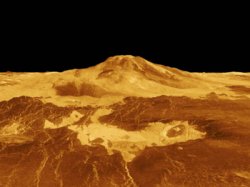
Imagem de Vénus produzida por computador Crédito: NASA
Foi recentemente apresentado o primeiro mapa geológico global de Vénus
Vénus
É o segundo planeta mais próximo do Sol. Em termos de dimensões e massa é muito semelhante à Terra. A sua caracteristica mais marcante é possuir uma atmosfera de CO2 muito densa e um efeito de estufa muito intenso. Elaborado pelo cientista russo M. Ivanov, O estudo das imagens (de radar) disponíveis, bem como das regiões já mapeadas, permitiu o reconhecimento de 11 unidades (ou tipos de terreno) e a conclusão de que essas poucas unidades cobriam toda a superfície do segundo planeta
planeta
Um planeta é um objecto que se forma no disco que circunda uma estrela em formação e cuja massa é superior à de Plutão (1/500 da massa da Terra) e inferior a 10 vezes a massa de Júpiter. Ao contrário das estrelas, os planetas não produzem luz, apenas reflectem a luz da estrela que orbitam.
Sistema Solar
O Sistema Solar é constituído pelo Sol e por todos os objectos que lhe estão gravitacionalmente ligados: planetas e suas luas, asteróides, cometas, material interplanetário.
Dito desta forma, parece que a geologia de Vénus é bastante simples… Mas esta simplicidade é enganadora, e traduz de facto um assombroso mistério: o que se passou em Vénus? Há poucas crateras de impacto
cratera de impacto
As crateras de impacto são depressões circulares resultantes de colisões entre corpos pequenos (por exemplo cometas, asteróides ou meteoritos) e a superfície de corpos celestes maiores, tais como planetas ou satélites naturais. As crateras de impacto possuem geralmente um bordo levantado, formado pelo material ejectado aquando da colisão, o que se explica pela densa atmosfera
atmosfera
1- Camada gasosa que envolva um planeta ou uma estrela. No caso das estrelas, entende-se por atmosfera as suas camadas mais exteriores. 2- A atmosfera (atm) é uma unidade de pressão equivalente a 101 325 Pa., capaz de "derreter" a maior parte dos bólides que nela penetram, e a sua distribuição indica que a actual superfície do planeta é (em termos geológicos e astronómicos) relativamente jovem. Não temos dados que nos indiquem qual seria o aspecto do planeta há mais de 1 milhar de milhões de anos atrás. Até na Terra, com toda a sua dinâmica e constante renovação da superfície, existem, espalhadas pelo planeta, pequenas peças rochosas do puzzle de tempos mais remotos. Terá Vénus sido vítima de um verdadeiro cataclismo vulcânico, com uma explosão de erupções há centenas de milhões de anos atrás, capaz de refazer quase toda a superfície num curto período? O certo é que os vulcões que ainda hoje observamos em Vénus parecem estar adormecidos, quiçá moribundos, gastos… Ainda não se detectou nenhuma erupção a ocorrer no planeta. Que, recordamos, tem aproximadamente as mesmas dimensões que o nosso – mas uma história muito diferente. E definitivamente nada simples.

Apoios:


© NUCLIO - Núcleo Interactivo de Astronomia 2001-2006

.

Lucimary Vargas
Presidente
Observatório Astronômico Monoceros
Além Paraíba-MG-Brasil
observatorio.monoceros@gmail.com
O Dia em Que o Mundo Não Acabou


O mundo não acabou. Ligar o maior e mais poderoso acelerador de partículas do mundo próximo a Genebra, Suiça, não disparou a criação de um buraco negro microscópico. E este buraco negro não começou rapidamente a sugar a matéria ao redor cada vez mais rápido até que devorou por completo a Terra, como jornalistas sensacionalistas sugeriram que poderia acontecer.


É claro que você já sabia disto, afinal você está vivo e lendo este artigo hoje. Atualmente o acelerador, um anel subterrâneo com cerca de 7,5 quilômetros chamado de Grande Colisor de Hádrons (Large Hadron Collider - LHC em inglês), foi desligado para reparos. Mas na hora em que esta máquina poderosíssima for religada, há alguma chance deste cenário do dia do juízo final ainda acontecer?


Relaxe. Como diria Mark Twain, relatos sobre a morte da Terra são sempre exagerados.


"Realmente nunca houve perigo vindo do acelerador, mas isto não impediu que as pessoas especulassem que poderia haver!" disse Robert Johnson, físico do Instituto Santa Cruz de Física das Partículas e membro da equipe científica do Telescópio Espacial de Raios Gama Fermi da NASA, que foi lançado em Junho para estudar raios gama de vários fenômenos, inclusive de possíveis buracos negros evaporando.


Existem vários motivos pelos quais o mundo não acabou em 10 de setembro, e porque o Grande Colisor de Hádrons não é capaz de iniciar esta calamidade.


Em primeiro lugar, sim, é verdade que o LHC pode criar microscópicos buracos negros. Mas, para registro, ele não poderia tê-los criado no seu primeiro dia. Isto porque os cientistas no CERN não puseram em rota de impacto os feixes de prótons para assim criar colisões de alta energia. O dia 10 de setembro foi apenas um pequeno aquecimento. Até agora, o colisor ainda não produziu qualquer colisão, e é a energia extrema destas colisões - até 14 tera-elétron Volts - que potencialmente poderia criar um microscópico buraco negro.


Na realidade, assim que o LHC voltar a funcionar e começar a produzir colisões, os cientistas ficarão emocionados se ele criar um pequeno buraco negro. Isto seria a primeira evidência experimental a suportar uma elegante mas não provada e controversa "teoria do tudo" chamada teoria das cordas.


Na teoria das cordas, elétrons, prótons, quarks, e todas as outras partículas fundamentais são diferentes vibrações de cordas infinitesimais de 10 dimensões: 9 dimensões espaciais e uma dimensão temporal. (As outras 6 dimensões espaciais estão escondidas por uma explicação ou outra, por exemplo por ser "embrulhada" em uma escala extremamente pequena.) Alguns cientistas exaltam a elegância matemática da teoria das cordas e sua habilidade em integrar a gravidade com outras forças da natureza. O geralmente aceito Modelo Padrão da física das partículas não inclui a gravidade, que é uma das razões dele não predizer que o LHC poderia criar um ponto gravitacionalmente colapsado - um buraco negro - enquanto a teoria das cordas o prediz.


Muitos cientistas começaram a ter dúvida se a teoria das cordas é verdadeira. Mas assumindo por um instante que ela seja, o que aconteceria quando um buraco negro nascesse dentro do LHC? A supreendente resposta é "quase nada." Mesmo que o buraco negro sobrevivesse por mais que uma fração de segundo (o que provavelmente não aconteceria), muito provavelmente ele seria arremessado no espaço. "Ele teria somente a massa de uma centena ou mais de prótons, e estaria se movendo próximo à velocidade do som, assim facilmente ele teria facilmente a velocidade de escape," explica Johnson. Já que o minúsculo buraco negro seria menor que um milionésimo do tamanho de um próton e teria um empuxo gravitacional extremamente fraco, ele poderia facilmente atravessar a rocha sólida sem sequer tocá-la - ou absorver - qualquer matéria. Do ponto de vista de algo tão minúsculo, os átomos que formam a rocha "sólida" parecem ser quase como um espaço inteiramente vazio: o enorme espaço entre o núcleo do átomo e seus elétrons. Assim, um micro buraco negro poderia mergulhar em direção ao centro da Terra e sair do outro lado sem causar nenhum dano. De qualquer maneira, ele acabaria no quase vácuo do espaço, onde a chance de tocar ou absorver qualquer matéria para se tornar uma ameaça crescente seria menor ainda.


Assim, a primeira coisa que um micro buraco negro faria era deixar para trás o planeta de forma segura. Mas existem outras razões ainda mais fortes pelas quais os cientistas acreditam que o LHC não ameaça de forma alguma a Terra. Uma delas é que um buraco negro criado no LHC quase que certamente evaporaria antes que fosse muito longe, acreditam quase todos os cientistas. Stephen Hawking, o físico que escreveu a Uma Breve História do Tempo, previu que buracos negros irradiam energia, um fenômeno conhecido como radiação de Hawking. Devido a sua perda de energia constante, o buraco negro finalmente evaporaria. Quanto menor for o buraco negro, mais intensa será a radiação Hawking, e mais rápido o buraco negro desaparecerá. Desta forma, um buraco negro milhares de vezes menor que um próton deveria desaparecer quase instantaneamente em uma rápida descarga de energia.


"A previsão de Hawking não é baseada na especulativa teoria das cordas mas sim em princípios bem conhecidos da mecânica quântica e da física das partículas," observa Johnson.


Apesar de sua forte fundamentação teórica, a radiação de Hawking nunca foi observada diretamente. Ainda assim, os cientistas estão confiantes que qualquer buraco negro criado pelo LHC não representa qualquer ameaça. Como eles podem estar tão certos? Istro deve-se aos raios cósmicos. Milhares de vezes por dia, raios cósmicos de alta energia atingem a atmosfera da Terra, colidindo com moléculas no ar com 20 vezes mais energia que a mais poderosa colisão que poderá ser criada pelo LHC. Assim, se este acelerador pudesse criar buracos negros devoradores da Terra, os raios cósmicos já o teriam feito bilhões de vezes ao longo da história da Terra.


Então, já que estamos aqui. Que comecem as colisões!!!


.


Lucimary Vargas
Presidente
Observatório Astronômico Monoceros
Além Paraíba-MG-Brasil
observatorio.monoceros@gmail.com

LinkWithin

Related Posts Plugin for WordPress, Blogger...