 News release: 2012-179 June 17, 2012 PASADENA, Calif. -- A new university-led study with NASA participation finds ancient Antarctica was much warmer and wetter than previously suspected. The climate was suitable to support substantial vegetation -- including stunted trees -- along the edges of the frozen continent. The team of scientists involved in the study, published online June 17 in Nature Geoscience, was led by Sarah J. Feakins of the University of Southern California in Los Angeles, and included researchers from NASA's Jet Propulsion Laboratory in Pasadena, Calif., and Louisiana State University in Baton Rouge. By examining plant leaf wax remnants in sediment core samples taken from beneath the Ross Ice Shelf, the research team found summer temperatures along the Antarctic coast 15 to 20 million years ago were 20 degrees Fahrenheit (11 degrees Celsius) warmer than today, with temperatures reaching as high as 45 degrees Fahrenheit (7 degrees Celsius). Precipitation levels also were found to be several times higher than today. "The ultimate goal of the study was to better understand what the future of climate change may look like," said Feakins, an assistant professor of Earth sciences at the USC Dornsife College of Letters, Arts and Sciences. "Just as history has a lot to teach us about the future, so does past climate. This record shows us how much warmer and wetter it can get around the Antarctic ice sheet as the climate system heats up. This is some of the first evidence of just how much warmer it was." Scientists began to suspect that high-latitude temperatures during the middle Miocene epoch were warmer than previously believed when co-author Sophie Warny, assistant professor at LSU, discovered large quantities of pollen and algae in sediment cores taken around Antarctica. Fossils of plant life in Antarctica are difficult to come by because the movement of the massive ice sheets covering the landmass grinds and scrapes away the evidence. "Marine sediment cores are ideal to look for clues of past vegetation, as the fossils deposited are protected from ice sheet advances, but these are technically very difficult to acquire in the Antarctic and require international collaboration," said Warny. Tipped off by the tiny pollen samples, Feakins opted to look at the remnants of leaf wax taken from sediment cores for clues. Leaf wax acts as a record of climate change by documenting the hydrogen isotope ratios of the water the plant took up while it was alive. "Ice cores can only go back about one million years," Feakins said. "Sediment cores allow us to go into 'deep time.'" Based upon a model originally developed to analyze hydrogen isotope ratios in atmospheric water vapor data from NASA's Aura spacecraft, co-author and JPL scientist Jung-Eun Lee created experiments to find out just how much warmer and wetter climate may have been. "When the planet heats up, the biggest changes are seen toward the poles," Lee said. "The southward movement of rain bands associated with a warmer climate in the high-latitude southern hemisphere made the margins of Antarctica less like a polar desert, and more like present-day Iceland." The peak of this Antarctic greening occurred during the middle Miocene period, between 16.4 and 15.7 million years ago. This was well after the age of the dinosaurs, which became extinct 64 million years ago. During the Miocene epoch, mostly modern-looking animals roamed Earth, such as three-toed horses, deer, camel and various species of apes. Modern humans did not appear until 200,000 years ago. Warm conditions during the middle Miocene are thought to be associated with carbon dioxide levels of around 400 to 600 parts per million (ppm). In 2012, carbon dioxide levels have climbed to 393 ppm, the highest they've been in the past several million years. At the current rate of increase, atmospheric carbon dioxide levels are on track to reach middle Miocene levels by the end of this century. High carbon dioxide levels during the middle Miocene epoch have been documented in other studies through multiple lines of evidence, including the number of microscopic pores on the surface of plant leaves and geochemical evidence from soils and marine organisms. While none of these 'proxies' is as reliable as the bubbles of gas trapped in ice cores, they are the best evidence available this far back in time. While scientists do not yet know precisely why carbon dioxide was at these levels during the middle Miocene, high carbon dioxide, together with the global warmth documented from many parts of the world and now also from the Antarctic region, appear to coincide during this period in Earth's history. This research was funded by the U.S. National Science Foundation with additional support from NASA. The California Institute of Technology in Pasadena manages JPL for NASA. For more information about NASA programs and projects, visit: http://www.nasa.gov/ . Alan Buis 818-354-0474Jet Propulsion Laboratory, Pasadena, Calif. alan.d.buis@jpl.nasa.gov J. D. Harrington 202-358-5241 NASA Headquarters, Washington j.d.harrington@nasa.gov Robert Perkins 213-740-9226 University of Southern California, Los Angeles perkinsr@usc.edu Zac Lemoine 225-578-1399 Louisiana State University, Baton Rouge jlemo26@lsu.edu - end - |

Mostrando postagens com marcador Geologia. Mostrar todas as postagens
Mostrando postagens com marcador Geologia. Mostrar todas as postagens
sábado, 23 de junho de 2012
Study Finds Ancient Warming Greened Antarctica


sábado, 21 de agosto de 2010
Cratera com 45 metros descoberta no Egito anima ciência no país

Próxima à fronteira com o Sudão, 'Kamil' tem 16 metros de profundidade. Equipe de italianos detectou impacto no solo pela 1ª vez há dois anos.
Agencia EFE
Com a recente descoberta no Egito de uma das crateras de impacto mais bem conservadas do mundo, formada por um meteorito milhares de anos atrás, os cientistas encaram o futuro da ciência egípcia com entusiasmo.

A cavidade de 45 metros de diâmetro e 16 metros de profundidade, batizada de Kamil, se encontra a sudoeste do deserto egípcio, perto da fronteira com o Sudão, em uma zona característica por sua inóspita superfície.
"Não há nada lá, nem vento, o que permitiu que a cratera se mantivesse tão bem conservada. Esse nível de preservação só pode ser encontrado na lua", disse à Agência Efe o diretor do Instituto Nacional de Pesquisa em Astronomia e Geofísica (NRIAG), Salah Mahmoud, cuja instituição está envolvida na pesquisa.

A cratera foi observada pela primeira vez por uma equipe de italianos em uma missão do Google Earth, há dois anos.
Não há nada lá, nem vento, o que permitiu que a cratera se mantivesse tão bem conservada. Esse nível de preservação só pode ser encontrado na Lua"Salah Mahmoud, diretor do Instituto Nacional de Pesquisa em Astronomia e Geofísica (NRIAG)Diante da promissora descoberta, foi formada uma equipe de cientistas italianos e egípcios, liderada pelo especialista Luigi Folco, do Museu Nacional da Antártida de Siena, na Itália, para analisar a zona e decifrar a origem da cratera.
Além de sua excepcional localização, seu bom estado de conservação se deve ao fato de o meteorito que originou a cratera não ter se fragmentado ao entrar em contato com a atmosfera terrestre, segundo as conclusões de um estudo dos cientistas, publicadas em julho passado na revista "Science".
O coautor do artigo da "Science" e geofísico do NRIAG Ahmed Lethy disse à Efe que, graças "à excepcional estrutura da cratera e seu tamanho, assim como a distribuição dos restos", os pesquisadores poderão calcular o risco e os danos que podem ser causados por um novo meteorito no futuro.
O cientista ressaltou que esta é a segunda descoberta do tipo no Egito, depois do maior campo de crateras do mundo ter sido encontrado na região de Gilf al-Kabir, em 2004, no sudoeste do país, "cuja origem não foi confirmada", por não existirem mostras.
No entanto, a cratera Kamil foi produzida por um meteoro do qual restou 1,7 tonelada de fragmentos, incluindo o pedaço maior que existe no Egito, de 85 quilogramas.
Com isto, segundo Lethy, é possível "estudar a atividade do universo de milhões de anos analisando o desenvolvimento de seus elementos internos".
Os cientistas egípcios começam a considerar o que décadas antes podia parecer impossível no Egito, um país no qual a ciência não foi uma prioridade durante muitos anos.
Um artigo publicado em 2006 pela Organização das Nações Unidas para a Educação, a Ciência e a Cultura (Unesco) e a Universidade de South Valley, no Cairo, descreveu a decadente situação da ciência no Egito.
"A despesa em pesquisa no Egito é muito baixa. Os pesquisadores egípcios estão entre os mais mal pagos nos países árabes. A pesquisa em ciências sofre uma decadente produção de tecnologia, o que faz com que a de alta qualidade seja tão complicada", explicava o documento.
Mahmoud se queixou que a redução de apoios e de interesse em projetos deste tipo de pesquisas é um problema comum no Egito, como em todos os países em desenvolvimento.
"Não é fácil, precisamos ter uma indústria completa. No final, é melhor importar para preservar o dinheiro com que contamos".
Mesmo assim, "sonhamos em poder produzir esse tipo de alta tecnologia para seu uso em diferentes campos", afirmou o geofísico.
O achado da cratera Kamil, com a bem-sucedida participação egípcia, é motivo de orgulho para os cientistas e dá uma projeção positiva a seu trabalho no mundo.
Para Lethy, "este tipo de publicações de alta qualidade encorajam o Governo a destinar mais dinheiro à pesquisa, porque veem nela resultados de interesse mundial".
"É uma mostra de que nosso nível de ciência está à altura do dos italianos", concluiu Mahmoud.
Com informações de Aleida Rueda, da EFE.
imagens arquivo virtual
quarta-feira, 11 de agosto de 2010
Supercontinente sofreu rotação na superfície terrestre, dizem geólogos
Movimento em 'Gondwana' teria ocorrido há 525 milhões de anos. Ângulo descrito durante o fenômeno teria sido de 60 graus.
Geólogos da Universidade Yale, nos Estados Unidos, afirmam que o supercontinente Gondwana, integrante da parte sul da Pangea, sofreu uma rotação de 60 graus na superfície terrestre durante o começo do período Cambriano, há 525 milhões de anos.
A Pangea representou o único continente da Terra no passado. Com o passar dos anos, a configuração atual das superfícies sólidas do planeta foram, pouco a pouco, tomando o formato atual.
Segundo o estudo, a posição do Brasil teria sido alterada bruscamente, saindo de perto da região onde hoje se encontram os pólos geográficos do planeta em direção à região tropical. Movimentos como esse tiveram influência nos níveis dos oceanos e nas concentrações de carbono.
A descoberta é tema da edição de agosto da revista Geology. O time de pesquisadores estudou o registro paleomagnético da Bacia de Amadeus, na Austrália, pertencente a Gondwana no passado. Com base nadireção da magnetização de rochas antigas, foi possível estimar a rotação sofrida por Gondwana durante o Cambriano.
Agumas regiões apresentaram taxas de variação de, pelo menos, 16 cm por ano. Atualmente, as mudanças mais rápidas se dão a uma velocidade de 4 cm em doze meses.
Para os geólogos, o fenômeno pode ser tanto fruto do movimento de placas tectônicas quanto uma alteração nos pólos geográficos da Terra, fruto do deslocamento da parte sólida do planeta, abaixo dos oceanos.
Esse "vagar" dos pólos não deve ser confundido com a precessão ou a nutação, ambos movimentos do planeta nos quais o eixo de rotação é alterado, de forma imperceptível no cotidiano.
quinta-feira, 31 de janeiro de 2008
Are We Living in a New Geologic Epoch?
Written by Nancy Atkinson
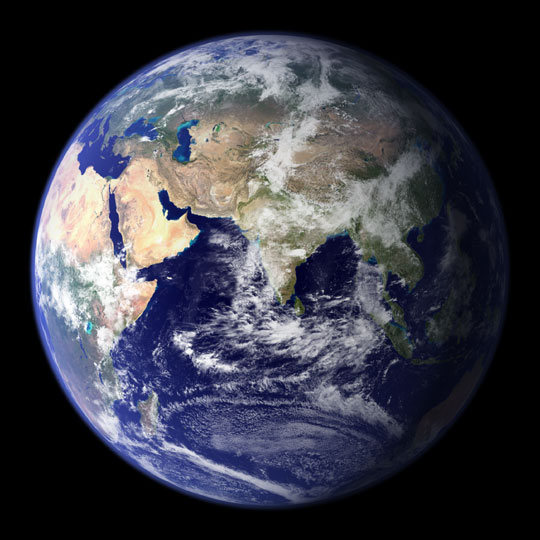
Have humans changed our planet Earth so much in the past 200 years that we are now living in a new geological age? A group of geologists believes this is the case. They have formally proposed designating a new geologic epoch, the Anthropocene, which would encompass the past 200 years or so of geologic history. The action is appropriate, they say, because during the past 2 centuries, human activity has caused most of the major changes in Earth's topography and climate.
Like rings in a tree, each layer in Earth's geologic record reflects the conditions of the time it was deposited and offers a glimpse into Earth's past. In this geologic history that is written in the rocks and soil of our planet, researchers have differentiated the layers into classifications of time called eons, eras, periods, epochs, and ages that reflect characteristic conditions. For example, the Carboniferous period, which lasted from 360 million to 300 million years ago, is known for the vast deposits of coal that formed from jungles and swamps. Even some of the longer stretches have been named based on biology, such as the Paleozoic ("old life") and the Cenozoic ("recent life").
Earth has been has always been subject to the same kinds of physical forces–wind, waves, sunlight–throughout the planet's existence. But the life that has arisen on the planet has had a much more varied impact such as the rise of plants that has shaped the planet in dramatic ways. But in the past 200 years, ever since the human population has reached 1 billion, our influences have affected the composition of Earth's strata, altering the physical and chemical nature of ocean sediments, ice cores and surface deposits. Some of these influences are the use of fossil fuels and the growth of large cities.
British Geologist Jan Zalasiewicz and several colleagues argue that the International Commission on Stratigraphy should officially mark the end of the current epoch. That would be the Holocene ("entirely recent"), which started after the end of the last ice age, about 10,000 years ago. The new epoch would be the Anthropocene.
The argument has merit, says American geologist Richard Alley. "In land, water, air, ice, and ecosystems, the human impact is clear, large, and growing," he says. "A geologist from the far distant future almost surely would draw a new line, and begin using a new name, where and when our impacts show up."
Original News Source: AAAS ScienceNow
Filed under: Earth
Fonte: Original desta notícia pode ser acessada através do site: http://www.gea.org.br/mss.html
Céu claro para todos!
José Geraldo Mattos - Moderador
"A desarmonia do universo é a mais perfeita criação; não foi e jamais será imitada pelo gênio humano" - (Prof. A. Seixas Neto) 
Assinar:
Postagens (Atom)
LinkWithin
