terça-feira, 5 de fevereiro de 2008

2009 - Ano Internacional da Astronomia


O ano de 2007 termina em grande, as Nações Unidas proclamaram 2009 como o Ano Internacional da Astronomia. A proposta foi feita pela Itália, país de Galileo e o grande homenageado em 2009. Trata-se de uma celebração dos 400 anos das primeiras observações astronómicas feitas por Galileo Galilei, que mudaram a nossa forma de perceber o Universo.

Portugal desde já aparece em grande destaque. O coordenador internacional do projecto é um astrofísico Português, Pedro Russo. Já estão garantidas a presença de cerca de 100 países nas celebrações durante 2009. A organização conta ainda com a participação de 14 nós organizacionais, como por exemplo NASA
, ESO
European Southern Observatory (ESO)
O Observatório Europeu do Sul é uma organização europeia de Astronomia para o estudo do céu austral fundada em 1962. Conta actualmente com a participação de 10 países europeus e ainda do Chile. Portugal tornou-se membro do ESO em 1 de Janeiro de 2001, no seguimento de um acordo de cooperação que durou cerca de 10 anos.
, ESA
European Space Agency (ESA)
A Agência Espacial Europeia foi fundada em 1975 e actualmente conta com 15 países membros, incluindo Portugal.
e o Global HOU, projecto em que o NUCLIO participa e cuja associação formal será criada em 2008 e cuja sede será em Portugal.

São 11 os cornerstones do projecto, em vários existem representantes portugueses: Cosmic Diary (Mariana Barrosa ) , From Earth to the Universe (António Pedrosa), Developing Astronomy Globally (Filipe Pires) e o Galileo Teacher Training Program (Rosa Doran).

A comissão nacional já tem um plano de actividades que pode ser consultado na página portuguesa para o AIA2009 (www.astronomia2009.org). O comissário nacional para este projecto é o Prof. João Fernandes da Universidade de Coimbra. O plano tem estado há vários meses aberto à discussão e foi já apresentado em vários encontros. Já foram promovidas sessões públicas e estão a ser feitas reuniões com várias organizações. A comissão está empenhada em fazer de 2009 um ano inesquecível.

A presidente do Conselho Executivo do NUCLIO, Rosa Doran, faz parte da comissão nacional. O NUCLIO participará activamente nesta celebração e estará também envolvido nas actividades do Global HOU como parceiro português deste projecto internacional que durante 2009 promoverá um programa para escolas, "Hoje sou Galileo ...
Amanhã sou Darwin", que pretende promover a colaboração entre escolas do mundo todo.

Mais informações sobre a declaração das Nações Unidas podem ser encontradas em:
(http://www.astronomia2009.org/images/stories/aia09/downloads/aia2009_onu_declaracao.pdf).

IAU
International Astronomical Union (IAU)
A União Astronómica Internacional foi fundada em 1919, tendo por missão promover, coordenar e salvaguardar a Ciência da Astronomia, em todos os aspectos, através de colaboração internacional. Conta com mais de 8 300 membros individuais, e ainda com 66 países membros. É a entidade internacionalmente reconhecida como autoridade para a atribuição de designações de objectos celestes e de quaisquer características à sua superfície, como por exemplo crateras e vulcões.
Press Release: http://www.iau.org/iau0702.486.0.html

IYA2009 Press Release: http://www.astronomy2009.org/content/view/344/116/


Esperamos que 2009 seja o ano em que muitos possam redescobrir o Universo, perceber que muito ainda há por descortinar, que o nosso Planeta é apenas um pontinho pequeno neste maravilhoso Universo. Que muitos descubram o gostinho de observar os céus e reconheçam a importância da ciência nas nossas vidas.
 

Apoios:


© NUCLIO - Núcleo Interactivo de Astronomia 2001-2006

Dia em megaburaco negro tem duração igual à do terrestre

23/01/2008 - 08h35
EDUARDO GERAQUE
da Folha de S.Paulo
Na hora de bater uma vitamina em um liqüidificador, a velocidade de rotação do motor do eletrodoméstico é fundamental para o sucesso da empreitada. No espaço, nos buracos negros carregados de massa, a situação é mais ou menos a mesma --o problema é que lá não existe um painel de velocidade disponível para ser usado.
Rodrigo Nemmen, pesquisador da UFRGS (Universidade Federal do Rio Grande do Sul), resolveu contribuir para o manual de instruções desses grandes liqüidificadores espaciais, que chegam a ter 1 bilhão de quilômetros de raio (quase a distância de Saturno ao Sol).
Segundo cálculos feitos por ele, mesmo com todo esse tamanho os buracos negros gigantes completam uma volta ao redor de seu eixo a cada 24 horas. Ou seja, seu "dia" tem a mesma duração do dia terrestre.
A inferência é um desdobramento da conclusão principal obtida pelo pesquisador e apresentada no início do mês na reunião anual da Sociedade Astronômica Americana. Os nove núcleos de galáxia (que contêm megaburacos negros) observados pelo telescópio de raios X Chandra estão girando em velocidades próximas à da luz.
"Essa é mais uma evidência de que os buracos negros com grande quantidade de massa giram rápido. Não existe consenso sobre isso na literatura", diz Nemmen, de 26 anos.
De acordo com o cientista, outros estudos já haviam demonstrado a rápida velocidade de rotação de alguns buracos negros, "mas para objetos bem menores", segundo o autor.
"Conseguimos criar uma nova maneira de estimar a rotação, mas é claro que ela não tem 100% de certeza", disse.
A alta velocidade de giro de um buraco negro com uma grande massa, na prática, resulta numa curvatura diferente do espaço ao redor, como havia previsto a teoria da relatividade geral, de Albert Einstein.
E a atração gravitacional alterada pela velocidade próxima à da luz acaba arrastando tudo, fenômeno que faz com que a matéria ao redor do buraco negro não consiga escapar dele.
"Você não consegue fugir do liqüidificador. Isso ocorre apenas em algumas situações, representada pela emissão de jatos de gás próximo à superfície do buraco negro", explica o pesquisador da UFRGS. Mas entender como isso ocorre é um outro tópico do manual de instruções -que ainda será escrito no futuro pelos cientistas.
Outro pesquisador que contribui com seu trabalho para o guia dos buracos negros, Reuven Opher, da USP, achou interessantes os resultados obtidos pelo grupo gaúcho. "É mais uma evidência razoável, baseada em observações do Chandra e em modelos teóricos, de que os buracos negros estão girando muito rápido", afirmou.
A velocidade de rotação dos buracos negros e a quantidade de massa dentro deles são dois dados essenciais para saber a identidade desses objetos.
O cobiçado manual de instruções dos buracos negros não será útil apenas para o avanço do conhecimento teórico.
"É claro que é incrível que a humanidade confinada neste planetinha no cantinho da Via Láctea consiga avançar no conhecimento dos fenômenos mais extremos do Universo, mas não é apenas isso", diz o pesquisador gaúcho.
Como os buracos negros estão ligados com as galáxias que eles habitam, saber a biografia deles é praticamente ter acesso à vida das galáxias. E também saber quando o liqüidificador foi ligado, diz Nemmen.

 
Posted by:
Lucimary Vargas
Além Paraíba-MG-Brasil
observatorio.monoceros@gmail.com

Make Room at the Moon

Written by Nancy Atkinson
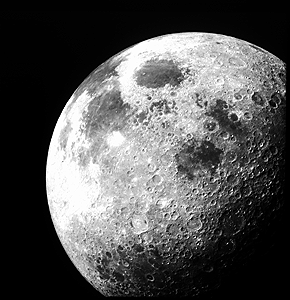
Our moon.  Image credit:  NASA, Apollo 12
Lunar orbit is getting to be a busy place, with several different countries sending spacecraft to the moon. Currently orbiting the moon are Japan's Kaguya (also known as SELENE) spacecraft, which has been sending back 3-D movies of the lunar surface, and China's Chang'e 1, which will gather information on the moon's chemical composition with its various cameras, spectrometers and other scientific equipment. In addition, two new missions to the moon will launch this year: India's Chandrayaan-1 and NASA's Lunar Reconnaissance Orbiter.

Chandrayaan, which means "journey to the moon" in Hindi, will study the moon at many wavelengths, from X-ray, visible and near-infrared to microwave. It will orbit the moon at just 100 km above the surface. The mission is scheduled to launch on April 9.
"The low orbit will give us really high resolution data," says Detlef Koschny, Chandrayaan project scientist. The principal mission objective is to map the moon's surface in unprecedented detail. Current lunar maps show detail from 30 – 100 meters across. Chandrayaan will produce maps with a resolution of between 5 and 10 meters across the whole surface of the moon.
The European Space Agency (ESA) is collaborating with Indian Space Research Organization (ISRO) for the Chandrayaan-1 mission. A Compact Imaging X-ray Spectrometer will produce x-ray spectroscopic mapping of the moon, and the Infrared Spectrometer will observe the moon's chemical composition. Another ESA instrument is the Sub-keV Atom Reflecting Analyzer, which will study the interaction between electrically charged particles from the solar wind and moon's surface.
Eight other instruments complete the suite of science instruments, including a 29-kg landing probe which will be dropped onto the Moon's surface at the beginning of the mission to conduct investigations.
Meanwhile, the Lunar Reconnaissance Orbiter (LRO) is currently undergoing testing at Goddard Spaceflight Center to get ready for its launch on October 28 of this year. LRO will spend at least a year mapping the surface of the moon. Data from the orbiter will help NASA select safe landing sites for astronauts, identify lunar resources and study how the moon's environment will affect humans.
Engineers at Goddard are building the orbiter and testing spacecraft components to ready them for the harsh environment of space. After a component or entire subsystem is qualified, it is integrated into the LRO spacecraft. The core suite of avionics for the orbiter is assembled and undergoing system tests.
"This is a major milestone for the mission," said Craig Tooley, LRO project manager at Goddard. "Our team has been working nearly around the clock to get us to this point. Reaching this milestone keeps us
on the path to sending LRO to the moon later this year."
Once fully integrated, the spacecraft will ship to NASA's Kennedy Space Center, Florida in August in preparation for launch. The orbiter and the Lunar Crater Observation and Sensing Satellite (LCROSS) will launch aboard an Atlas V rocket. LCROSS will study the poles of the moon to confirm the presence or absence of water ice in a permanently shadowed craters. The trip to the moon for the spacecraft will take approximately four days. The Lunar Reconnaissance Orbiter initially will enter an elliptical orbit, also called the commissioning orbit. Once moved into its final orbit, a circular polar orbit approximately 31 miles above the moon, the spacecraft's instruments will map the lunar surface.
Original News Sources: Chandrayaan Press Release, LRO press release


Posted by:
Lucimary Vargas
Além Paraíba-MG-Brasil
observatorio.monoceros@gmail.com

Using Gravity to Find Planets in the Habitable Zone


Written by Fraser Cain
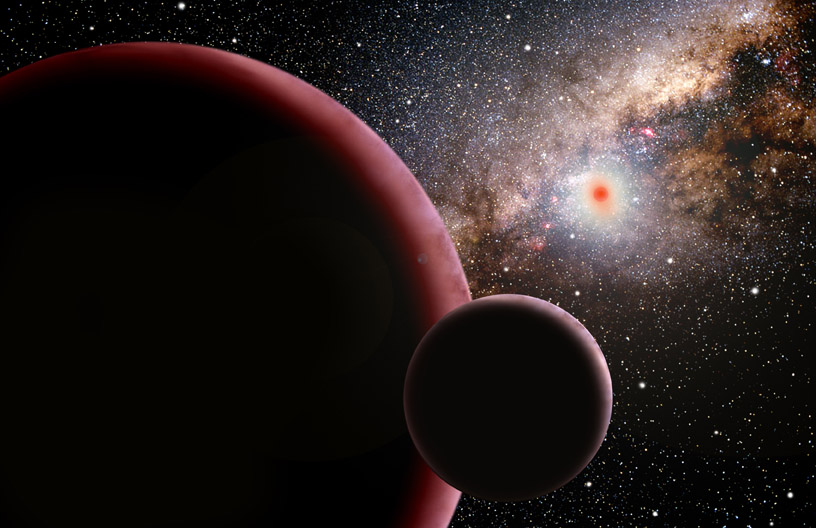
Artist

Astronomers have several techniques to discover planets. But one of the least used so far, gravitational microlensing, might be just the right technique to find planets in the habitable zone of nearby dwarf stars.

The first way astronomers find planets is with the radial velocity technique. This is where the gravity of a heavy planet yanks its parent star around so that the wobbling motion too and fro can be measured.
The second technique is through transits. This is where a planet dims the light coming from its parent star as it passes in front. By subtracting the light from when the planet isn't in front of the star, astronomers can even measure its atmosphere.
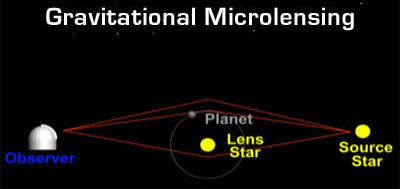
The third way is through gravitational microlensing. When two stars are perfectly lined up, the closer star acts as a natural lens, brightening the light from the more distant star. Here on Earth, we see a star brighten in a very characteristic way, and then dim down again. A blip in the change of brightness can be attributed to a planet.

Geometry of a lensing event.
Unlike the other two methods, microlensing allows you to reach out and see planets at tremendous distances - even clear across the galaxy. The problem with microlensing is that it's a one-time opportunity. You're never going to see those stars line up in just the same way again.
But Rosanne Di Stefano and Christopher Night from the Harvard-Smithsonian Center for Astrophysics in Cambridge, MA think there's another way microlensing could be used. In their research paper entitled, Discovery and Study ofNearby Habitable Planets with Mesolensing, the researchers propose that many stars have a high probability of becoming a lens.
Instead of watching the sky, hoping to see a lensing event, you watch specific stars and wait for them to pass in front of a more distant star.
These high-probablility lenses are known as mesolenses. By studying a large number of dwarf stars, they expect that many of them should pass in front of a more distant star as often as once a year. And if pick your targets carefully, like dwarf stars moving in front of the Magellanic Clouds, you might get even more opportunities.
Unlike other methods of planet detection, gravitational lensing relies on light from a more distant star. It is therefore important to ask what fraction of nearby dwarfs will pass in front of bright sources and so can be studied with lensing. Within 50 pc, there are approximately 2 dwarf stars, primarily M dwarfs, per square degree.
For less massive red dwarf stars, you should be able to see them at a distance of 30 light years, and for Sun-mass stars out to a distance of 3,000 light years. These stars are close enough that if a planet is detected in the habitable zone, followup techniques should be possible to confirm the discovery.
They calculated that there are approximately 200 dwarf stars passing in front of the Magellanic Clouds right now. And many of these will have lensing events with the stars in the dwarf galaxies.
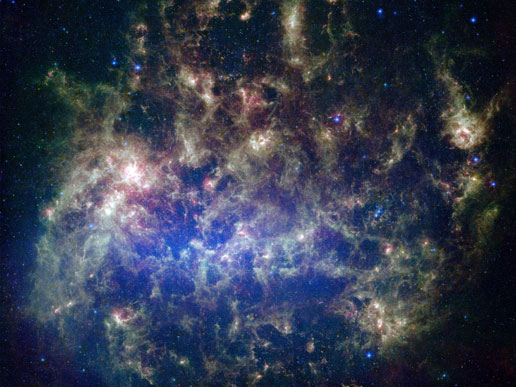
Large Magellanic Cloud. Image credit: NASA
Instead of monitoring specific stars, previous surveys have just watched tens of millions of stars per night - hoping for any kind of lensing event. Even though 3,500 microlensing candidates have been discovered so far, they tend to be with stars at extreme ranges. Even if there were planets there, they wouldn't show up in the observations.
But if you pick your stars carefully, and then watch them for lensing events, the researchers believe you should see that brightening on a regular basis. You could even see the same star brighten several times, and make follow-up observations on its planets.
And there's another advantage. Both the radial velocity and transit methods rely on the planet and star being perfectly lined up from our vantage point. But a microlensing event still works, even if the planetary system is seen face on.
By using this technique, the researchers think that astronomers should turn up lensing events on a regular basis. Some of these stars will have planets, and some of these planets will be in their star's habitable zone.
Original Source: Arxiv

Posted by:
Lucimary Vargas
Além Paraíba-MG-Brasil
observatorio.monoceros@gmail.com

Finding Dark Energy in a Supercomputer

Written by Fraser Cain
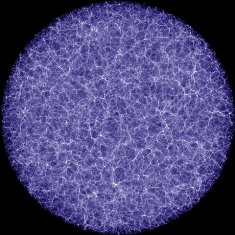
Map of dark energy ripples. Image credit: Durham University
Dark energy is probably the most influential force in the cosmos, overwhelming the pull of dark matter, and absolutely dominating the meager impact of regular matter. And scientists have absolutely no idea what it is. But a new supercomputer simulation by cosmologists at Durham University might give astronomers a few places to look; to know how to measure this mysterious force.

When dark energy was discovered in 1998, it came as a complete surprise. By measuring the distance to supernovae, astronomers were hoping to calculate the rate at which the Universe's expansion is slowing down. Instead of slowing down, though, they found that the expansion of the Universe is actually accelerating. Instead of coming together in a big crunch, it looks like dark energy will spread the Universe out faster and faster.
Physicists now believe that dark energy makes up 70% of the Universe, with the remaining amount made of mostly dark matter, and a sprinkling of regular matter. Since that discovery, astronomers haven't been able to find the source of this dark energy.
So a new simulation, run on Durham University's Cosmology Machine supercomputer could help astronomers in their search. The simulation looked at the tiny ripples in the distribution of matter in the Universe made by sound waves a few hundred thousand years after the Big Bang. These ripples have long since been destroyed by the 13.7 billion years of the lifetime of the Universe, but the simulations show they might have survived in some conditions.
By changing the nature of dark energy, the researchers found that the ripples changed in length. In other words, if astronomers can find the ripples in the real Universe, this can help constrain the parameters for dark energy.
Durham University Professor Carlos Frenk said, "the ripples are a gold standard. By comparing the size of the measured ripples to the gold standard we can work out how the Universe has expanded and from this figure out the properties of the dark energy."
An upcoming ESA mission called the SPectroscopic All-sky Cosmic Explorer (SPACE) should have the capabilities to detect these ripples, and so help put some constraints on the nature of dark energy.
If all goes well, SPACE will launch in 2017.
Original Source: Durham University News Release
 
 
Posted by:
Lucimary Vargas
Além Paraíba-MG-Brasil
observatorio.monoceros@gmail.com

A Winged MESSENGER Flies By Mercury

Written by Nancy Atkinson
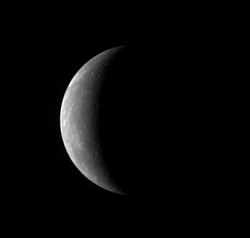
MESSENGER Image of Mercury.  Image Credit : NASA / JHUAPL / CIW

On January 14 the MESSENGER spacecraft skimmed just 200 kilometers (124 miles) above the surface of Mercury in the first of three flybys of the planet. Today (Jan. 15) the spacecraft will turn back towards the Earth to start down-linking the on-board stored science data it acquired during the flyby. The probe's equipment gathered data on the mineral and chemical composition of Mercury's surface, its magnetic field, its surface topography and its interactions with the solar wind. "This was fantastic," said Michael Paul, a mission engineer. "We were closer to the surface of Mercury than the International Space Station is to the Earth."

The closest approach was on the planet's night side, the side facing away from the sun, and the spacecraft flew in the region along the equator. The scientific results will be available for the public at the end of January.
"The engineers and operators …pulled off a tremendous feat, acquiring and locking onto the downlink signal from the spacecraft within seconds, providing the necessary Doppler measurements for the Radio Science team" said MESSENGER Mission Systems Engineer Eric Finnegan, of the Applied Physics Lab in Laurel, Maryland. "The spacecraft is continuing to collect imagery and other scientific measurements from the planet as we now depart Mercury from the illuminated side, documenting for the first time the previously unseen surface of the planet." The signal from the spacecraft is tracked by the Deep Space Network, an international network of antennas that supports space missions.
In addition to Monday's rendezvous, MESSENGER is scheduled to pass Mercury again this October and in September 2009, using the pull of the planet's gravity to guide it into position to begin a planned yearlong orbit of the planet in March 2011. By the time the mission is completed, scientists also hope to get answers on why Mercury is so dense, as well as determine its geological history and the structure of its iron-rich core and other issues.
MESSENGER stands for Mercury Surface, Space Environment, Geochemistry and Ranging. Launched in 2004, it already has flown past Venus twice and Earth once on its way to Mercury.
Only one spacecraft has previously visited Mercury. Mariner 10 flew past the planet three times in 1974 and 1975, and mapped about 45 percent of its surface.
With Pluto now considered a dwarf planet, Mercury is the solar system's smallest planet, with a diameter of 3,032 miles, about a third that of Earth.
A surface feature of great interest to scientists is the Caloris basin, an impact crater about 800 miles in diameter, one of the biggest such craters in our solar system. It likely was caused when an asteroid hit Mercury long ago. Scientists hope to learn about the subsurface of the planet from studying this crater.
True to its name, temperatures on the closest plant to the sun are quite "mercurial," as Mercury experiences the largest swing in surface temperatures in our solar system. When its surface faces the sun, temperatures hit about 800 degrees Fahrenheit (425 Celsius), but when its faces away from the sun they can plummet to minus-300 Fahrenheit (minus-185 Celsius).
Original News Source: Reuters
 
Posted by:
Lucimary Vargas
Além Paraíba-MG-Brasil
observatorio.monoceros@gmail.com

Opening up the infrared sky


UKIDSS makes its first release of infrared telescope images.
Provided by the Joint Astronomy Centre
This image shows a globular cluster in the constellation Aquila, about 9,000 light-years from Earth, observed as part of the UKIDSS DR1 release. UKIRT [View Larger Image]
January 9, 2008
The infrared sky is expanding significantly for the world community with the first world release of data (DR1) from the UKIRT Infrared Deep Sky Survey (UKIDSS).

UKIDSS DR1 has mapped a larger volume of the sky than any previous infrared survey. As the UKIDSS project progresses, it will gradually become the dominant source of information about the infrared sky, expanding its volume by a factor of 15 beyond DR1.

For the past 2 years, the United Kingdom Infrared Telescope (UKIRT) in Hawaii has been systematically scanning the heavens for five different "colors" of faint infrared light. This allows astronomers to penetrate dark clouds where stars are currently forming, and to locate stars much less massive and cooler than the Sun. Furthermore, our own galaxy (the Milky Way) is transparent to the infrared, making it possible to see all the way to its center and beyond. And finally, the expansion of the universe stretches visible light from the most distant (and youngest) galaxies and quasars into the infrared part of the spectrum. By observing this infrared light we can trace the evolution of galaxies from their youngest members. The first world release of these data makes all this information available to researchers everywhere.

Andy Lawrence from the University of Edinburgh, the UKIDSS principal investigator, says, "We are moving into new territory. This survey probes huge volumes of space, so that we can locate rare but important objects like the very coolest and least luminous stars and the most distant galaxies. Astronomers in Europe have started getting the science out, but this world release should really unleash the scientific potential of the dataset."
The image shows the structure of an HII region in the constellation of Cygnus, about 5,500 light years from Earth, observed as part of a future UKIDSS public release. UKIRT [View Larger Image]
The present release, large though it is, however, is just the beginning. Andy Adamson, associate director of UKIRT, says, "WFCAM has recently taken its one millionth observation, and the UKIDSS survey is progressing strongly. UKIDSS will have surveyed a volume 15 times larger than the current release, DR1, by the time it is completed in 2012."

Results from this world-leading effort are released in two stages, first to the member nations of the European Southern Observatory (ESO), and 18 months later to the world astronomical community. The data now being released worldwide were obtained in the first, intensive and exciting, WFCAM observing periods on the UKIRT telescope, up to January 2006. There will be new data releases approximately every 6 months over the coming 5 years.

Astronomers from the ESO nations have been busily following up on the early UKIDSS data for the past year. The survey has proved itself a rich source of exotic objects, exactly as expected. Steve Warren, the UKIDSS survey scientist, highlights the discovery of the coolest known brown dwarf in the galaxy, ULAS J0034 for short, which, at an absolute temperature only just over twice that of the Earth, is fully 100 degrees cooler than any other known brown dwarf.

This is likely one of the closest astronomical objects outside the solar system and was discovered in the shallow UKIDSS Large Area Survey (LAS). UKIDSS is also expected to discover some of the most distant objects known. It appears to be well on the way to this goal. DR1 includes early data from the Ultra-Deep Survey (UDS), which aims to study the evolution of galaxies when the universe was a fraction of its current age. This project is extraordinarily ambitious, requiring the telescope to revisit the same square-degree area of sky on hundreds of nights. "A hundred thousand very distant galaxies are detected even in the earliest UDS data, and there is also a 'needle in a haystack' object, a quasar at a redshift just in excess of 6, meaning 12.7 billion light-years from Earth," says co-discoverer Ross McLure. "The light we now see from this object is very, very old, having set off on its journey to the telescope only a billion years after the Big Bang."
This image shows the United Kingdom Infrared Telescope on Mauna Kea, Hawaii. UKIRT [View Larger Image]
The first world release also contains large amounts of data on the Milky Way, with millions of stars, young stars and other objects seen clearly through the thick veils of dust which block the Milky Way to visible light. Phil Lucas, head of the Galactic Plane Survey (GPS), notes "in terms of detected objects, the GPS dominates UKIDSS, with hundreds of millions of infrared stars in DR1 and many times that still to come. And with the science archive now hosting a large-scale image of the GPS so far, we're able to visualize the infrared Milky Way better than ever before."

These results are among the motivations for carrying out surveys of the infrared sky. Comprising five separate surveys, some of which are highlighted here, UKIDSS has now scoured a larger volume of the universe than any previous sky survey, and only slightly less than the largest visible light surveys. When the observations are completed in 2012, UKIDSS will have probed some 70 times deeper on average than the previous largest survey.

"The UKIDSS survey program was expressly designed to capitalize on the unique technical capabilities of the UKIRT Wide-Field Camera," says Gary Davis, director of the Joint Astronomy Centre in Hawaii, which operates the UKIRT. "It is rewarding to see the effort and dedication of a large team of scientists and engineers over many years coming to fruition. The release of DR1 presages the huge impact that UKIRT will make on world astronomy over the next several years by probing deeper into the infrared universe than ever before."


Posted by:
Lucimary Vargas
Além Paraíba-MG-Brasil
observatorio.monoceros@gmail.com

Image catches Pickering's Triangle

A new double-wide image of the piece of Cygnus Loop was released.
Provided by NOAO
This image of Pickering's Triangle was taken with the National Science Foundation's Mayall 4-meter telescope at Kitt Peak National Observatory. T.A. Rector/University of Alaska Anchorage, H. Schweiker/WIYN and NOAO/AURA/NSF [View Larger Image]
January 9, 2008
A new wide-field image of Pickering's Triangle is being released today in Austin, Texas, at the 211th meeting of the American Astronomical Society. The image was taken with the National Science Foundation's Mayall 4-meter telescope at Kitt Peak National Observatory.

Pickering's Triangle is part of the Cygnus Loop supernova remnant, which includes the famous Veil Nebula. It is located about 1,500 light-years from Earth, in the constellation Cygnus, the Swan. Astronomers estimate that the supernova explosion that produced the nebula occurred between 5,000 to 10,000 years ago; the entire shell stretches more than six full Moons in width across the sky.

This new image was obtained September 2007 by Travis Rector and Heidi Schweiker by combining two full pointings of the 64-megapixel NOAO Mosaic-1 imager, mounted on the historic Mayall telescope.
RELATED ARTICLES
Piercing the Veil


Posted by:
Lucimary Vargas
Além Paraíba-MG-Brasil
observatorio.monoceros@gmail.com

Stars in the Middle of Nowhere

Stars form in galaxies, right? Usually, but apparently not always. Astronomers have found several young star clusters that don't belong to any particular galaxy. "They're in the middle of nowhere," says Duilia de Mello (Catholic University of America and NASA/Goddard Space Flight Center), who described her team's discovery at this week's meeting of the American Astronomical Society in Austin, Texas.

Blue Blobs near M81 and M82
An ultraviolet view of galaxies M81 and M82 in Ursa Major, from the GALEX spacecraft, reveals numerous "blue blobs" in the space around them. Close-ups from the Hubble Space Telescope resolve these clumps into myriad stars. These appear to have formed in the wake of a collision between M81 and M82 about 200 million years ago.
NASA / ESA / D. de Mello

The clusters announced their presence in ultraviolet images of the Messier 81 galaxy group made with NASA's Galaxy Evolution Explorer (GALEX). Located in Ursa Major near the bowl of the Big Dipper, the group includes the stately spiral M81 and cigar-shaped M82, an irregular galaxy undergoing a burst of star formation.
Radio Emissions from the M81 Group
This map shows radio emissions from hydrogen gas in and around the galaxies M81 (the large spiral), M82 (top), and NGC 3077 (lower left). The three systems are locked in a gravitational embrace, as evidenced by the tidal arcs of gas torn out of the galaxies during their interactions.
NRAO / AUI
GALEX found a motley assortment of unidentified "blue blobs" scattered through intergalactic space near the galaxies.

M81, M82, and another galaxy known as NGC 3077 are known to be participating in a three-way cosmic ballet. Radio maps show the trio enmeshed in a vast swirl of hydrogen gas torn from the galaxies during close encounters between them. The blue blobs seen by GALEX appear coincident with a gaseous arc called Arp's Loop.

As it turns out, this region had been viewed by the Hubble Space Telescope's ultrahigh-resolution Advanced Camera for Surveys. Upon pulling the image from the Hubble archive, de Mello and her colleagues were astonished to see the blobs resolved into clusters of stars. The gas in Arp's Loop was thought much too rarefied to condense into stars.

Judging from their brightnesses and colors, the clusters appear quite young, with stars ranging in age from 10 million to 200 million years. Not coincidentally, M81 and M82 had their last close interaction 200 million years ago, and Arp's Loop is thought to have been drawn out of the galaxies during the mashup. De Mello proposes that turbulence from the encounter created some knots of gas dense enough to trigger star formation, leading to the free-floating clusters we see there now.


Posted by:
Lucimary Vargas
Além Paraíba-MG-Brasil
observatorio.monoceros@gmail.com

When worlds collide

Have astronomers observed the aftermath of a distant planetary collision?
Provided by Harvard-Smithsonian CfA
Illustrated here in this artist's concept, astronomers may have observed the aftermath of a collision between two protoplanets, one Jupiter-sized and one Neptune-sized, in the system 2M1207. David A. Aguilar (Harvard-Smithsonian CfA) [View Larger Image]
January 9, 2008
Astronomers announced today that a mystery object orbiting a star 170 light-years from Earth might have formed from the collision and merger of two protoplanets. The object, known as 2M1207B, has puzzled astronomers since its discovery because it seems to fall outside the spectrum of physical possibility. Its temperature, luminosity, age, and location do not match up with any theory.

"This is a strange enough object that it needs a strange explanation," says Eric Mamajek of the Harvard-Smithsonian Center for Astrophysics (CfA).

The announcement was made in a press conference at the 211th meeting of the American Astronomical Society.

2M1207B orbits a 25-Jupiter-mass brown dwarf called 2M1207A seen in the direction of the constellation Centaurus. Computer models show that 2M1207A is very young, only about 8 million years old; therefore its companion should also be 8 million years old. At that age, it should have cooled to a temperature of less than 1300° F (1000 K). However, observations show that 2M1207B is actually about 2400° F (1600 K). The extra heat might be the result of a protoplanetary collision.

"Most, if not all, planets in our solar system were hit early in their history. A collision created Earth's moon and knocked Uranus on its side," explains Mamajek. "It's quite likely that major collisions happen in other young planetary systems, too."

Given its temperature, astronomers would expect a certain luminosity for 2M1207B, but it is 10 times fainter than expected. In 2006, astronomers suggested that it is obscured by a dusty, edge-on disk. Mamajek and his colleague, Michael Meyer of the University of Arizona, propose an alternative explanation: 2M1207B is small, only about the size of Saturn, and therefore has a smaller-than-expected surface area radiating energy.

They derive a radius of 31,000 miles (50,000 km) for 2M1207B, compared to 37,000 miles (60,000 km) for Saturn. Given typical densities for giant planets, this would give 2M1207B a mass about 80 times Earth (or one-fourth Jupiter). The only plausible way for such a small object to be so hot millions of years after it formed is if it suffered a recent, titanic collision that heated it.

The planets in our solar system assembled from dust, rock, and gas, gradually growing larger over millions of years. But sometimes, two planet-sized objects collided catastrophically. For example, the Moon formed when an object about half the size of Mars hit the proto-Earth. If planet formation works the same way in other star systems, then 2M1207B might be the product of a collision between a Saturn-sized gas giant and a planet about three times the size of Earth. The two smacked into each other and stuck, forming one larger world still boiling from the heat generated in the collision.

"The Earth was hit by something one-tenth its mass, and it's likely that other planets in our solar system were too, including Venus and Uranus," explains Meyer. "If that one-tenth scale holds in other planetary systems, then we could be seeing the aftermath of a collision between a 72 Earth-mass gas giant and an 8 Earth-mass planet, even though such collisions are very unlikely."

Mamajek also points out that the collision theory is reasonable from a timescale point of view. A 2400-degree, Saturn-sized object would radiate its heat away over about 100,000 years. If the system were billions of years old, it is unlikely that we would be looking at the right time, but since the system is young, the chances are much better that we would catch it shortly after the collision while the hot aftermath is still observable.

The collision hypothesis makes several predictions that astronomers can test. Chief among them is a low surface gravity (which depends on a planet's mass and radius). To check this prediction, astronomers will need to get a better spectrum of 2M1207B, a challenge since it is very faint and very close to the brown dwarf 2M1207A. Others are checking the dusty disk theory by looking for signs of polarization in the light from 2M1207B. More answers should be forthcoming within a year or two.

Mamajek emphasizes that while a planet collision may not be the correct explanation for the weirdness of 2M1207B, examples of colliding planets are likely to be found by the next generation of ground-based telescopes.

"Hot, post-collision planets might be a whole new class of objects we will see with the Giant Magellan Telescope."

"Even if we're wrong, I wouldn't be surprised if someone finds a clear-cut case in the next 10 years," Mamajek adds.


Posted by:
Lucimary Vargas
Além Paraíba-MG-Brasil
observatorio.monoceros@gmail.com

New X-ray source in nearby galaxy spawns mystery


OHIO STATE UNIVERSITY NEWS RELEASE
Posted: January 9, 2008


AUSTIN, Texas -- Astronomers studying a nearby galaxy have spied a rare type of star system -- one that contains a black hole that suddenly began glowing brightly with X-rays.
Though this type of star system is supposed to be rare, it's the second such system discovered in that galaxy, called Centaurus A.
The discovery suggests that astronomers have more to learn about the lives and deaths of massive stars in galaxies such as our own.
Normally when astronomers study Centaurus A, it's the giant X-ray jets emanating from the heart of the galaxy that steal the show, explained Gregory Sivakoff, a postdoctoral researcher in astronomy at Ohio State University. The jets extend from the galaxy for 13,000 light years in different directions.
But when his team studied Centaurus A with NASA's Chandra X-ray Observatory starting in March 2007, they saw a new X-ray source -- much smaller than the X-ray jets, but still glowing brightly. The source wasn't there during the last survey of the galaxy in 2003, but it shined throughout the time of the new observations, from March to May of 2007.
Because it hadn't been seen before, the astronomers classified the object as a "transient" X-ray source, meaning that the object had been there before 2007, but had only recently brightened enough to stand out.
Sivakoff discussed the results in a press briefing at the American Astronomical Society meeting in Austin, Texas.
The newly bright object, dubbed CXOU J132518.2-430304, is most likely a binary star system, the researchers concluded. The two stars likely formed at the same time, with one much more massive than the other. The more massive star evolved more quickly, and collapsed to form a black hole. It is now slowly devouring its companion. Such binary systems are thought to be extremely rare.
But this is the second bright, transient X-ray binary system discovered in Centaurus A -- and that's the problem, Sivakoff said.
"When we look at other galaxies like Centaurus A, we don't see these bright, transient X-ray binaries," he said. "But now we've found two such objects in Centaurus A, and the implication is that we may not understand these objects as well as we thought we did."
"So right now, our discovery is actually pointing to a puzzle rather than a solution."
Because Centaurus A is near to our galaxy, astronomers have long hoped to use it as a Rosetta stone for studying other galaxies with black holes.
As astronomers piece together an explanation for the existence of the newly-discovered binary system, they may gain a better understanding of how black holes form from massive stars and how binary systems evolve.
"These binary systems are signposts of the massive stars that once existed in galaxies like Centaurus A. To understand the massive stars, we must first know how to read the signs," he said.
Sivakoff and Ralph Kraft of the Harvard-Smithsonian Center for Astrophysics led the study; their collaborators were from NASA Goddard Space Flight Center, Oak Ridge Associated Universities, University of Hertfordshire, University of Virginia, University of Bristol, McMaster University, and the University of Birmingham.
This research was sponsored by NASA.  
 
 
Posted by:
Lucimary Vargas
Além Paraíba-MG-Brasil
observatorio.monoceros@gmail.com

Dark matter found in accretion disks

This new discovery suggests major revisions to concepts of disk structure and luminosity.
Provided by NOAO
An artist's concept of the accretion disk around the binary star system WZ Sge. This image shows the previous concept. P. Marenfeld and NOAO/AURA/NSF [View Larger Image]
January 10, 2008
Observations of the interacting binary star using telescopes at Kitt Peak National Observatory and NASA's Spitzer Space Telescope suggest that the disks of hot gas that accumulate around a wide variety of astronomical objects, from degenerate stars in energetic binary systems to supermassive black holes at the hearts of active galaxies, are likely to be much larger than previously believed.

The target of this specific investigation, named WZ Sagittae (WZ Sge), is an interacting binary star located in the constellation Sagitta, the arrow of the archer Sagittarius. As part of a program called the Spitzer-NOAO Observing Program for Teachers and Students, Steve B. Howell and a team of astronomers and educators imaged WZ Sge using the National Science Foundation's 2.1-meter telescope and the WIYN 0.9-meter telescope, both located at Kitt Peak, and the Infrared Array Camera (IRAC) on Spitzer.

"We were very surprised to see the contrasting results obtained with the optical telescopes on the ground and the infrared telescope in space," says Howell, an astronomer at the National Optical Astronomy Observatory (NOAO) and leader of the team who made the discovery that was reported Wednesday in Austin, Texas, at the 211th meeting of the American Astronomical Society (AAS). "The much larger size of the infrared-emitting portion of the accretion disk around WZ Sge was immediately obvious in the data. Our observations strongly imply the presence of dark matter in these structures, which are ubiquitous throughout the universe."

Interacting binary stars such as WZ Sge contain a white dwarf star (a compact star about the size of the Earth, but with a mass near that of the Sun) and a larger, but less massive and much cooler companion star. The companion, usually a low-mass star or a brown dwarf, has material ripped off its surface by the stronger gravity of the white dwarf. This material flows toward the more massive star and, in the process, forms a disk surrounding the white dwarf, known as an accretion disk.
This image is an artist's conception of the revised concept of the accretion disk using new data from Kitt Peak Observatory and the Spitzer Space Telescope. P. Marenfeld and NOAO/AURA/NSF [View Larger Image]
Stars such as WZ Sge are called cataclysmic variables due to their rapid and often large changes in brightness, all caused by variations in the accretion disk. The two stars in such systems orbit about each other at a similar distance to that between Earth and the Moon, but with tremendous angular momentum that results in orbital periods ranging from a few hours down to as short as tens of minutes (the period of WZ Sge is 81 minutes).

Whether they form in cataclysmic variable systems or they surround the massive black hole hearts of active galaxies, accretion disks have been well observed and modeled using measurements obtained across much of the electromagnetic spectrum, from X-rays to the near-infrared. The derived picture of the "standard accretion disk" model is a geometrically thin disk of gaseous material surrounding the white dwarf or black hole. Accretion disk models, bolstered by observation, are generally composed of hot gas having a temperature distribution within them, being hottest near the center and falling off in temperature toward the outer edge.

In order to confirm the general accretion disk models and extend them into the mid-infrared portion of the spectrum, Howell's team obtained the first time series observations of an accretion disk system at 4.5 and 8 microns with the Spitzer Space Telescope. At nearly the same time, they obtained optical observations of WZ Sge at Kitt Peak. The optical observations confirmed the standard view of the accretion disk size and temperature, values known for over a decade.

The mid-infrared observations, however, were completely unexpected and revealed that a larger, thicker disk of cool dusty material surrounds much of the gaseous accretion disk. This outer dust disk likely contains as much mass as a medium-sized asteroid. The newly discovered outer disk extends about 20 times the radius of the gaseous disk.

"This discovery suggests that our current model for accretion disks of all kinds is wrong," says team member Donald Hoard of the Spitzer Science Center. "We will need to rethink and recast these models for accretion disks, not only in interacting binary stars but also in distant, highly luminous active galaxies."

The implications from such a discovery are far reaching, affecting not only the theoretical models (since the formation and evolution of the disks are modeled based on their size, temperature, and composition-all quantities that now need to be revised), but also nearly all previous observations of systems containing accretion disks.

In addition, the dust disk (which is thicker than the known gaseous disk) blocks infrared light emitted by the compact central object and the inner hot regions of the gaseous disk. Not knowing that some mid to far infrared light is blocked by the newly discovered outer dust ring can lead observers to significantly underestimate the total luminosity of the central object. "The amount of this underestimation is not yet accurately known from our initial discovery, but may be as large as 50 percent," Howell says.


Posted by:
Lucimary Vargas
Além Paraíba-MG-Brasil
observatorio.monoceros@gmail.com

LinkWithin

Related Posts Plugin for WordPress, Blogger...