| Mercury may have its volcanic plains, Mars its buried glaciers, and the Kuiper Belt its dwarf planets — but arguably there's no more exciting place in the solar system right now than the Saturnian moon Enceladus. It's drawn the attention of planetary dynamicists, geophysicists, volcanologists, glaciologists, oceanographers, astrobiologists, and plasma physicists — not bad for a modest moon that's barely 300 miles (490 km) across.  A false-color view of geysers jetting from near the south pole of Enceladus, as recorded by Cassini in 2005. NASA / JPL / Space Science Inst. The heat to power all this activity — an astounding 15 gigawatts, based on the latest Cassini estimates — must be due to a tidal interaction with Saturn that's causing the icy crust to flex rhythmically during each orbit. This causes frictional heat to build up inside the icy moon. On paper, the heat must have created a subsurface global ocean at some depth, the "lubricant" that decouples the flexing crust from the moon's deeper interior.  The tortured surface of Saturn's moon Enceladus exhibits five distinct terrain types, including four rifts near its south pole that are the source of its gas-and-particle plumes. Blue tints in this false-color view from Cassini indicate an icy surface covered with coarse grains and boulders. Click on the image for a larger view. NASA / JPL / Space Science Inst. A few weeks ago, at a meeting of geophysicists in Toronto, a trio of dynamicists led by James Roberts (Applied Physics Laboratory) explained there almost has to be a layer of liquid water down there somewhere — it's the only physically plausible way to channel so much heat out of the interior. But they also emphasized that Enceladus can't possibly remain warm-hearted indefinitely — and consequently, given the current orbital arrangement, a subterranean water ocean is "likely to freeze on a geologically short timescale." So if a hidden ocean exists, what's it like? Initially, the Cassini team envisioned a body of water so close to the icy surface that rivulets can escape upward along fractures and rush into space after explosively decompressing into vapor. Not everyone agrees with this "Cold Faithful" geyser model. Others have speculated that an ocean might not be needed at all. Instead, frozen water-based compounds called clathrates, which lock up volatile molecules like methane, carbon dioxide, or nitrogen, are decomposing into the jets of gas and ice..  A closeup of the four 80-mile-long rifts near Enceladus's south pole (white cross). These "tiger stripes"are the source of its gas-and-particle plumes. Blue tints in this false-color view from Cassini indicate an icy surface covered with coarse grains and boulders. NASA / JPL / Space Science Inst. Two new results, published today in Nature, offer glimpses into the jets' true origin. In one, Frank Postberg (Max Planck Institute for Nuclear Physics) and others reveal that about 6% of the tiny particles in Saturn's E ring are quite salty, containing up to 1½% sodium chloride (NaCl). This makes sense if the ocean inside Enceladus has been in contact with deep-seated rocks for millions of years, long enough for sodium and other elements to leach into the water. Postberg's team concludes that the moon's ocean might be as salty as terrestrial seawater (6 to 20 grams of NaCl per kilogram). But an extensive effort to detect sodium in the plumes spectroscopically from Earth has come up empty. Even a trace should have been evident — atomic sodium has very strong emissions in yellow light. Nicholas Schneider (University of Colorado), who headed the observing team, concludes that the lack of sodium in the plume vapor rules out the near-surface geyser model, because in such an explosive getaway both the gas and particles should mimic each other's composition. Instead, Schneider believes the saltless spectra imply that the gas is slowly evaporating in deep caverns below the surface — just like water escaping as vapor from the top of Earth's oceans. The gas collects in pressurized pockets until it can jet to space through fissures. "This idea of slow evaporation from a deep cavernous ocean is not the dramatic idea that we imagined before," Schneider notes in a press release. He adds that other explanations are possible, including warm clathrate-rich ice decomposing and escaping to space — or liquid water created from the friction and heat when tidal flexure causes slabs of ice to rub against each other. "These are all hypotheses, but we can't verify any one with the results so far," said Schneider. "We have to take them all with, well, a grain of salt." Cute turn of phrase, Nick. But seriously, folks, Enceladus in exciting because its putative ocean is rapidly emerging as one of the places in the solar system most conducive to the development of life. As Cassini investigator John Spencer (Southwest Research Institute) notes in his accompanying Nature perspective, this little hotbed of activity appears to have all three of the basic ingredients: a source of heat, a suitable chemical mix, and liquid water. Fonte da notícia:http://www.skyandtelescope.com/news/49027426.html |

sexta-feira, 10 de julho de 2009
A "Briny Deep" Inside Enceladus?


Einstein's Gravity Protects Earth
| If the universe obeyed Newton's laws of gravity, there would be about a 60% chance that Mercury would head toward the Sun or Venus during the Sun's lifetime. But according to a new study, corrections to Newton's laws using Einstein's theory of gravity (general relativity) lower these chances to about 1%. That's good news, because if Mercury had a near miss with Venus or the Sun, it could wreak havoc on Earth.  Artist's concept of a collision between Venus and Earth. J. Vidal-Madjar / IMCCE / CNRS If that happens, Mercury would likely smash into Venus or the Sun, according to a new study by Jacques Laskar and Mickael Gastineau (Paris Observatory, France), published in the June 11th issue of Nature. For all of Jupiter's mass, sending Mercury farther out than Venus requires an "alignment of planets" of sorts — a near-perfect geometry that physicists call a resonance — allowing a small effect to build up over time. In the case of Jupiter and Mercury, the accidental matching is provided by the speed at which their elliptical orbits move around the Sun — the precession of their perihelia — which happens to be nearly synchronized. But the warping of space-time near the Sun predicted by general relativity introduces a slight mismatch, by speeding up Mercury's precession. So the resonance is less likely to happen. We can thank Einstein once more (and Laskar too) for informing us that Mercury has only a 1% chance of going out of whack. Laskar's estimate following Newtonian gravity was 60%. "[The Newtonian calculation] had to be wrong," says Jack Lissauer (NASA/Ames Research Center), arguing that, with such high probabilities, Mercury would already have hit Venus or the Sun during the past few billion years.  Example of long-term evolution of the planetary orbits: Mercury (white), Venus (green), Earth (blue), Mars (red). Time is indicated in thousands of years (kyr). (a) In the vicinity of the current state, the orbits become distorted under the influence of planetary perturbations, but without allowing close encounters or collisions. (b) In about 1% of cases, the orbit of Mercury may be distorted enough to allow a collision with Venus or the Sun in less than 5 billion years. (c) In one of the trajectories, the eccentricity of Mars increases sufficiently to allow for a close encounter or collision with Earth. (d) This leads to a destabilization of the terrestrial planets and collision between Venus and Earth. ASD / IMCCE / CNRS Mercury's demise brings little consequences for Earth, unless Venus tidally disrupts Mercury, sending fragments our way. "There would be a lot of these chunks, and they could hit Earth," says Lissauer. If Mercury goes haywire but misses Venus and the Sun on its new, highly eccentric trajectory, Mercury can perturb the orbits of Mars, Venus, or Earth; the more massive outer planets would remain unaffected. It's difficult to know whether this will happen, because the solar system is chaotic. "That the system is chaotic doesn't mean anything can happen," Laskar explains, but relates to the "butterfly effect.." All the planets and smaller bodies gravitationally influence each other, meaning that any imprecision on today's trajectory is multiplied by ten every 10 million years. Because of this chaos, astronomers will never be able to predict the positions of planets beyond a few hundred million years, and nobody can guarantee that Earth will even orbit the Sun so far in the future. "We can never overcome this limitation," says Laskar, even if the inaccuracy started out less than a trillionth of a trillionth of an inch. "If I jump in the air, Earth moves more than that," Laskar says. So instead of aiming for the unknown exact trajectory of Mercury, Laskar and Gastineau went for a random sampling of what might happen. Modifying Mercury's current position in steps of 0.38 millimeters, they created 2,501 trajectories. These tiny variations could be thought of as due to Laskar jumping up, an asteroid or star passing by, the influences of tides, or the finite size of the planets. We can't tell the 2,501 trajectories apart today, but as they diverge in the future, they provide a sample of the innumerable possible outcomes. The result is expressed in terms of probabilities, yielding the 1% for Mercury going haywire, and only a small fraction of this percent for it going haywire but missing Venus or the Sun. If it misses, Mercury can then send Mars or Venus hurling toward Earth, with dramatic consequences. Even without a direct hit, Earth's orbit can be enormously modified, Laskar says, "In all these cases, we have very strong climate change." Mercury may cause chaotic events in the future, says Renu Malhotra (University of Arizona), but it might even owe its current eccentricity, inclination, and high density to some previous collision. Maybe this isn't a coincidence after all… See a movie on Jacques Laskar's website. For an expert's opinion, read the News & Views in Nature by Greg Laughlin (University of California, Santa Cruz). Fonte da notícia: http://www.skyandtelescope.com/news/48552537.html |
New Candidates for Midsize Black Holes
| Long, long ago, when I was a college student, my profs taught me about stellar black holes, the remains of collapsed stars so dense and massive (3 to 15 Suns's worth) that not even light could escape from them. Then along came evidence for "supermassive black holes," hoarding millions or billions of times the Sun's mass, and by the 1990s it became clear that these behemoths must lurk at the center of most galaxies. Several years ago astronomers began to speculate about the existence of a third class of supercompact object that, heft-wise, lies somewhere in between. The evidence for these intermediate-mass black holes was largely circumstantial: an ultra-luminous stream of X rays coming from inside a galaxy — but not from its center. The candidates included sources in the famous globular cluster Omega Centauri and in Messier 81 (Bode's Galaxy). But no observer could make an ironclad case for an IMBH. Skeptics argued that these beacons could simply be stellar-mass black holes that are beaming X-ray jets at Earth, thus appearing more massive than they actually are. Or they could be massive white-dwarf stars gobbling matter from companions at a furious rate, belching copious X rays in the process. Or they could even be unrelated X-ray sources juxtaposed either directly in front or behind the candidate galaxy.  In this red-light image obtained with the Very Large Telescope, a yellow circle marks the location of a putative intermediate-mass black hole designated HLX-1. The black oval shows the positional uncertainty of a strong radio source coming from the host galaxy, whose extent is indicated by the gray oval. S. A. Farrell & others / Nature The first, reported in Nature for July 2nd, involves the edge-on spiral galaxy ESO 243-49 in the southern constellation Phoenix. Observers led by Sean Farrell (now at the University of Leicester) first identified it in a 2004 X-ray survey compiled by XMM-Newton, a European space observatory launched in 1999. When the researchers made a follow-up observation last November, they found that their target had dimmed and its X-ray spectrum had changed. Dubbed HLX-1 (for Hyper-Luminous X-rays), the source is offset from the galaxy's center by about 8 arcseconds. Farrell and his colleagues believe they've ruled out alternate explanations like X-ray beaming, a voracious white dwarf, or a binary neutron star. They can't completely dismiss a more distant X-ray beacon coincidentally aligned with the galaxy — there's a 1-in-11 chance of that.  Artist's impression of the X-ray beacon HLX-1 (starburst to upper left of the galactic bulge) in the edge-on spiral galaxy ESO 243-49. Astronomers believe HLX-1 is likely an intermediate-mass black hole weighing in at 500 Suns or more. Heidi Sagerud / Univ. of Leicester A second strong candidate has been identified by Rodrigo Ibata (University of Strasbourg) and others, who're making their claim in a paper submitted to Astrophysical Journal Letters. This time the host is a globular cluster, Messier 54, which is embedded in the Sagittarius dwarf galaxy. Ibata's team used the Very Large Telescope in Chile to measure the orbital velocities of stars whirling tightly around the cluster's densely packed core. The high speeds observed argue that they're circling something quite massive. But what is it? Ibata and his colleagues admit that one explanation is a central crush of stars in peculiar orbits. But if it's an IMBH, then its mass must be about 9,400 Suns. Observations with the Chandra X-ray Observatory, which found a bright source at the same location, appear to back up this claim. This estimated mass is strikingly similar to that of the candidate object at the center of Omega Centauri, a globular that astronomers suspect is what remains of a galaxy stripped of everything but its core. The same fate has been suggested for the Sagittarius dwarf galaxy. So might M54 be the core of a once-larger system, the decimated loser of an intergalactic fight? Fonte da notícia:http://www.skyandtelescope.com/news/49871412.html |
A Glowing Vision of the Early Universe
| Galaxy formation in the early universe just became a little less mysterious.  A composite image of a black hole (blue) lighting up a lyman alpha blob (yellow) X-ray (NASA/CXC/Durham Univ./D.Alexander et al.); Optical (NASA/ESA/STScI/IoA/S.Chapman et al.); Lyman-alpha Optical (NAOJ/Subaru/Tohoku Univ./T.Hayashino et al.); Infrared (NASA/JPL-Caltech/Durham Univ./J.Geach et al.) But why did galaxies come out the size they did, rather than staying small or growing indefinitely huge? Astronomers have new insight on this question thanks to images obtained in 2007 by NASA's Chandra X-ray Observatory and released to the public today. Scientists have known for nearly 10 years about gassy objects in the early universe called "Lyman-alpha blobs.." They're named for their emission of ultraviolet light at the Lyman-alpha wavelength given off by hot hydrogen atoms. The energy to make the blobs light up must come from somewhere. In a paper to be published in the July 10th Astrophysical Journal, a team describes observing a region of Lyman-alpha blobs called SSA22 about a half million light-years in diameter.. They say they have found why the blobs shine and have also turned up a correlation between the blobs and active black holes at the center of galaxies within them. Massive black holes exist in most galaxies, but only some of the holes are consuming matter fast enough to light up brightly. Co-author Jim Geach (Durham University, UK) says 1% to 10% of galaxies in general have an active-black-hole nucleus, but the percentage is five times higher among the early galaxies with Lyman-alpha blobs surrounding them. These are large galaxies in the late stages of formation, seen when the universe was only about 15% of its present age. By then the holes in question had grown very massive, to roughly a billion solar masses. Apparently, when we see a Lyman-alpha blob we are seeing the blaze from these black holes (and perhaps from nascent stars) heating a galaxy's remaining gas and driving it off into intergalactic space, thereby preventing it from coalescing into new stars. In other words, we're seeing galaxies at the point when they shut off their own growth. Theorists modeling the early universe have been eager to observe this crucial "feedback" stage in galaxy evolution. The feedback mechanism explains the strong correlation between the mass of a galaxy's central bulge of old stars and the mass of its central black hole (the ratio is always about 700 to 1). The growing flood of radiation from the growing black hole blows remaining gas out of the galaxy — both preventing the galaxy from forming new stars and preventing the hole's further growth. (The gassy disk of a spiral galaxy, full of younger stars, would be the result of new material falling in later.) This transition stage should be brief in cosmic terms, which is why it has been hard to catch in progress. But the research team suspects that nearly all galaxies should go through it. More information is available in today's press release. Valerie Daum is an editorial intern at Sky & Telescope Fonte da notícia:http://www.skyandtelescope.com/news/49035521.html |
"First Light" for New Lunar Orbiter
| NASA's newest lunar orbiter arrived on the scene just a few days ago, but it's wasting little time building its portfolio of stunning Moon shots. Today members of the Lunar Reconnaissance Orbiter Camera (LROC) team released the instrument's first views of the crater-scarred terrain below.  Taken on June 30, 2009, this dramatic image from the Lunar Reconnaissance Orbiter Camera shows a swatch of crater-dotted about 3,000 feet (900 m) wide. The smallest details are only 10 feet (3 m) across. Click here for a larger, full-frame view. NASA / GSFC / Arizona State Univ. The view here, a region east of Hell E crater in the lunar highlands south of Mare Nubium, reveals details down to about 10 feet (3 meters) across. The deep shadowing suggests a craggy and inhospitable surface, explains LROC team leader Mark Robinson in a press release. But in reality, he notes, "the area is similar to the region where the Apollo 16 astronauts safely explored in 1972." Click here for additional details about the craft's first images of the lunar surface. Besides LROC, ground controllers have already activated two other instruments: the Lunar Exploration Neutron Detector, or LEND, designed to identify regions enriched in hydrogen (a tracer for deposits of water ice); and the Cosmic Ray Telescope for the Effects of Radiation (CRaTER). The remaining four will be switched on next week. Fonte da notícia: |
Galaxies Coming of Age in Cosmic Blobs
| Galaxies Coming of Age in Cosmic Blobs 06.23.09  Artist concept of a galaxy inside of a glowing hydrogen "blob." Image credit: NASA/CXC/M.Weiss The "coming of age" of galaxies and black holes has been pinpointed thanks to new data from NASA's Chandra X-ray Observatory and other telescopes. This discovery helps resolve the true nature of gigantic blobs of gas observed around very young galaxies. About a decade ago, astronomers discovered immense reservoirs of hydrogen gas -- which they named "blobs" – while conducting surveys of young distant galaxies. The blobs are glowing brightly in optical light, but the source of immense energy required to power this glow and the nature of these objects were unclear. A long observation from Chandra has identified the source of this energy for the first time. The X-ray data show that a significant source of power within these colossal structures is from growing supermassive black holes partially obscured by dense layers of dust and gas. The fireworks of star formation in galaxies are also seen to play an important role, thanks to Spitzer Space Telescope and ground- based observations. "For ten years the secrets of the blobs had been buried from view, but now we've uncovered their power source," said James Geach of Durham University in the United Kingdom, who led the study. "Now we can settle some important arguments about what role they played in the original construction of galaxies and black holes." Galaxies are believed to form when gas flows inwards under the pull of gravity and cools by emitting radiation. This process should stop when the gas is heated by radiation and outflows from galaxies and their black holes. Blobs could be a sign of this first stage, or of the second. Based on the new data and theoretical arguments, Geach and his colleagues show that heating of gas by growing supermassive black holes and bursts of star formation, rather than cooling of gas, most likely powers the blobs. The implication is that blobs represent a stage when the galaxies and black holes are just starting to switch off their rapid growth because of these heating processes. This is a crucial stage of the evolution of galaxies and black holes - known as "feedback" - and one that astronomers have long been trying to understand. "We're seeing signs that the galaxies and black holes inside these blobs are coming of age and are now pushing back on the infalling gas to prevent further growth," said coauthor Bret Lehmer, also of Durham. "Massive galaxies must go through a stage like this or they would form too many stars and so end up ridiculously large by the present day." Chandra and a collection of other telescopes including Spitzer have observed 29 blobs in one large field in the sky dubbed "SSA22." These blobs, which are several hundred thousand light years across, are seen when the Universe is only about two billion years old, or roughly 15% of its current age. In five of these blobs, the Chandra data revealed the telltale signature of growing supermassive black holes - a point-like source with luminous X-ray emission. These giant black holes are thought to reside at the centers of most galaxies today, including our own. Another three of the blobs in this field show possible evidence for such black holes. Based on further observations, including Spitzer data, the research team was able to determine that several of these galaxies are also dominated by remarkable levels of star formation. The radiation and powerful outflows from these black holes and bursts of star formation are, according to calculations, powerful enough to light up the hydrogen gas in the blobs they inhabit. In the cases where the signatures of these black holes were not detected, the blobs are generally fainter. The authors show that black holes bright enough to power these blobs would be too dim to be detected given the length of the Chandra observations. Besides explaining the power source of the blobs, these results help explain their future. Under the heating scenario, the gas in the blobs will not cool down to form stars but will add to the hot gas found between galaxies. SSA22 itself could evolve into a massive galaxy cluster. "In the beginning the blobs would have fed their galaxies, but what we see now are more like leftovers," said Geach. "This means we'll have to look even further back in time to catch galaxies and black holes in the act of forming from blobs." These results will appear in the July 10 issue of The Astrophysical Journal. NASA's Marshall Space Flight Center in Huntsville, Ala., manages the Chandra program for NASA's Science Mission Directorate in Washington. The Smithsonian Astrophysical Observatory controls Chandra's science and flight operations from Cambridge, Mass. More information, including images and other multimedia, can be found at: Janet Anderson, 256-544-6162 Marshall Space Flight Center, Huntsville, Ala. Janet.L.Anderson@nasa.gov Megan Watzke 617-496-7998 Chandra X-ray Center, Cambridge, Mass. m.watzke@cfa.harvard.edu Fonte da notícia:http://www.nasa.gov/mission_pages/chandra/main/index.html |
First pictures from Lunar Reconnaissance Orbiter
| NASA PHOTO RELEASE Posted: July 2, 2009 NASA's Lunar Reconnaissance Orbiter has transmitted its first images since reaching the moon on June 23. The spacecraft's two cameras, collectively known as the Lunar Reconnaissance Orbiter Camera, or LROC, were activated June 30. The cameras are working well and have returned images of a region in the lunar highlands south of Mare Nubium (Sea of Clouds). As the moon rotates beneath LRO, LROC gradually will build up photographic maps of the lunar surface. "Our first images were taken along the moon's terminator -- the dividing line between day and night -- making us initially unsure of how they would turn out," said LROC Principal Investigator Mark Robinson of Arizona State University in Tempe. "Because of the deep shadowing, subtle topography is exaggerated, suggesting a craggy and inhospitable surface. In reality, the area is similar to the region where the Apollo 16 astronauts safely explored in 1972. While these are magnificent in their own right, the main message is that LROC is nearly ready to begin its mission." These images show cratered regions near the moon's Mare Nubium region, as photographed by the Lunar Reconnaissance Orbiter's LROC instrument. Each image shows a region 1,400 meters (0.87 miles) wide. the bottoms of both images face lunar north. The image below shows the location of these two images in relation to each other.
The satellite also has started to activate its six other instruments. The Lunar Exploration Neutron Detector will look for regions with enriched hydrogen that potentially could have water ice deposits. The Cosmic Ray Telescope for the Effects of Radiation is designed to measure the moon's radiation environment. Both were activated on June 19 and are functioning normally. Instruments expected to be activated during the next week and calibrated are the Lunar Orbiter Laser Altimeter, designed to build 3-D topographic maps of the moon's landscape; the Diviner Lunar Radiometer Experiment, which will make temperature maps of the lunar surface; and the Miniature Radio Frequency, or Mini-RF, an experimental radar and radio transmitter that will search for subsurface ice and create detailed images of permanently-shaded craters. The final instrument, the Lyman Alpha Mapping Project, will be activated after the other instruments have completed their calibrations, allowing more time for residual contaminants from the manufacture and launch of LRO to escape into the vacuum of space. This instrument is an ultraviolet-light imager that will use starlight to search for surface ice. It will take pictures of the permanently-shaded areas in deep craters at the lunar poles. "Accomplishing these significant milestones moves us closer to our goals of preparing for safe human return to the moon, mapping the moon in unprecedented detail, and searching for resources," said LRO Project Scientist Richard Vondrak of NASA's Goddard Space Flight Center in Greenbelt, Md. While its instruments are being activated and tested, the spacecraft is in a special elliptical commissioning orbit around the moon. The orbit takes less fuel to maintain than the mission's primary orbit. The commissioning orbit's closest point to the lunar surface is about 19 miles over the moon's south pole, and its farthest point is approximately 124 miles over the lunar north pole. After the spacecraft and instruments have completed their initial calibrations, the spacecraft will be directed into its primary mission orbit in August, a nearly-circular orbit about 31 miles above the lunar surface. Goddard built and manages LRO, a NASA mission with international participation from the Institute for Space Research in Moscow. Russia provides the neutron detector aboard the spacecraft. Fonte da notícia: http://spaceflightnow.com/atlas/av020/090702firstpix/ |


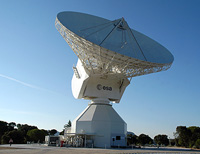
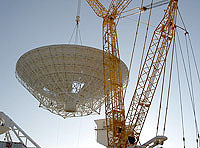
ESA to build its third deep space ground station in Argentina

Supernovae: Cosmic-Ray Superfactories
| Astronomers have had good reasons for quite a while to think that shock waves in supernova remnants create cosmic rays. These are charged particles that have been accelerated to very near light-speed; some of them have been boosted to energies far higher than the best particle accelerators can do on Earth.  X-ray emission from the supernova remnant RCW 86. The white box shows the region studied. ESA / Univ. of Utrecht / J.Vink et al. Yes, according to a new study published today in Science Express (Thursday, June 25th). Expanding supernova remnants could put half or more of their energy into cosmic-ray acceleration, accounting for all the "intermediate-energy" particle Earth receives. No one knew the process was so efficient. High and very-high energies Cosmic rays are the highest-energy particles in the universe. At the very highest-end, a single proton can pack as much kinetic energy as a well-served tennis ball (1020 electron-volts). These probably have extragalactic sources related to active galactic nuclei. Much more abundant are particles with millions of times less energy, but still much more than the best accelerators on Earth can impart. These are the ones in the new study, and they likely come from within our galaxy.  Composite image of X-ray and visible emission from part of supernova remnant RCW 86, 8,200 light-years away. The image is about 6 arc minutes across. ESO / E. Helder / NASA / Chandra Enrico Fermi even described a plausible mechanism in 1949. When a star explodes, says Vink, "the supernova ejecta material goes at a speed much larger than the speed of sound" (pressure waves) in the surrounding interstellar medium. So it forms a shock wave, in which particle density and magnetic field strengths vary wildly. Such a magnetic field can repeatedly send charged particles back and forth behind the shock front, where they can gain momentum -at the expense of the shock wave's speed- until they reach extremely high energies. The Missing Energy Three supernovae explode in the Milky Way on average per century. On paper, that's more than enough energy to accelerate all the cosmic rays we see. But is the process efficient enough actually to do it? "The only missing link now was: can they convert this energy into cosmic rays?" says Vink. "The answer seems to be: Yes!" "At least half the energy of the shock goes into cosmic rays," says lead author Eveline Helder (Astronomical Institute Utrecht, Netherlands). That, anyway, is the case for the part of the ejecta ring that Helder and collaborators studied in the young supernova remnant RCW 86, located 8,200 light-years away. Chinese (and even maybe Roman) records from 185 AD mention a corresponding nine-month-lived star. The scientists deduced the energy of the shock wave by comparing X-ray images three years apart, taken by NASA's Chandra X-Ray Observatory. The motion of the shock wave between the images amounted to approximately 6,000 km per second, or about 2 percent of the speed of light. Behind the shock, the scientists found the thin gas to be much less hot than expected: 30 million degrees centigrade instead of half a billion. To measure the temperature of the gas, the scientists used ESO's Very Large Telescope to observe visible light emitted by hydrogen atoms. The width of the hydrogen emission lines, created by the Doppler shift due to the random thermal motion of atoms, told the temperature.  The Paranal site, at 8,600ft in Chile, with the four 8..2-meter units making up the Very Large Telescope at the summit of the mountain, and ESO's famous Residencia hotel below, featured in the 22nd James Bond movie "Quantum of Solace". ESO This is more than a simple confirmation of previous results. "It's a much more sophisticated set of measurements," says Luke Drury (IAS Dublin, Ireland). "This one I think will generate much more interest from the community." The new result confirms that the cosmic-ray production process is remarkably efficient. "Everyone was a bit nervous about saying that, because it seemed so outlandish," says Drury. This research may also help in understanding similar acceleration processes occurring in gamma-ray bursts and radio jets, says Don Ellison (North Carolina State): "Supernova remnants offer the best laboratory to study the mechanism." Fonte da notícia: http://www.skyandtelescope.com/news/49089086.html |

quinta-feira, 9 de julho de 2009
Astrônomos detectam supernova gigante que 'explodiu' há 11 bilhões de anos
Objeto entrou em colapso uns 2 bilhões de anos após o Big Bang.Achado ajuda a entender formação de outras estrelas Cosmos afora.
Da France Presse
Astrônomos liderados por Jeff Cooke, da Universidade da Califórnia em Irvine (EUA), afirmam ter detectado a mais distante supernova já vista, uma estrela gigante que se estraçalhou há 11 bilhões de anos. Uma nova técnica permitiu o achado, que deve trazer novos dados sobre esses fenômenos e sobre seu papel como geradores de outras estrelas. A pesquisa está na revista científica "Nature".

O cadáver de supernova RCW 86 (Foto: AFP/Nasa)
As supernovas ocorrem quando uma estrela de grande massa fica sem combustível, entra em colapso sobre si mesma, por causa da força de sua própria gravidade, e torna-se um objeto pequeno e muito denso, que pode ser uma estrela de nêutrons ou um buraco negro. A estrela então explode, enviando através do espaço uma onda de choque que reverbera pela galáxia.
A supernova antiga foi achada depois que os astrônomos compararam vários anos de imagens feitas de uma região do céu, o que lhes permitiu procurar objetos que mudavam de brilho ao longo do tempo.
RedLIADA No. 478: Lea en ¿ Sabías qué? "Los observatorios en el espacio" (Parte 2)
LIADA...+50 años
"Semper Observandum"
______________________________
RedLIADA - La Red de Observadores
Liga Iberoamericana de Astronomía
______________________________
Secciones
InfoLIADA-Observe-LaPortada-AstroNoticias-
AstroNáutica-Efemérides-Cometas-Meteoros
El Cielo de este mes
Lea al final...¿Sabías que...?
Edición Electrónica No. 478 - Domingo 05 de Julio de 2009
Coordinada por ALDA - Asociación Larense de Astronomía de Barquisimeto (VE)
y por la LIADA - Liga Iberoamericana de Astronomía (AR)
Editores Responsables:
Jesús Guerrero Ordáz - ALDA/LIADA (VE) y
Jorge Coghlan - CODE/LIADA (AR)
Colaboradores en este número:
Katherine Vieira, José Vicente Histol, Andrés Eloy Mendoza, Bronny Sánchez,
Jesús Guerrero y Francisco Suárez. (VE)
Visite las páginas
http://www.tayabeixo.org y http://www.liada.net
RedLIADA es distribuída a más de 9000 lectores de 52 Foros Iberoamericanos
de Astronomía desde el Observatorio CODE de Santa Fe (AR)
http://sites.google.com/site/obscode/
ASOCIESE a la LIADA. Infórmese en
http://www.liada.net/afilia.htm
*********************************************
InfoLIADA
La Voz de la LIADA en RadioKosmos
Escuche "Desde el Sur Explorando el Cosmos" los Miércoles a las 21:30 Hs. de
Argentina (00:30 hs. GMT)
desde:
http://radiokosmosargentina.blogspot.com/
Ricardo Sanchez (AR)
____________________________________________
Concurso: LOGO para la Sección Estrellas Dobles
Instrucciones para participar en:
http://www.liada.net/Concursodobles.pdf
Carlos Alberto Krawczenko (AR)
___________________________________________
CURSOS LIADA A DISTANCIA
Se están publicando los Cursos LIADA a Distancia gratuitos con entrega de
Certificados sobre Cosmología Básica; Sistema Solar; Cohetería Civil;
Estrellas Variables; Estrellas Dobles y Cometas.
Toda la información sobre los distintos Cursos LIADA está en:
http://www.liada.net/cursos.htm
Prof. Dr. Raúl Podestá (AR)
Carlos Alberto Krawzenko (AR)
Luis Alberto Mansilla (AR)
__________________________________________________
NUEVA REVISTA AMATEUR HISPANA SOBRE
ESTRELLAS DOBLES
La revista se puede descargar de:
http://elobservadordeestrellasdobles.wordpress.com/
Francisco Rica Romero (ES)
__________________________________________________
EVENTOS
REUNION DE ASTRONOMOS PROFESIONALES CON AFICIONADOS
Se anunció la realización de una reunión dedicada a astrónomos aficionados
en la Facultad de Ciencias Astronómicas y Geofísicas de la Universidad
Nacional de La Plata durante los días 19 y 20 de septiembre del corriente
año.
Una reunión de estas características puede ser un invaluable punto de
partida para estrechar los vínculos entre las comunidades que comparten la
misma pasión por la Astronomía.
Información e inscripciones: info.reunionlp@gmail.com
Viviana Bianchi - Guillermo Bosch - Roberto Venero
Facultad de Ciencias Astronómicas y Geofísicas de la Universidad Nacional de
La Plata
____________________________________________
Tercer Simposio Iberoamericano de Cometas de la LIADA y el 5º IWCA
International Workshops on Cometary Astronomy
Toda la información en:
http://cometasliada.blogspot.com/2008/11/encuentro-internacional-de-observadores.html/
__________________________________________________
OBSERVE ESTA SEMANA…
SIMPLE VISTA:
Toda la semana:
- Jueves 09. Máximo de la lluvia de meteoros Pegásidas (JPE).
- Domingo 12. Máximo de la lluvia de meteoros Tau Capricórnidas.
Toda la semana:
- Mercurio en el cielo de la mañana (-1m,2).
- Venus en el cielo de la mañana (-4m,0).
- Marte en el cielo de la mañana (1m,3).
- Júpiter en el cielo de la mañana (-2m,3).
- Saturno en el cielo de la noche (1m,3).
CON TELESCOPIOS.
- Domingo 12. El asteroide (386) Siegena oculta a TYC 0439-01109-1 (11m,2).
____________________________________________
LA PORTADA DE LA SEMANA
LA PORTADA DE LA SEMANA
LAS NEBULOSAS NORTEAMÉRICA Y PELICANO.
Imagen que nos muestra estas vistosas nebulosas de emisión.
Veala en:
http://www.tayabeixo.org
____________________________________________
LA NOTICIA DE LA SEMANA.
LA NOTICIA DE LA SEMANA.
SE ACTIVA EL SOL
04 de julio de 2009.
Una región de emisión de flujo observada desde hace días dio surgimiento al
primer grupo de manchas solares del nuevo ciclo que lentamente inicia,
presentando algunas tormentas solares menores.
La región, que recibió la clasificación internacional NOAA 11024, presenta
siete manchas en clara configuración bipolar. Aunque no se espera que crezca
mucho, se puede considerar que es la primera región de manchas "madura" del
nuevo ciclo.
El ciclo de manchas solares número 24 ha tenido un notable retraso en
iniciar. Un reciente estudio de astrónomos estadounidenses ha revelado que
las corrientes de plasma que surgen de los polos del Sol y se trasladan en
un tiempo promedio de 18 años hasta el ecuador solar, han descendido con una
menor pendiente, lo que ha provocado el retraso en el inicio del ciclo de
manchas.
Más información en:
http://cosmos.astro.uson.mx/webtv/index.htm
http://cosmos.astro.uson.mx/INFORMATICA/observacion/solar/eosdata.htm
http://spaceweather.com/
Imágenes en:
http://cosmos.astro.uson.mx/INFORMATICA/noticias/julio04_09.htm
********************************************
ASTRONOTICIAS.
ASTRONOTICIAS.
COMPLETADO EL MÁS GRANDE ESTUDIO DE DISTANTES CÚMULOS DE GALAXIAS..
03 de Julio de 2009.
Un equipo internacional de astrónomos han completado el más grande estudio
jamás diseñado para encontrar muy distantes cúmulos de galaxias.
Conocido como "Spitzer Adaptation of the Red-Sequence Clusters Survey –
SpARCS - detecta cúmulos de galaxias usando observaciones ópticas en
tierra, desde los telescopios CTIO, de 4 metros, y el CFHT, de 3,6m,
combinado con observaciones infrarrojas del Telescopio Espacial Spitzer.
El "SpARCS" ha descubierto cerca de 200 nuevos candidatos a cúmulos de
galaxias. El estudio permitirá develar cómo los cúmulos y sus galaxias se
formaron y evolucionaron en el Universo primigenio.
Más información en:
http://www.skynightly.com/reports/Largest_Ever_ Survey_Of_
Very_Distant_Galaxy_Clusters_Completed_999.html
FERMI DESCUBRE 16 NUEVOS PULSARES EN RAYOS GAMMA.
02 de Julio de 2009.
Por primera vez, el Telescopio Espacial de Rayos Gamma Fermi, de la NASA, ha
descubierto un nuevo grupo de Pulsares usando solo emisiones de rayos gamma,
en ausencia de las radio señales, que son orientadas a la Tierra.
Estos son los primeros 16 Pulsares detectados solo por rayos gamma. De estos
16, un grupo de 13 están asociados a fuentes no identificadas de rayos
gamma, previamente encontradas por el Observatorio Compton.
La mayoría de los 1.800 pulsares conocidos, se encontraron a través de sus
emisiones periódicas de radio.
Más información en:
http://www.universetoday.com/2009/07/02/by-gamma-rays-alone-fermi-raises-the-curtain-on-16-new-pulsars/
INTENSO CALOR PUDO ANIQUILAR LAS GALAXIAS EN EL UNIVERSO.
02 de Julio de 2009.
Nuestra Vía Láctea logro sobrevivir debido a que esta ya se encontraba
inmersa en una gran nube de Materia Oscura, la cual atrapó gases dentro de
este. Es la aseveración de un grupo de científicos que presentó sus
resultados en la conferencia "La Unidad del Universo"
Pequeñas galaxias dentro de las nubes de materia oscura, fueron afectadas
por el calor, la cual alcanzó temperaturas de 20.000 a 100.000 grados
centígrados. Estos examinaron por qué galaxias como la Vía Láctea tienen tan
pocas galaxias "compañeras" o satélites.
Estos dicen que el calor de las primeras estrellas y agujeros negros
hicieron de esa materia oscura, estéril e incapaz de sostener el desarrollo
de sistemas estelares satélites. Las simulaciones muestran que cientos de
miles de pequeñas nubes de materia oscura, podrían estar orbitando nuestra
galaxia.
Más información en:
http://www.spacedaily.com/reports/Intense_Heat_Killed_The_Universe_Would_Be_Galaxies_999.html
SONDA LRO ENVÍA LAS PRIMERAS IMÁGENES.
02 de julio de 2009.
La sonda lunar de la NASA, Lunar Reconnaissance Orbiter (Orbitador de
Reconocimiento Lunar, LRO), ha transmitido las primeras imágenes desde que
fue lanzada el pasado 23 de junio. Las dos cámaras de la sonda, conocidas
como LROC, trabajaron como estaba previsto, colectando imágenes de las
tierras altas de la región Sur del Mar de las Nubes (Mare Nubium)..
Más información en:
http://www.nasa.gov/mission_pages/LRO/main/index.html
M87 SE MUESTRA A LOS ASTRÓNOMOS.
02 de Julio de 2009.
Cuando la gigante radio galaxia M87 libera un torrente de radiación gamma y
de radio, un grupo de 390 científicos estaban listos para observarlo. Los
resultados dieron a estos las primeras evidencias experimentales de
partículas que son aceleradas a energías muy extremas en las cercanías del
supermasivo agujero negro.
Los rayos gamma poseen una energía de 1 trillón de veces más fuerte que la
de la luz visible. Localizada a una distancia de 50 millones de años-luz, en
el cúmulo de galaxias de Virgo, esta posee un supermasivo agujero negro en
su centro, con una masa de 6 billones más masiva que nuestro Sol.
El radio Schwarzschild de este agujero negro es comparable al radio de
nuestro Sistema Solar. Para ello se utilizó el Sistema en Formación del
Telescopio de Imágenes de Radiación Muy Energética (VERITAS) y la Formación
de Línea de Base Muy Largo (VLBA).
Más información en:
http://www.universetoday.com/2009/07/02/messier-87-shows-off-for-hundreds-of-earth-bound-astronomers/
ASTRÓNOMOS DESCUBREN AGUJERO NEGRO DE MASA INTERMEDIA.
01 de Julio de 2009.
La nueva fuente HLX-1, que es un objeto de luz azul arriba a la izquierda
del bulbo galáctico, es el embajador de una nueva clase de agujeros negros,
con más de 500 veces la masa del Sol. Este se encuentra en la periferia de
la galaxia espiral ESO 243-49, que se encuentra a 290 millones de años-luz
de distancia.
Este nuevo descubrimiento es la primera evidencia sólida de una nueva clase
de agujeros de masa intermedia. Este fue hecho con el telescopio espacial de
rayos X de la Agencia Espacial Europea, XMM Newton.
Tales agujeros no habían sido detectados, hasta ahora. Una teoría sugiere
que los agujeros negros supermasivos se formaron por la fusión de un número
de estos agujeros de masa intermedia.
Más información en:
http://www.universetoday.com/2009/07/01/astronomers-discover-medium-sized-class-of-black-holes/
http://www.spacedaily.com/reports/New_class_of_black_hole_could_explain_cosmic_leviathans_999.html
http://www.astronomynow.com/news/n0907/01bh/
http://www.astronomy.com/asy/default.aspx?c=a&id=8417
EL DISCO OSCURO DE LA VÍA LÁCTEA.
01 de Julio de 2009.
Científicos han mostrado que masivas fusiones satelitales en los primigenios
discos galácticos pudieron llevar a la deposición de Materia Oscura en
configuraciones tipo discos que co-rotaron con la galaxia.
Este fenómeno tiene consecuencias potencialmente muy dramáticas para la
detección de la Materia Oscura en los experimentos. Estos discos oscuros
pueden proveernos con predicciones de los modelos de Materia Oscura de las
Partículas Masivas de Débil Interacción WIMP.
El descubrimiento sugiere que el disco oscuro de la Vía Láctea podría
mostrar señales indirectas para los experimentos de detección, contribuyendo
a cerca del 25% de la señal en la aniquilación de la Materia Oscura, en
dirección al centro de la galaxia.
Más información en:
http://arxiv.org/abs/0906.5348
PRUEBA EXITOSA DEL ENDEAVOUR.
01 de julio de 2009.
Los ingenieros y técnicos de la NASA realizaron exitosamente una prueba de
llenado del tanque externo de combustible del transbordador Endeavour, luego
de la cancelación del lanzamiento de la misión STS-127, en dos
oportunidades, por las fugas de hidrógeno gaseoso durante la carga.
El escape fue detectado en el "cordón umbilical" del tanque llamado Ground
Umbilical Carrier Plate (GUCP) y el lanzamiento, originalmente planeado para
el 13 de junio, fue postergado hasta determinar las causas del mismo..
Tras la exitosa prueba, el lanzamiento de la misión STS-127, hacia la
Estación Espacial Internacional, quedó confirmado para el día 11 de julio a
las 23:39 (GMT).
Más información en:
http://prensaespacial.blogspot.com/2009/07/los-ingenieros-y-tecnicos-de-la-nasa.html
CÚMULOS GLOBULARES Y GALAXIAS SATÉLITES: COMPAÑEROS DE LA VÍA LÁCTEA.
01 de Julio de 2009.
Los grandes titanes galácticos del Grupo Local, como Andrómeda y la Vía
Láctea, con su poderosa atracción gravitatoria, crean lazos para capturar a
todo aquello que se encuentre en su vecindario.
Nuestra Vía Láctea, es un anfitrión de un gran número de compañeros. Estos
"inquilinos" están gravitacionalmente atados a la Vía Láctea, siendo
sistemas estelares en todo el sentido de la palabra.
Estos incluyen una población de cerca de 30 galaxias enanas satélites y 150
cúmulos globulares. El estudio muestra la relación entre las galaxias enanas
satélites y los cúmulos globulares, utilizando un modelo interactivo en 3D
de la Vía Láctea.
Más información en:
http://arxiv.org/abs/0906.5370
SONDA ULYSSES LLEGA AL FINAL DE SU MISIÓN.
01 de julio de 2009.
Después de 18 años de continuada investigación del Sol y el medio
interplanetario, la sonda Ulysses ha llegado al final de su misión. Los
controladores enviaron el 30 de junio varias órdenes: a las 20:09 UTC la
nave transfería las comunicaciones a su antena de baja ganancia, lo que
impediría que éstas pudiesen ser captadas desde la Tierra, y a las 20:15
UTC, apagaba también su transmisor.
La sonda Ulysses, construida por la Agencia Espacial Europea, ESA, fue
lanzada el 6 de octubre de 1990, desde Cabo Kennedy y debía tener una vida
útil de unos 5 años. Sus sistemas, sin embargo, le permitieron operar mucho
más tiempo, durante casi tres órbitas alrededor del Sol. Los ingenieros han
tenido que luchar en este tiempo contra la paulatina degradación de sus
equipos. Dado que el suministro de energía empezaba a disminuir y que
algunas de sus partes ya estaban demasiado frías para trabajar, los
ingenieros otorgaron a la sonda un tiempo de vida no más allá de julio de
2008. No obstante, el vehículo continuó funcionando hasta ahora, cuando la
distancia con respecto a la Tierra había crecido de nuevo y ya era muy poca
la información que podía enviar. La dirección del programa decidió entonces
que era un buen momento para desconectarla, liberando tiempo de escucha para
las estaciones de seguimiento que tienen que ser utilizadas para
otras misiones interplanetarias.
Más información en:
http://notesp.blogspot.com/2009/07/la-sonda-ulysses-finaliza-su-mision.html
LA ESTRUCTURA A GRAN ESCALA DEL UNIVERSO.
30 de Junio de 2009.
Nuevos estudios llevados a cabo, presentan el paradigma de la estructura a
gran escala del Universo, haciendo énfasis en el trabajo realizado por Yakov
Zeldovich.
Los científicos utilizaron los datos del Sloan Digital Sky Survey, mostrando
que la distribución de los pases de ondas de densidad de varias escalas en
nuestro Universo actual, están correlacionados. Las posiciones de máxima y
mínima en ondas de densidad (sus pases), son más estables.
El nacimiento de la primera generación de estrellas ocurrió muy
probablemente, en las regiones centrales de ricos proto-supercúmulos, donde
la densidad fue más alta en el Universo primigenio.
Más información en:
http://arxiv.org/abs/0906.5272
PERDIDA DE BARIONES EN LA VÍA LÁCTEA Y EL GRUPO LOCAL.
29 de Junio de 2009.
La Vía Láctea y otras galaxias están perdiendo la mayor parte de sus
bariones. Esta es varias veces menos del radio cósmico determinado por el
estudio realizado por WMAP.
Esto implica, o que los bariones nunca caen dentro de las galaxias, o que
poderosos vientos galácticos remueven la mayor parte de estos. Es posible
discriminar entre estos dos caminos, si se logra determinar los bariones
perdidos y medir sus propiedades: distribución espacial; temperatura y
metalicidad.
Se estima que las observaciones en rayos X, obtenidas con equipos como el
IXO, puedan ser usados para identificar y estudiar a estos elusivos
bariones..
Más información en:
http://arxiv.org/abs/0906.4993
PRIMERA FIRMA CONCLUYENTE DE URANIO EN LA LUNA.
29 de Junio de 2009.
Utilizando datos obtenidos de los espectrómetros de rayos gamma de la nave
espacial Kaguya, los científicos han descubierto firmas de uranio, un
elemento no visto en anteriores esfuerzos de cartografía de la Luna. Además
de uranio, el Kaguya también detectó muestras claras de torio, potasio,
oxígeno, magnesio, silicio, calcio, hierro y titanio.
"Ya hemos recibido los resultados de uranio, que nunca se han reportado
antes", dijo Robert C. Reedy, del Instituto de Ciencias Planetarias.
"Estamos cada vez obteniendo más nuevos elementos, refinando y confirmando
los resultados encontrados en los antiguos mapas."
Más Información en:
http://www.universetoday.com/2009/06/29/first-conclusive-signature-for-lunar-uranium/
LA VÍA LÁCTEA Y ANDRÓMEDA: LA HISTORIA DE DOS DISCOS.
29 de Junio de 2009.
Científicos han estudiado la evolución química de los discos de la Vía
Láctea y Andrómeda (M31), con el objetivo de encontrar puntos en común y
diferencias entre las dos más grandes galaxias del Grupo Local.
El estudio muestra que, cuando se expresa en términos de la correspondiente
longitud en la escala del disco, el perfil radial observado de la Vía Láctea
y Andrómeda exhiben interesantes similitudes, sugiriendo la posibilidad de
una descripción dentro de un esquema común.
Se encontró que el perfil de estrellas, fracción del gas y metalicidad de
las dos galaxias, como también sus propiedades globales, muestran que la
eficiencia en la formación de estrellas en Andrómeda es más del doble que en
la Vía Láctea.
Se atribuyen estas discrepancias al hecho de que Andrómeda tuvo una historia
más activa en la formación de estrellas que la Vía Láctea, incluso en el
pasado reciente.
Más información en:
http://arxiv.org/abs/0906.4821
UN REGISTRO DE MIGRACIÓN PLANETARIA EN EL CINTURÓN PRINCIPAL DE ASTEROIDES.
24 de Junio de 2009.
El cinturón principal de asteroides se encuentra entre las órbitas de los
planetas Marte y Júpiter, pero el mismo no se encuentra totalmente lleno,
sino que presenta zonas vacías, que se denominan "vacíos de Kirkwood". Estos
vacíos se han asociado a resonancias orbitales con los planetas gigantes.
Los planetas en estas posiciones siguen órbitas caóticas y escapan del
cinturón de asteroides.
Un equipo de astrónomos ha estudiado la distribución observada de asteroides
en el cinturón principal y ha encontrado un patrón de deflexión en la
cantidad de asteroides, sobre todo en las resonancias 5:2, 7:3 y 2:1,
asociadas con Júpiter.
Estas deflexiones no se consideran producto de las perturbaciones
planetarias ocurridas en el actual Sistema Solar, pero son consistentes con
la eyección dinámica de asteroides por el barrido de resonancias
gravitatorias durante la migración de Júpiter y Saturno.
Más información en:
http://arxiv.org/abs/0906.4574
********************************************
EFEMERIDES
LOS PLANETAS DURANTE LA SEMANA.
Tiempos en Hora Legal de Venezuela (HLV) y Tiempo Universal (UT).
Mercurio:
Se observa en las mañanas, hacia el Este. Muy cerca del Sol. Se encuentra en
la constelación de Géminis. Su Salida ocurre a las 05:33 HLV (10:03 UT).
Venus:
Se observa en las mañanas, hacia el cielo del Este. Se encuentra en la
constelación de Aries. Su Salida ocurre a las 2:54 HLV (7:24 UT).
Marte:
Se observa en las mañanas, hacia el cielo del Este. Se encuentra en la
constelación de Aries. Su Salida ocurre a las 2:25 HLV (6:55 UT).
Júpiter:
Se observa en las mañanas, hacia el cielo del oeste. Se encuentra en la
constelación de Capricornio. Su Salida ocurre a las 20:57 HLV (1:27 UT).
Saturno:
Se observa en las noches, hacia el cielo del Oeste. Se encuentra en la
constelación de Leo (León). Su Puesta ocurre a las 22:23 HLV (2:53 UT).
EVENTOS DE LA SEMANA
(Del 06 de Julio al 12 de Julio de 2009)
Tiempos en Hora Legal de Venezuela (HLV) y Tiempo Universal (UT).
Lunes 06
06 – Efemérides físicas del Sol; Po=-0,3° Bo=3,3° Lo=235,8°
06 – La Luna a 1° de Nunki (sigma sgr). 10:00 p.m.
06 – Meridiano central de Júpiter, Sistema II, 00 UT; 196,7°
Martes 07
07 – 17:00 HLV. Luna en Apogeo. Estará a 406.200 Km.
07 – 9 UT. Luna Llena.
07 - Eclipse penumbral de Luna visible en América. 3:50 a.m. Sin percepción
visual.
07 – Meridiano Central de Marte, 00 UT; 190,8°
Miércoles 08
08 - 10:53 HLV. Luna en el Nodo Ascendente de su órbita.
08 – 2:11.4 UT. Tránsito de Ganímedes. Ingreso
08 – 2:16.0 UT. Tránsito de la sombra de Ganímedes. Egreso
08 – 5:48.2 UT. Tránsito de Ganímedes. Egreso
08 – Inicio del Día Juliano 2.455.020,5
08 – Mercurio en Perihelio. Estará a 0,31 AU del Sol.
08 – Tránsito del Sol por el Meridiano de Barquisimeto, 12:05:08 HLV.
Jueves 09
09 – Efemérides físicas del Sol; Po=1,0° Bo=3,6° Lo=196,1°
09 - Máximo de la lluvia de meteoros Pegásidas (JPE). Activa del 07 al 13 de
julio. Radiante en AR=22h40m dec=+15º. Tasa de 3 meteoros por hora.
09 – Meridiano Central de Marte, 00 UT; 171,2°
Viernes 10
10 – 2:37.1 UT. Eclipse de Europa. Desaparece
10 – 7:14.4 UT. Ocultación de Europa. Reaparece
10 - El asteroide 2001 HY7 en vuelo cercano a la Tierra (0,092 AU).
10 – La Luna a 5° de Júpiter. 10:00 p.m.
10 – Meridiano central de Júpiter, Sistema II, 00 UT; 78,3°
10 – Salida y Puesta del Sol. 5:53 y 18:36 HLV.
10 – Tránsito de la GMR por el Meridiano Central de Júpiter. 01:31 UT.
Sábado 11
11 – Meridiano Central de Marte, 00 UT; 151,7°
11 – Salida de la Luna. 21:35 HLV.
Domingo 12
12 - 02:37 UT. El asteroide (386) Siegena oculta a TYC 0439-01109-1
(11m,2).. Duración 13,0 s.
12 – 1:54.8 UT. Eclipse de Io. Desaparece
12 – 5:00.4 UT. Ocultación de Io. Reaparece
12 – Inicio del Día Juliano 2.455.024,5
12 - Máximo de la lluvia de meteoros Tau Capricórnidas. Activa del 02 de
junio al 29 de julio. Radiante en AR=20h20m dec=-13º. Tasa de 5 meteoros por
hora.
NATALICIOS DE LA SEMANA.
07 – 193 aniversario (1816) del nacimiento de Johann Wolf, astrónomo suizo
que descubrió un método para determinar la actividad solar.
07 – 49 aniversario (1960) del nacimiento de Kevin A. Ford, astronauta
estadounidense.
08 – 74 aniversario (1935) del nacimiento de Vitali Sevastyanov, cosmonauta
soviético que voló en las misiones Soyuz 9 y Soyuz 18. Estuvo dos meses en
la estación espacial Salyut 4 (1976).
09 – 115 aniversario (1894) del nacimiento de Pyotr Leonidovich Kapitsa,
físico ruso que descubrió los superfluidos (1937). Premio Nobel en 1978.
09 – 66 aniversario (1943) del nacimiento de John Howard Casper, astronauta
estadounidense que acumuló 825 horas de vuelo espacial en 4 misiones.
STS-36, STS-62, STS-77.
09 – 83 aniversario (1926) del nacimiento de Ben Roy Mottelson, físico
estadounidense nacionalizado danés, premio Nobel en 1975 por su
investigación de la estructura del núcleo atómico.
10 – 153 aniversario (1856) del nacimiento de Nikola Tesla, inventor serbio,
célebre por sus aportes en electricidad y magnetismo.
10 – 177 aniversario (1832) del nacimiento de Alvan Graham Clark, astrónomo
y fabricante de lentes estadounidense, que confeccionó los lentes del mayor
telescopio refractor del mundo (Observatorio Yerkes, 40 pulgadas, 1,016
metros) y descubrió el satélite de la estrella Sirio.
10 – 67 aniversario (1942) de Pyotr Ilyich Klimuk, cosmonauta bielorruso que
voló en las misiones Soyuz 13, 18 y 30. Estuvo en la estación espacial
Salyut 4 (1975).
10 – 89 aniversario (1920) del nacimiento de Owen Chamberlain, físico
estadounidense, premio Nobel en 1959 por descubrimiento del antiprotón.
11 – 277 aniversario (1732) del nacimiento de Joseph de Lalande, astrónomo
francés, director del observatorio de Paris.
11 – 93 aniversario (1916) del nacimiento de Aleksandr Mikhailovich
Prokhorov, físico ruso, premio Nobel en 1964 por sus trabajos en laser y
maser.
12 – 146 aniversario (1863) del nacimiento de Paul Karl Ludwig Drude, físico
alemán especialista en óptica, responsable de introducir la letra "C" para
identificar la velocidad de la luz en el vacío.
ANIVERSARIOS DE LA SEMANA.
09 – 30 aniversario (1979) del sobrevuelo a Júpiter por la sonda Voyager 2.
11 – 30 aniversario (1979) del reingreso a la atmósfera de la estación
espacial Skylab.
____________________________________________
COMETAS DE JULIO 2009
HEMISFERIO SUR:
En el comienzo de la noche:
C/2008 Q3 Garradd en magnitud 7 y con una altura máxima de 72º;
C/2008 T2 Cardinal en magnitud 8 y con una altura máxima de 21º;
C/2007 Q3 Siding Spring en magnitud 10 y con una altura máxima de 12º;
C/2009 G1 STEREO en magnitud 10 y con una altura máxima de 30º;
88P/Howell en magnitud 12 y con una altura máxima de 57º;
116P/Wild 4 en magnitud 12 y con una altura máxima de 38º;
P/2009 L2 Yang-Gao en magnitud 13 y con una altura máxima de 18º;
67P/Churyumov - Gerasimenko en magnitud 13 y con una altura máxima de 7º;
C/2006 OF2 Broughton en magnitud 13 y con una altura máxima de 3º;
C/2007 G1 LINEAR en magnitud 13 y con una altura máxima de 9º;
En la medianoche:
C/2008 Q3 Garradd en magnitud 7 y con una altura máxima de 11º;
C/2006 W3 Christensen en magnitud 8 y con una altura máxima de 26º;
22P/Kopff en magnitud 9 y con una altura máxima de 49º;
C/2009 G1 STEREO en magnitud 10 y con una altura máxima de 5º;
217P/LINEAR en magnitud 12 y con una altura máxima de 12º;
P/2009 L2 Yang-Gao en magnitud 13 y con una altura máxima de 58º;
88P/Howell en magnitud 13 y con una altura máxima de 3º;
En el final de la noche:
C/2006 W3 Christensen en magnitud 8 y con una altura máxima de 22º;
22P/Kopff en magnitud 9 y con una altura máxima de 65º;
C/2009 G1 STEREO en magnitud 10 y con una altura máxima de 24º;
C/2009 F6 Yi-SWAN en magnitud 11 y con una altura máxima de 1º;
217P/LINEAR en magnitud 12 y con una altura máxima de 60º;
P/2009 L2 Yang-Gao en magnitud 13 y con una altura máxima de 4º;
64P/Swift - Gehrels en magnitud 13 y con una altura máxima de 3º;
C/2007 G1 LINEAR en magnitud 13 y con una altura máxima de 25º;
HEMISFERIO NORTE:
En el comienzo de la noche:
C/2008 Q3 Garradd en magnitud 7 y con una altura máxima de 22º;
C/2006 W3 Christensen en magnitud 8 y con una altura máxima de 43º;
88P/Howell en magnitud 12 y con una altura máxima de 33º;
116P/Wild 4 en magnitud 12 y con una altura máxima de 20º;
P/2009 L2 Yang-Gao en magnitud 13 y con una altura máxima de 46º;
67P/Churyumov - Gerasimenko en magnitud 13 y con una altura máxima de 3º;
En la medianoche:
C/2006 W3 Christensen en magnitud 8 y con una altura máxima de 87º;
22P/Kopff en magnitud 9 y con una altura máxima de 33º;
217P/LINEAR en magnitud 12 y con una altura máxima de 8º;
P/2009 L2 Yang-Gao en magnitud 13 y con una altura máxima de 57º;
En el final de la noche:
C/2006 W3 Christensen en magnitud 8 y con una altura máxima de 89º;
22P/Kopff en magnitud 9 y con una altura máxima de 46º;
217P/LINEAR en magnitud 12 y con una altura máxima de 45º;
P/2009 L2 Yang-Gao en magnitud 13 y con una altura máxima de 30º;
64P/Swift - Gehrels en magnitud 13 y con una altura máxima de 13º;
Visibles entre las latitudes:
Para la última semana de junio:
P/2009 L2 (Yang-Gao): 45ºN a 70ºS
C/2009 G1 (STEREO): 15ºS a 90ºS
C/2009 F6 (Yi - SWAN): en conjunción
C/2009 E1 (Itagaki): 50ºN a 30ºS
C/2008 T2 (Cardinal): 10ºN a 75ºS
C/2008 Q3 (Garradd): 40ºN a 90º S
C/2008 A1 (McNaught): 50ºN a 30ºN
C/2007 Q3 (Siding Spring): 5ºS a 80ºS
C/2007 N3 (Lulin): en conjunción
C/2007 G1 (LINEAR): 45ºS a 90ºS
C/2006 W3 (Christensen): 50ºN a 40ºS
C/2006 OF2 (Broughton): elongación pobre
116P/Wild 4: 45ºN a 55ºS
88P/Howell: 45º N a 60º S
77P/Longmore: 40ºN a 60ºS
67P/Churyumov-Gerasimenko: elongación pobre
65P/Gunn: 50ºN a 50ºS
29P/Schwassmann-Wachmann: elongación pobre
22P/Kopff: 50ºN a 85ºS
Eventos para julio de 2009:
02 - Comet 99P/Kowal 1 en su máximo acercamiento a la Tierra a 4,647 UA.
03 - Comet 187P/LINEAR en su máximo acercamiento a la Tierra a 2,806 UA.
05 - Comet C/2009 E1 (Itagaki) en su máximo acercamiento a la Tierra a 0,923
UA.
06 - Comet C/2006 W3 (Christensen) en el Perihelio a 3,126 UA.
07 - Comet 77P/Longmore en el Perihelio a 2,310 UA.
08 - Comet 172P/Yeung en su máximo acercamiento a la Tierra a 1,871 UA.
08 - Comet 142P/Ge-Wang en su máximo acercamiento a la Tierra a 2,475 UA.
09 - Comet 162P/Siding Spring en su máximo acercamiento a la Tierra a 1,872
UA.
14 - Comet 169P/NEAT en su máximo acercamiento a la Tierra a 1,299 UA.
16 - Comet C/2008 N1 (Holmes) en su máximo acercamiento a la Tierra a 2,577
UA.
18 - Comet 116P/Wild 4 en el Perihelio a 2,175 UA.
22 - Comet 199P/Shoemaker 4 en su máximo acercamiento a la Tierra a 2,069
UA.
22 - Comet C/2008 P1 (Garradd) en el Perihelio a 3,896 UA.
25 - Comet P/1999 XB69 (LINEAR) en el Perihelio a 1,652 UA.
27 - Comet 186P/Garradd en su máximo acercamiento a la Tierra a 3,489 UA.
30 - Comet 74P/Smirnova-Chernykh en el Perihelio a 3,558 UA.
Cometas Observables del grupo de Cometas_Obs de España.
producido por Esteban Reina Lorenz del Observatorio de Masquefa con Cod. MPC
232.
Observables por Esteban Reina
Efemérides disponibles en RdC "Rastreadores de Cometas"
Efemerides para Julio de 2009
Cartas celestes producidas por Astrosite Groningen
últimas cartas
Fuentes: Seiichi Yoshida's Home Page, BAA Comet Section, Astrosite Groningen
y Space Calendar JPL.
***ATENCION***
Pedido de la Sección Cometas de la LIADA
para continuar la observación del C/2006 W3 (Christensen)
ya que está por pasar el perihelio y se necesita medir con exactitud el pico de
máximo brillo.
Estamos siguiendo esta curva de luz con detenimiento y se necesitan la mayor
cantidad de medidas del mismo.
Julio 06 - C/2006 W3 (Christensen) en el Perihelio a 3,126 UA.
Es visible para observadores entre las latitudes 50ºN a 40ºS
entre Pegasus (Pegaso) y Cygnus (Cisne) -
Como una primera referencia de la zona está a unos 15 grados al SE -sureste- de
la nebulosa Norte América
y la magnitud media en estas noches ronda entre mag 8,5 a 9,0
digamos como para ser observado bien con un telescopio de 20 cm de abertura
Fechas T Asc. Rec. Declin.
2009- 7- 4 -2.66 22 0.34 34 38.4
2009- 7- 5 -1.66 21 58.43 34 31.9
2009- 7- 6 -0.66 21 56.48 34 25.0
2009- 7- 7 0.34 21 54.49 34 17.6
2009- 7- 8 1.34 21 52.47 34 9.7
2009- 7- 9 2.34 21 50.42 34 1.4
2009- 7-10 3.34 21 48.33 33 52.6
2009- 7-11 4.34 21 46.21 33 43.3
2009- 7-12 5.34 21 44.06 33 33.4
2009- 7-13 6.34 21 41.88 33 23.1
2009- 7-14 7.34 21 39.66 33 12.2
2009- 7-15 8.34 21 37.42 33 0.8
2009- 7-16 9.34 21 35.16 32 48.8
2009- 7-17 10.34 21 32.86 32 36.3
Dto. Publicaciones
SECCION COMETAS LIADA
___________________________________________
METEOROS DE JULIO 2009
Toda la información de esta Campaña de observación de meteoros del
corriente mes está en
www.liada.net/meteoros.htm
LA AVENTURA DE OBSERVAR METEOROS
A los observadores antiguos y nuevos les comunicamos que hemos publicado una
serie de artículos que iremos compartiendo, con el afán de recordar aspectos
básicos de la observación de meteoros. Pueden acceder a
los artículos publicados en la web de la LIADA:
http://www.liada.net/home.htm
Pável Balderas E. (BO)
Coordinador General
*********************************************
EL CIELO DE ESTE MES
Relato ameno y didáctico de Claudia Pérez Ferrer (AR) de cómo se nos
presenta el cielo cada mes en
http://www.liada.net/universo/cielo/index.htm
*********************************************
¿SABÍAS QUÉ?
Por Jesús Guerrero Ordáz (VE)
LOS OBSERVATORIOS EN EL ESPACIO (Parte 2)
A lo largo del mes de julio iremos presentando los observatorios dedicados al estudio astronómico orbitando la Tierra, ordenándolos cronológicamente. Las sondas planetarias y los satélites dedicados a pruebas en el Sistema Solar están excluidos y en otras oportunidades las iremos listando como una categoría aparte.
La tabla que se muestra a continuación recoge los siguientes aspectos siguiendo este orden:
Nombre Común del Observatorio, Longitud de Onda recibida; Año de lanzamiento y Agencia Espacial.
1) HEAO 1; Rayos X; 1976; NASA.
2) Explorador Ultravioleta Internacional(IUE); Ultravioleta; 1978; NASA.
3) Observatorio Einstein(HEAO 2); Rayos X; 1978; NASA, ESA y SERC.
4) Hakucho; Rayos X; 1979; ISAS. Feb
5) HEAO 3; Rayos X y Rayos Gamma; 1979; NASA. Sep
6) IRAS; Infrarrojo; 1983; NASA.
7) Tenma; Rayos X; 1983; ISAS.
8) Astron; Rayos X y Ultravioleta; 1983; IKI.
9) Exosat; Rayos X; 1983; ESA.
10) Ginga; Rayos X; 1987; ISAS.
Fuente: http://en.wikipedia.org/wiki/List_of_space_telescopes
********************************************
Fin de la RedLIADA No. 478
RedLIADA está disponible durante toda la semana en
http://www.liada.net/lared/lared.htm
apta para imprimir.
Lectura; suscripción y archivo de Ediciones anteriores en
el Grupo RedLIADA de Yahoo Grupos
Suscripción: redliada-subscribe@gruposyahoo.com.ar
*********************************************************************
"...Desde 1958 en la LIADA unimos al Mundo Astronómico
Iberoamericano.
Conózcanos en www.liada.net ..."
"...Desde 1958 na LIADA unimos o Mundo Astronômico
Iberoamericano... "
"Conheça-nos em www.liada.net
********************************************
A lo largo del mes de julio iremos presentando los observatorios dedicados al estudio astronómico orbitando la Tierra, ordenándolos cronológicamente. Las sondas planetarias y los satélites dedicados a pruebas en el Sistema Solar están excluidos y en otras oportunidades las iremos listando como una categoría aparte.
La tabla que se muestra a continuación recoge los siguientes aspectos siguiendo este orden:
Nombre Común del Observatorio, Longitud de Onda recibida; Año de lanzamiento y Agencia Espacial.
1) HEAO 1; Rayos X; 1976; NASA.
2) Explorador Ultravioleta Internacional(
3) Observatorio Einstein(HEAO 2); Rayos X; 1978; NASA, ESA y SERC.
4) Hakucho; Rayos X; 1979; ISAS. Feb
5) HEAO 3; Rayos X y Rayos Gamma; 1979; NASA. Sep
6) IRAS; Infrarrojo; 1983; NASA.
7) Tenma; Rayos X; 1983; ISAS.
8) Astron; Rayos X y Ultravioleta; 1983; IKI.
9) Exosat; Rayos X; 1983; ESA.
10) Ginga; Rayos X; 1987; ISAS.
Fuente: http://en.wikipedia
********************************************
Fin de la RedLIADA No. 478
RedLIADA está disponible durante toda la semana en
http://www.liada.net/lared/lared.htm
apta para imprimir.
Lectura; suscripción y archivo de Ediciones anteriores en
el Grupo RedLIADA de Yahoo Grupos
Suscripción: redliada-subscribe@gruposyahoo.com.ar
*********************************************************************
"...Desde 1958 en la LIADA unimos al Mundo Astronómico
Iberoamericano.
Conózcanos en www.liada.net ..."
"...Desde 1958 na LIADA unimos o Mundo Astronômico
Iberoamericano... "
"Conheça-nos em www.liada.net
********************************************
Jorge Coghlan
Sede Social LIADA
Observatorio Astronómico CODE
Santa Fe - Argentina
http://sites.google.com/site/obscode/
Sede Social LIADA
Observatorio Astronómico CODE
Santa Fe - Argentina
http://sites.google.com/site/obscode/
54 0342 155-001236
-----------------------------------------------
Visite nossos sites e nossos BLOGS:
http://www.monoceros.xpg.com.br
http://astronomicando.blogspot.com
http://twitter.com/astronomicando
http://arqueoastronomy.blogspot.com
http://twitter.com/arqueoastronomy
http://www.radiolatina.rg3.net
http://twitter.com/radiolatinafm
Comunidade no Orkut: http://www.orkut.com/Community.aspx?cmm=11100690
---------------------------------------------
* 2009 - ANO INTERNACIONAL DA ASTRONOMIA *
OBSERVATÓRIO ASTRONÔMICO MONOCEROS
ALÉM PARAÍBA - MG - BRASIL
---------------------------------------------
Assinar:
Postagens (Atom)
LinkWithin
